Attributes
Attributes govern raw capability - how physically powerful, resilient, perceptive, charming, animated, and the like a Character is. Traits, covered in the next section below, determine how Characters apply that capability under pressure.
Attributes are the innate capacities characters are born with that allow them to perform certain cognitive and physical tasks. Unlike Traits, all Attributes begin at 0, regardless of race and class. Attributes serve many purposes, including as prerequisites for gear, including Armaments and equipment, and to acquire talents, skills and Traits as well.
The seven Attributes; artistry, fortitude, intellect, perception, physique, resilience, and wisdom. Through their scores, purchased throughout progression, Attributes determine how strong a character is in a variety of areas, including; Abilities, talents, skills and Traits, referred to as Talents, Skills, and Traits (TST). Attribute Scores also serve as prerequisites and more.
The Seven Attributes
Artistry (ART)
Creativity, performance, dexterity-based crafts, and deception.
Fortitude (FRT)
Physical resilience, endurance, and resistance to ongoing effects.
Intellect (INT)
Mental acuity, spellcasting power, reasoning, and willpower.
Perception (PER)
Awareness, detection, intuition, and luck.
Physique (PHY)
Physical strength, speed, agility, and toughness.
Resilience (RES)
Magical resistance and protection from elemental damage.
Wisdom (WIS)
Spiritual recovery, vitality caps, capacity, and knowledge.
Attribute Development
To develop Attributes, starting at Level 0 (character creation) and again at every new class level, players roll 1d6 9 times, discard the two lowest results, and assign the remaining 7 results as points to their respective slots in the Attribute Repository. At Level 0, all results are assigned and locked in - once finalized, the character advances to Level 1.
Each Attribute can be assigned a number of points between 1 and 6 in its respective Repository slot, and those REM Points are spent to purchase: the score of the Attribute (default 3 REM Points each), and/or talents, skills and Traits TST (default 2 REM Points each) aligned with that Attribute, OR saved as Remnants. The main purpose of Remnants is to hold left over REM Points that players weren't able to spend on Attributes and/or TST.
Before ending the progression process, anything left over is considered a REM Point and can be saved until the next level where the rolling and REM Point spending process is repeated. No REM Points need to be spent on Attribute Score; they can be saved as Remnants to be spent on items later in the game. Remnants allow players to save REM Points they could not spend and use them in future levels. Remnants may also be saved to spend on special items later in the game. Once a REM Point is spent to purchase an Attribute Score or TST, it cannot be refunded - it's locked in. There's no turning back.
Although there isn't a minimum (Attributes can be 0), characters may not apply more than 2 points of their roll results to any given Attribute at every level of progression. No Attribute may exceed a score of 50. For example, at level 2, an Attribute Score may be 0, but can be no higher than 4 before the process ends.
The Attribute cap of 50 is a theoretical maximum, achievable only by dedicating 2 points per level to one Attribute for 25 levels. Because each Attribute is individually capped at 50 and points are spread across all Attributes, most characters will have one high Attribute and the rest significantly lower, encouraging specialization. Players should expect most Attributes to fall between 12-25 unless they deliberately hyper-specialize.
Example - Kaida, Barbarian Mountaineer
| Attribute | Level Reached Score | Max Score (per lvl cap) |
|---|---|---|
| Intellect | 1 | 2 |
| Artistry | 5 | 10 |
| Resilience | 10 | 20 |
| Physique | 25 | 50 (cap) |
Kaida's physique is capped at level 25. With 5 levels remaining, she can gain up to 10 more score in Resilience (2 per level x 5 levels). At level 30, remaining REM Points are spent on talents, skills, or Traits (TST).
It's important to note that TST scores cannot be above the score of their aligned Attribute. So if you have a score of 1 in physique, the score of one of its aligned Traits Strength, may not be greater than 1. This keeps Attribute Scores relatively low because they are often used as modifiers.
Diagram 1 shows the Repository with the roll results and where the player assigned them.
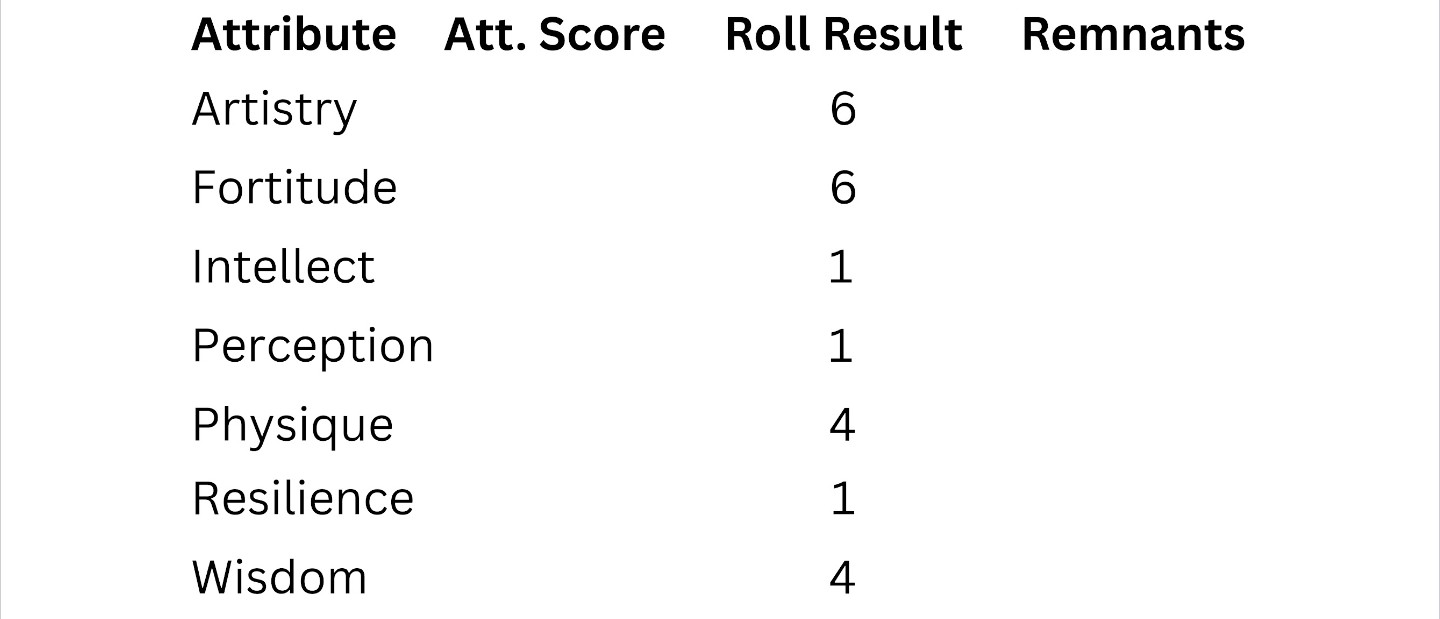
Each score for an Attribute costs 3 REM Points with a score cap of 2 per level. Each TST, aligned to the Attribute, costs 2 REM Points. One example of a Trait alignment to an Attribute is the Trait Agility, which is aligned to the Attribute Physique.
Diagram 2 shows the Repository with the above roll results assigned to Attribute Score, held in the score results to spend on that, and saved as remnants where they can be spent later.
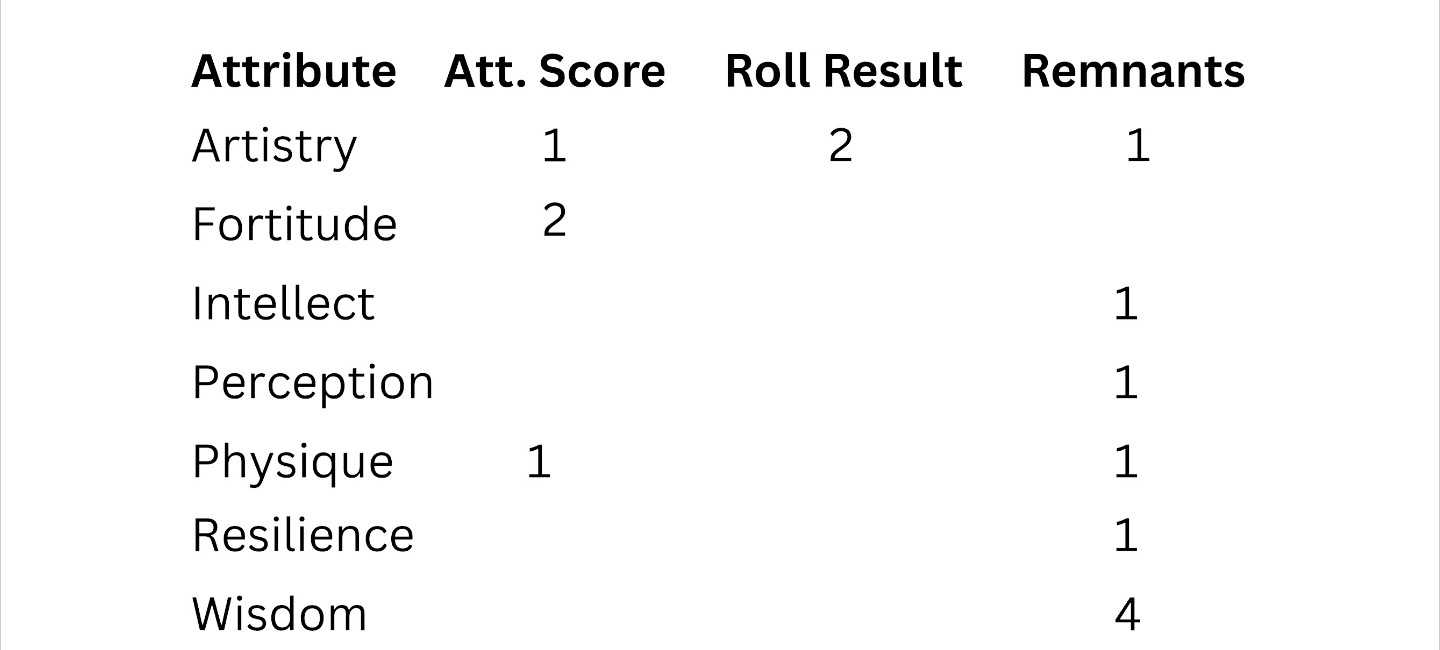
Above lets examine Artistry. The player assigned a roll of 6 to Artistry, purchased a score of 1 in the Attribute Artistry which cost 3 of the 6, kept 2 in the roll result to purchase one TST (whether it's a talent, skill or Trait) at a cost of 2, for a total of five spent and has 1 left over as a REM Point for the next class level. 3 + 2 + 1 = 6, which is the assigned roll value.
Let's examine Fortitude next. Here the max score of 2 was placed into the actual fortitude score, costing all 6 REM Points assigned as the FRT roll result. Although the player may not spend any REM Points on TST, because each score costs 3 REM Points, the character can use the score of 2 as a prerequisite and modifier during their adventures.
Intellect, Resilience and Perception were all results of 1 and were both placed as Remnants. Looking at Wisdom, all 4 REM Points were allocated to the remnant slot of the Repository. These Remnants can be spent on special items later, or with caps and minimums in play, spent on Wisdom and its aligned TST.
You'll first need a score of 1 in any Attribute before purchasing any TST aligned to it because 1 is the †default prerequisite for purchasing TST. The default price for any TST is 2 REM Points. Again a TST score cannot exceed its aligned Attribute Score, so with that score of 1, you'll go no higher than 1 for any TST aligned to it. There isn't a maximum of TST types though, so if you have the REM Points (Remnants), you could have any number of TST with a score of, in this case 1.
Players have the freedom to allocate REM Points according to their preferences. These REM Points can enhance athletic or cognitive talents, attack and Protection Abilities such as evasion, Traits like strength and agility, allowing for a customized character build.
Notes to the GM - Using Attribute Scores
GMs are provided with detailed guidelines within campaign modules but may also use Attribute Score at their discretion - for example, when adventures go off-script, or when applying homebrew rules or Unique story elements.
Talents (TST)
Talents are specialized actions that characters acquire from their chosen Talent Trees. These actions come into play when characters encounter interactive challenges in the game world. A Scout may carve a branch into a tool or guide the party along a safer route. An Olympiad might leap across a chasm. A Hacker could manipulate security systems or decipher complex codes. A Thief might pick locks or stealthily pocket items with precision.
To access a talent from a Talent Tree, characters must first align themselves with that tree. Each alignment grants specialized gear that characters must carry to effectively use their talents. Players select talents during Character Creation, and these actions can be enhanced with each Class Level gained. Talent scores are capped at 45. REM Points spent on talent scores cannot exceed the score of the aligned Attribute.
Additional talent trees are released with each module and its expansions. See Pg. 6 for a list of all available talent trees.
Talents are specific learned skills - Sneak, Sprint, Jump, Hack, Disarm Trap, and others. The talent score is the bonus factored into d100 rolls, and Attribute prerequisites must be met for acquisition. For example, a Sprint talent score of 3 requires Physique 3 as its prerequisite - when sprinting, the character adds 3 squares (15 ft.) to their base movement. The Agility Trait score also stacks, adding further to that sprint roll.
Talents are accessed through proficiency tiers - see Proficiency Tiers below.
Skills (TST)
Skills are specialized abilities directly tied to a character's chosen profession and form the backbone of their craftsmanship. Each profession provides access to a unique set of skills, allowing characters to perform intricate tasks - forging weapons, preparing elaborate meals, crafting potent remedies - that define their role and expertise within the game world.
Professions are unlocked by initially investing 2 REM Points, enabling REM Point allocation to skills during creation and progression. Skill scores are capped at 45. Skills progress through tiers (Apprentice, Journeyman, Expert, Artisan, Master, Grandmaster), each requiring aptitude points. Success with skills relies on experience, appropriate tools, recipes, materials, and often a workshop.
Additional professions are released with each module and its expansions. See Pg. 6 for a list of all available professions.
Skills are accessed through proficiency tiers - see Proficiency Tiers below.
Crafting Resolution
Crafting is resolved through a d100 skill check against a Difficulty Score (DIFS) set by the GM. The DIFS depends on the item's complexity, rarity tier, and required quality. A character rolls d100, adds their relevant skill score plus any aligned Attribute modifiers, and compares the total to the DIFS.
Crafting Check Formula: d100 + Skill Score + Attribute Modifier vs. DIFS
The Attribute modifier used depends on the specific skill - for example, a Blacksmith check might use Strength or Intellect, a Jeweler check uses Artistry or Intellect, and an Herbalist check uses Wisdom or Perception. The skill card or GM determines which Attribute applies.
Difficulty by Rarity: The GM may use the following as a baseline, or adjust based on complexity:
- Common: DIFS 40-50 (straightforward, well-understood designs)
- Uncommon: DIFS 55-65 (moderately complex, requires precision)
- Rare: DIFS 70-80 (intricate, demands mastery)
- Unique and above: DIFS 85+ (exceptional, near-legendary difficulty)
Success Outcomes: On a successful check, the character creates the intended item. The quality matches the rarity tier if the check was within normal success range. A critical success (96-100 roll) may grant a bonus property or improved quality tier. On a failure, the character wastes materials and time, or creates a flawed version (determined by the GM).
Resources Required: Crafting requires appropriate tools, a workspace (workshop, forge, etc.), materials, and time. All three must be available - missing any prevents the craft attempt. The time required varies by item complexity and is noted on each skill card or recipe.
Material Cost: The cost of materials is separate from the character's gold - materials are consumed during crafting. A failed craft consumes the materials but produces nothing of value. A successful craft consumes materials and produces the finished item.
Endurance and Crafting: Crafting is not combat and does not consume Stamina or Mana per turn. However, extended crafting sessions consume Endurance based on duration and physical intensity. Light crafting (jewelry, enchanting) may consume 1 Endurance per hour. Intensive crafting (blacksmithing, armor-making) may consume 2-3 Endurance per hour. The GM determines consumption based on the task. A character cannot engage in crafting if they lack sufficient Endurance for the planned duration.
Proficiency Tiers (Talents and Skills)
Talents and skills are organized into proficiency tiers. To access talents or skills within a tier, players must first spend REM Points to open that tier. Tiers must be unlocked in order - you cannot skip ahead. A talent or skill score cannot exceed its aligned Attribute score.
| Tier | Open Cost | Per Talent/Skill |
|---|---|---|
| Novice | 2 REM | 2 REM |
| Apprentice | 3 REM | 2 REM |
| Journeyman | 4 REM | 2 REM |
| Master | 5 REM | 3 REM |
| Grandmaster | 6 REM | 4 REM |
Proficiency Tier Cap
No tier may exceed a total accumulated score of 79 across all talents and skills within it. The individual cap is 45 - this means one talent or skill may be fully maxed, leaving up to 34 points for the rest. This encourages diversity rather than stacking everything into a single entry.
Advancing to the Next Tier
To unlock the next tier, the total accumulated score across all talents and skills in the current tier must meet the advancement threshold.
| Advance From | Score Threshold |
|---|---|
| Novice → Apprentice | 10 |
| Apprentice → Journeyman | 25 |
| Journeyman → Master | 45 |
| Master → Grandmaster | 80 |
Example - Advancing Through Novice (Olympiad Talent Tree, PHY Aligned)
Level 1: The player rolls a 6 and assigns it to their PHY slot. They spend 3 REM Points on PHY(1) and 2 REM Points to open the Novice tier in Olympiad, saving 1 Remnant.
Level 2: Another roll of 6 assigned to PHY. Combined with the saved Remnant, they have 7 REM Points. They spend 3 REM Points on PHY(2) and 2 REM Points on a Novice talent (score 1), saving 2 Remnants. Novice total score: 1.
Level 3: Roll of 6 assigned to PHY plus 2 saved Remnants gives 8 REM Points. They spend 3 REM Points on PHY(3) and raise 2 more Novice talent scores at 2 REM Points each, saving 1 Remnant. Novice total score: 3.
Level 4: Roll of 6 assigned to PHY gives 6 REM Points plus saved Remnant (7 total). They spend 3 REM Points on PHY(4) and use the remaining 4 REM Points on 2 more Novice talent scores. Novice total score: 5.
Following this pattern - rolling well and focusing on one Attribute - the player reaches the Apprentice threshold of 10 around level 6-7, at which point they spend 3 REM to open Apprentice. A balanced character investing across multiple Attributes will reach Apprentice closer to level 10-12.
Note: Grandmaster tier is near end-game. Exemplary levels beyond level 30 are still under development. Refer to GM Codex for expanded proficiency rules, full talent trees, and profession skill lists.
Traits (TST)
Note: Apex and Spirit govern Vitality caps and recovery rate respectively. They are covered under Vitality above and are not Traits.
Introduction to Traits: In the world of Essentia, Traits are essential capabilities that Characters utilize to navigate challenges, resist damage, and assert dominance in combat. Traits are a variety of different special actions that include survival, delegation and mitigation. Different from talents, which are more or less non-combat actions, and different from skills which are profession related, so players have many ways to empower their characters.
Traits are closely aligned with talents and combat Abilities that are associated with the same Attribute. For example, Traits linked to physique will influence talents related to physical strength and agility, while Traits associated with intellect will impact mental skills and resistance. This alignment ensures that a character's proficiency in talents and combat maneuvers is influenced by their Traits and the corresponding Attributes, creating a cohesive system where core qualities directly impact specialized skills.
Each Trait embodies a particular aspect of a character's capabilities - both in resisting harm and in gaining offensive advantages. These Traits reflect core qualities that influence both defensive resilience and offensive potential, often working in tandem with talents and Abilities aligned with the same Attribute.
Each Trait operates on its own mechanics. Example: at default; Rolling D100, Luck's roll is 1d4 + x; where x is Luck's score; Luck (1) is 1d4 + 1, Luck (2) is 1d4 + 2 and so on. Stacking with other Traits (like Defense rolls), Basic Hits, Skills, and Talents adding to d100 when rolling vs. DIFS, and other probability-based outcomes like loot (refer to other Traits in this section for their respective mechanics details). Agility adds to martial ranged hit and crit, PROTS, Initiative and other movement factors. Strength drives melee attack rolls, damage, grapple checks, and carry capacity, and its score is added as a bonus to melee Critical Hits. Dexterity triggers on craftsmanship, intricate and tedious tasks such as mechanical trap avoidance and disassembly, guile checks, and quick strikes with offhand martial weapons, with physical fluidity assisting sneaks, fall damage, and off balance or falling penalty absorption. Willpower resists mind effects and its score is added as a bonus to spell Critical Hits. Charisma rolls against a DIFS in social interactions. Defense requires qualifying gear and rolls d100 + score against the attacker's hit roll with all modifiers. Each functions independently. Some Traits stack with others...
Mechanics
Traits serve primarily as modifiers to d100 rolls - adding bonuses or penalties to attack rolls, defense rolls, skill checks, and any other d100 action aligned to that Trait. When a character is subjected to damage, effects, or combat actions, the GM calls for a Trait Check. The player rolls d100, adds their Trait score, and compares the total to the Difficulty Score (DIFS).
Trait Checks require no action and no Stamina cost. They apply automatically when the GM calls for them - adding the flat Trait score to, or subtracting it from, a d100 roll against the DIFS. Defensive Traits add directly to a character's Protection Score (PROTS). Trait scores can be negative, particularly from racial starting values - an Ogre begins at -5 Wit, for example. Innate negative Traits can still be improved through development, but the deficit must be overcome first - reaching +1 Wit from -5 requires a Wit score of 6. Some defensive Traits, such as Parry, also require qualifying equipment to activate.
- Success: The character resists the effect or enhances their attack.
- Failure: The effect or damage proceeds normally, or the offensive benefit is not gained.
Note: Trait scores are capped at 25. Traits are used for survival and mitigating harm, additional offense and defense, and other interactions. A TST score cannot exceed its aligned Attribute Score. You must have at least a score of 1 in an Attribute before purchasing aligned TST (default cost: 2 REM Points each).
To the reader: Think of Attributes as building blocks and Traits as the things the character can do with those blocks.
-
Agility
Description: Represents quickness, balance, and speed.
Application: Resistance to martial ranged attacks, balance disruptions, and speed-based effects. Bonus to martial ranged attack rolls and damage. Agility score is added as a bonus to martial ranged Critical Hits.
ATT: PHY
Defensive - Lira has PROTS 62. Her Agility score is 5. PROTS 62 + 5 = 67. The attacker rolls 63. Miss. Offensive - Lira rolls D100: 68 + Agility 5 = 73 vs DIFS 70. Hit. Negative - Grommak the Ogre has Agility -3. PROTS 58 + (-3) = 55. The attacker rolls 60. Hit. -
Strength
Description: Embodies brute force, physical power, and intimidation.
Application: Bonus to melee attack rolls with two-handed and main-hand weapons, damage, and grapple checks. Strength score is added as a bonus to melee Critical Hits. Increased damage output and control in melee combat; can be used to intimidate or push opponents. Each positive point of Strength adds 15 lbs to base carry capacity - see Encumbrance (below) for how carry weight affects movement and combat.
ATT: PHY
Offensive - Darro rolls D100: 55 + Strength 6 = 61 vs DIFS 60. Grapple success. Negative - Gnomes begin at -5 Strength. Darro's Gnome ally rolls D100: 48 + (-5) = 43 vs DIFS 50. Grapple fails. -
Courage
Description: Represents mental bravery and resolve, helping resist fear, intimidation, and mental control.
Application: Bonus to resist fear effects, intimidation attempts, and mental domination. Reduce effects of fear and intimidation.
ATT: FRT
Defensive - Vex rolls D100: 61 + Courage 4 = 65 vs DIFS 60. Holds steady. Negative - A character at -2 Courage rolls D100: 57 + (-2) = 55 vs DIFS 60. Fails, routed by fear. -
Constitution
Description: Physical body integrity and cellular resilience, reflecting how well a character's body sustains and builds Life over time.
Application: Constitution score is added to Life gained each level. Also extends the negative Life threshold before rejuvenation is required - threshold = -(10 + Constitution score).
ATT: PHY
Passive - Mira has Constitution 4. Each level, her Life increases by her level gain + 4. Her negative Life threshold is -14. -
Vigilance
Description: Reflects awareness, perception, and alertness, allowing characters to detect surprises and environmental hazards.
Application: Bonus to perception checks, awareness, and avoiding environmental dangers. Better detection of hazards, traps, and ambushes.
ATT: PER
Defensive - Kael rolls D100: 58 + Vigilance 6 = 64 vs DIFS 60. Spots the pressure plate trap. Negative - Grommak the Ogre is at -2 Vigilance. D100: 55 + (-2) = 53 vs DIFS 60. Fails - Grommak steps on it. -
Intuition
Description: Represents a character's instinctive sense for danger, hidden truths, or upcoming events. Allows characters to make quick judgments, anticipate enemy moves, and sense deception or traps before they are fully revealed.
Application: Bonus to perception checks for sensing danger, detecting lies, or noticing subtle clues that indicate hidden threats or deception, helping avoid ambushes and traps.
ATT: PER
Defensive - Nira rolls D100: 60 + Intuition 5 = 65 vs DIFS 62. Senses the ambush before it springs and warns the party. -
Dexterity
Description: Represents hand-eye coordination, guile, and craftsmanship. Precision behind fine motor tasks, physical fluidity, and intricate work.
Application: Bonus to craftsmanship, intricate and tedious tasks such as; mechanical trap avoidance and disassembly, guile checks, and quick strikes with offhand martial weapons, as well as physical fluidity assisting with sneaks, fall damage, and off balance or falling penalty absorption.
ATT: ART
Offensive - Nira rolls D100: 61 + Dexterity 5 = 66 vs DIFS 65. Picks the lock cleanly. Note: Parry requires a qualifying weapon or bracers to activate. -
Deceit
Description: Focuses on deception, mimicking death, and trickery to mislead opponents.
Application: Bonus to deception checks, feints, and mimicking death. Use deception to create openings or manipulate Hostile Creatures.
ATT: ART
Offensive - Vex rolls D100: 55 + Deceit 4 = 59 vs DIFS 60. Falls short - the enemy doesn't buy the feint. Defensive - Vex tries again: D100: 58 + 4 = 62 vs DIFS 62. Meets exactly - the guard is distracted long enough. -
Resistance
Description: Represents protection against Spells and magic, including elemental damage.
Application: Bonus to resist Spell damage, magical effects, and their mitigation checks. Resistance type is given to races innately or chosen by the player. For instance, Arctic Dwarves innately have +3 ice resistance but -5 to fire.
ATT: RES
Defensive - Tira has PROTS 60. Her Resistance score is 7. PROTS 60 + 7 = 67. The mage's spell roll is 65. Miss. Negative - An Ogre at -1 Resistance: PROTS 62 + (-1) = 61. Mage rolls 65. Hit. -
Toughness
Description: Represents the outer physical protection of a character - tough skin, dense muscles, and strong bones. Adds an Armor Score bonus equal to the Toughness score, providing additional protection against physical damage and penetrating attacks.
Application: Used by unarmored or lightly armored characters. Bonus to absorbing initial damage and resisting penetrating attacks.
ATT: PHY
Defensive - Darro rolls D100: 63 + Toughness 5 = 68 vs DIFS 65. Absorbs the blow with no penetrating effect. Offensive - Darro rolls D100: 66 + 5 = 71 vs DIFS 70. Breaks through the barricade. -
Grit
Description: Raw physical toughness that anchors a character against disruptive forces and combat conditions.
Application: Rolls d100 + Grit score against DIFS when subjected to stun, knockback, or knockdown effects.
ATT: PHY
Defensive - Darro is hit by a shockwave. D100: 58 + Grit 6 = 64 vs DIFS 60. Holds his ground - no knockback. -
Vigor
Description: Physical endurance and bodily resilience against harmful substances and conditions.
Application: Rolls d100 + Vigor score against DIFS when subjected to poison, disease, venom, or ongoing bleeding effects.
ATT: FRT
Defensive - Mira rolls D100: 47 + Vigor 3 = 50 vs DIFS 55. Fails - the poison takes hold and Mira begins taking ongoing damage. -
Willpower
Description: Mental determination and the ability to resist intellectual mind control, temptation, and confusion.
Application: Bonus to resist mental influence, temptation, and confusion. Maintain mental clarity and resistance to mind effects. Willpower score is added as a bonus to spell Critical Hits.
ATT: INT
Defensive - Vex rolls D100: 70 + Willpower 6 = 76 vs DIFS 75. Resists the charm spell. Negative - An Ogre at -2 Willpower rolls D100: 65 + (-2) = 63 vs DIFS 75. Charmed. -
Wit
Description: Mental resilience, sharp perception, and the ability to avoid deception or complex traps.
Application: Bonus to perception checks, trap detection, and mental defenses. Use wit to deceive or manipulate opponents.
ATT: INT
Defensive - Kael rolls D100: 58 + Wit 5 = 63 vs DIFS 60. Spots the merchant's scam before paying. Negative - Ogres begin at -5 Wit. D100: 62 + (-5) = 57 vs DIFS 60. Fails - pays double. -
Piety
Description: Embodies a character's devotion, reverence, and moral integrity toward their deity, sacred principles, or spiritual path. It reflects their commitment to their faith through acts of worship, moral conduct, and spiritual discipline. Characters with high Piety often gain divine favor, protection, and influence, while those with low Piety may lack spiritual resilience or be more susceptible to dark influences.
Application: Use Piety to resist divine corruption, dark curses, or malevolent holy magic. Roll against effects that threaten spiritual integrity or invoke divine wrath, gaining bonuses when defending against holy or divine effects.
ATT: WIS -
Knowledge
Description: Represents the depth of a character's learning and understanding, such as facts, history, theory, and accumulated experience.
Application: Bonus to skill checks involving lore, history, magical theory, technical expertise, and experience-based tasks. Characters with higher Knowledge gain increased experience rewards for tasks that grant experience.
ATT: WIS -
Luck
Description: Represents chance and fortune, allowing for various amounts of extra chances in both combat and non-combat situations.
Application: Luck rolls 1d4 and adds the Luck score to the result - 4% (d4) + Luck score - stacking with basic Hit, Defense rolls, all Trait checks, Skills, Talents, all DIFS, and probability-based outcomes like loot drops and crafting. Luck does not stack with ability-based hit rolls. On tied Initiative, Luck is used as a tiebreaker. See More on Luck below.
ATT: PER -
Charisma
Description: Represents a character's personal magnetism, leadership, and ability to influence others. Charisma affects social interactions, persuasion, intimidation, and the ability to rally allies or manipulate opponents. Contributes to narrative advantages in roleplay scenarios.
Application: Bonus to social rolls involving persuasion, intimidation, or deception. Both offensive and defensive: use Charisma to sway or demoralize opponents, or to inspire allies in Critical moments.
ATT: ART -
Defense
Description: Defense type is determined by the character's approach to avoiding harm - Parry requires a 2H Weapon, Bracers of Defense, or Dual Wield (melee only - excludes orbs, tomes, special items, and environmental objects), Block requires a Shield, and Dodge requires light armor and speed.
Application: When attacked, a character who has learned the Defense Trait and has at least one qualifying item equipped may roll Defense - d100 + Defense trait score against the attacker's hit roll including all modifiers. Meet or exceed the attacker's roll and the defense succeeds. Fall short and the attack lands. Characters without the Defense Trait or qualifying gear cannot use Defense.
ATT: PHY -
Focus
Description: The ability to concentrate and maintain ongoing focus through tense situations requiring multiple actions or turns - channeling Spells, disabling traps under pressure, or performing complex tasks.
Application: Bonus to maintaining concentration on complex tasks, Spellcasting, or disabling traps. Reduces the chance of losing focus due to distractions or damage. Also see Panic Engine.
ATT: INT
Additional Considerations
- Limitations: Trait Checks have no usage limit. Specific abilities may have per-encounter or per-day restrictions as noted in their descriptions.
- Synergy & Development: Traits can be combined or specialized over time, allowing characters to customize their Abilities and tactical options.
- Inheritance & Acquisition: Traits may be inherited through race or acquired via class, profession, or experience to foster growth and specialization.
More on Luck
Luck (LCK) is advanced just like other Traits. At character creation (Level 0), players assign an initial Luck score. During each level-up, players can invest additional points until reaching the cap of 25. Once a Trait reaches 25, no further points can be allocated, although exemplary sublevels (e.g., 25[0.001]) may be tracked for record-keeping without affecting the score.
Luck and Outcome Probability: Luck rolls 1d4 and adds the Luck score to the result - expressed as 4% (d4) + Luck score. Luck stacks with basic Hit rolls, Defense rolls, all Trait checks, Skills, Talents, and all DIFS. Luck does not stack with ability-based hit rolls. On tied Initiative, Luck is used as a tiebreaker. For probability-based outcomes - loot drops, crafting success, and similar checks - the d4 result represents up to 4% and the Luck score is added on top. The final probability of any outcome cannot exceed 100%.
Note: The maximum Luck score is capped at 25, consistent with all other Trait scores.
Luck Cap and Application: Luck does not influence outcomes with a base probability of 0%, unless the GM explicitly decides otherwise. When multiple effects modify probabilities, combine all results first, then cap at 100%.
Exemplary Levels: Beyond level 30 (e.g., 30[0.001]), the game tracks incremental levels in thousandths, but these do not increase Trait scores directly.
GM Discretion: Some outcomes or story events may be designated as unaffected by Luck, at the GM's discretion. For more details, see the SorC Probability Loot, Crafting, and Discovery System.
Example - To the GM: Creating a Level 30 Divine Wild Chimassu
Utilizing the rules found in SORC's GM Codex, on Species and Rank, this Chimassu's Innate Traits started as a Hawkbear of the same species and size. Hawkbear Innate Traits - the closest playable race to the Chimassu because both are Goliath-sized hybrid creatures combining two distinct animal forms, sharing the same fusion of brute physical power and aerial agility.
The character begins with three negative traits. Before any growth can happen in Wit, Deceit, and Piety, REM Points must first be spent just climbing back to zero. Climbing out of negatives costs the same 2 REM Points per score point. Wit: 2 REM Points x 2 = 4 REM Points just to reach 0. Deceit: 2 REM Points x 2 = 4 REM Points just to reach 0. Piety: 2 REM Points x 1 = 2 REM Points just to reach 0. Total: 10 REM Points spent before any real growth in those traits. Averaging 28 REM Points per level x 30 levels = 840 total REM Points, minus 10 REM Points climbing out of negatives = 830 REM Points to work with.
840 - 608 = 232 Remnant Points (REM Points). Those Remnants reflect the randomness of 30 levels of rolling. A Divine rank Chimassu would have used these to push remaining attributes and traits even higher, or saved them as a GM resource for special abilities befitting its Divine status.
Vitality
The Vitality System in Slayers of Rings & Crowns encapsulates a character's life force, magical energy, immediate stamina, and long-term endurance, all tracked via stackable Chips, representing one unit of Vitality gained or lost. These core resources - Life (life), Mana (magic energy), Stamina (physical energy), and Endurance (daily energy) - are color-coded and begin with base amounts determined by the character's size category. Each Vitality resource grows per level and is further boosted by Apex. Recovery rate is set by Spirit - both are explained below.
Apex
Apex adds a flat bonus equal to the Apex score to all four Vitality resources - Life, Mana, Stamina, and Endurance. Apex is developed through standard REM Point spending (2 REM Points per score point) and is bounded by the character's Wisdom Attribute score - Apex cannot exceed Wisdom. Apex is capped at 25 through standard progression. Vitality can be raised further through Relic quests - players may find Relics as whole pieces or fragments during these quests. Relic fragments can be combined into a whole Relic. Full Relic rules are covered in the GM Codex.
Spirit
Spirit determines Vitality recovery rate - how fast Life, Mana, and Stamina regenerate. Between every turn, each point of Spirit recovers 1 chip of Life, Mana, and Stamina. This applies at all times - in combat, out of combat, and during rest. Spirit stacks with any spell or ability that recovers Vitality. This regeneration counters the Stamina and Mana costs from TST, Spells, and movement (see Stamina and Mana Costs under Actions). Spirit is developed through standard REM Point spending and is bounded by the Wisdom Attribute score.
Versatility
Versatility is not one of the 20 core Traits - it does not roll up under any Attribute and is not bounded by one. Instead, it represents a character's raw adaptability: the ability to perform competently at tasks outside their trained specialties.
Effect: When activated, a character may substitute their Versatility score for any one of the 20 core Traits they have no score in (a score of 0), as if it were that Trait, for the remainder of the current encounter.
Frequency: Versatility may be activated once per encounter for every full 10 points of Versatility score, up to a maximum of one activation per encounter per 10 points, refreshing at the start of each new encounter. A character with Versatility 10 gets 1 use per encounter, Versatility 20 gets 2 uses per encounter (each substituting a different missing Trait, or reused on the same Trait), and Versatility 30 gets 3 uses per encounter.
Example - Dani has Versatility 20 and no score in Dexterity or Knowledge. During an encounter she needs to pick a lock: she activates Versatility, rolling D100: 58 + Versatility 20 = 78 vs DIFS 70 - success. Later in the same encounter she needs to recall a piece of lore: she activates her second Versatility use, substituting it for Knowledge. Both uses are spent for this encounter and refresh when the next encounter begins.
Versatility is developed through standard REM Point spending and is not subject to the 25-point cap that applies to the core 20 Traits.
Larger races begin with higher Life and Stamina but lower Mana - their mass favors physical endurance over magical capacity. Smaller races begin with higher Mana but lower Life and Stamina, reflecting a natural affinity for magical energy over brute resilience. Standard-sized races begin with balanced amounts across all four. Base values for each size category are listed under Playable Races (Pg. 2). Race-specific innate traits, Attributes, and class bonuses modify these base values further.
Resource consumption occurs through actions like attacking, Spellcasting, and moving. Combat abilities cost Stamina - base cost is 2 Stamina chips, with each ability's cost listed on its card. Spells cost Mana - base cost is 2 Mana chips, with each spell's cost listed on its card. Both also cost at least 1 action. Life, Mana, and Stamina regenerate via Spirit between every turn. Endurance is spent by every action taken across the day and resets at the start of each day. Each Vitality resource has its own score - called a Vitality Score (VIT Score) - tracked through Chips. Each VIT Score is individually determined by its Extent, which is the number of Chips that Vitality is capped at.
Vitality Progression
Each Vitality resource grows every level. Life increases by 18 per level, plus the character's Constitution score. Mana increases by 12 per level, plus the character's Wit score. Stamina increases by 12 per level, plus the character's Willpower score. Endurance increases by 11 per level. These rates are consistent across all sizes - size differences are reflected in the base values. Total Vitality = Base + (level x per-level rate) + Trait modifier per level + Apex. Relic attunement can further raise Vitality beyond standard progression. Relics can be discovered through special missions or found during Relic quests - often long Elite chain quests delivered to powerful Attuners in hard to reach areas.
Life Red / Purple Chips
At half: Move at half speed.
At zero: Incapacitated. Use purple Chips to track negative Life. At -(10 + Constitution score) Life, must go through rejuvenation (see dying and death below).
Mana Blue Chips
At half: Deals half of the Spell's power.
At zero: Cannot cast until Mana regenerates (see Spirit). Spell costs vary by Spell Card.
Stamina Yellow Chips
Costs: TST consume Stamina chips based on card. Movement in structured encounters consumes Stamina equal to 1 chip per the character's base speed per turn, plus 1 additional chip for every 5 feet moved beyond that. See Stamina and Mana Costs under Actions.
At half: Half results on all combat abilities.
At zero: Cannot use combat abilities, TST, or move until Stamina regenerates (see Spirit). See Encumbrance (below) for weight-based movement and action penalties.
Endurance Green Chips
Endurance determines how many actions a character can take in a day. Each action taken costs 1 Endurance Chip - whether combat, crafting, or talent use. Base Endurance is 30 for all sizes, giving 30 actions per day. It is up to the player how to distribute those actions. Unlike Life, Mana, and Stamina, Endurance does not recover through rest or Breathers - it only recovers through buffs, abilities, or other specific conditions that grant Endurance recovery. Endurance resets to full at the start of each day. Reminder: Endurance Apex can be raised through Relic quests.
At zero: No more actions for the day.
Characters with leftover Endurance at the end of a campaign can craft while the player is away, as long as they have the materials and recipes. Rolls are made at the start of the next session to determine crafting outcomes.
Prestige
Prestige measures how your character is seen by the world - shaped by your actions, decisions, achievements, and failures throughout their journey. It influences your identity, reputation, and ultimately your legacy, affecting how NPCs, creatures, and even other players respond to you.
Developing Prestige
Prestige begins with your character's appearance, background, and reputation, and evolves through feats, downfalls, choices, and interactions.
Stance & Alignment
Your relationship with factions (stance), moral outlook (alignment), religious discipline, and political leanings can affect and be affected by your Prestige. Unless restricted by culture or class, alignments aren't chosen, they're developed. Be careful because broken alignment rules don't go unnoticed. Stance and alignment are also important to various main class trees, for instance Avengers and Overseers should maintain at least a good alignment or they can fall. Your accumulated Boasted and Exposed Titles are exactly what the GM weighs when judging this drift - see Beginning the Path under Fallen and Risen Classes.
Titles
You earn titles for notable actions, achievements, or infamous deeds. Heroic and Villainous titles are tracked, each with a value that impacts how the world reacts to you. Only one Hero and one Villain title can be highlighted at a time, affecting your recognition and appearance.
Boasted Titles: Boasted titles are prestigious honors earned through Heroic deeds, like achievements and feats, or distinguished actions, which players may display in their Hero slot to showcase their character's valor and reputation to others.
Shamed Titles: Shamed titles are given to the characters at the GM's will and creation, or by a series of titles the GM may choose from. Shamed titles are always Exposed in the Shamed slot, but they can dissipate over time as the character performs good deeds. On the other hand, these titles become more difficult to remove if the character continues bad deeds. There is no unlocking Shamed titles, and the Shamed Title Exposed, is replaced by other Shamed titles that are of a lower negative integer value. Not all NPCs will forget your bad deeds, and depending on the level of these deeds you'll have to constantly watch your back.
Titles are integrated tools to help campaigns remember their deeds, both good and bad. There are archives, journals and other places where this information is kept.
Reputation
Your ongoing actions build your reputation, leading to bonuses, penalties, and unique interactions. Both good and bad reputations matter, and unwitnessed deeds may become rumors. Your reputation is directly tied to your standing with factions and NPCs - boasted titles recognized by a faction can raise standing over time, while shamed or exposed titles can lower it. Depending on the severity of a deed, standing may drop to Disliked or Hated regardless of prior history. Factions talk, and a standing drop with one may ripple into others.
Affiliation
Affiliation is formal membership in a faction. You join. This comes with deeper access, obligations, and consequences. Affiliation is a choice and a commitment - benefits come with expectations, and betrayal has weight. Your standing with an affiliated faction is still tracked separately, so you can be a member and still fall from Respected to Disliked if your actions warrant it.
NPC Disposition
NPCs interact with characters based on Stance - their standing relative to the character, their race, and their faction. Some Stances are set by default: Orcs and Dwarves are enemies by nature, Dwarves and Elves carry a long-standing dislike, and Blood Draco and Humans share a natural affinity. These defaults can shift through player actions, quests, and story events, but they are the baseline. Disposition is tracked on NPC Encounter Cards and noted by the GM.
Standing Tiers
Exalted: The deepest trust an NPC or faction can have in a character. Reached only through a Bond Quest - available once Cherished standing is achieved. Through the Bond Quest, the NPC's history, loyalties, and secrets unfold as the relationship deepens. At Exalted, the NPC acts in the character's interest even at personal cost - beyond what faction loyalty or standing would normally allow.
Cherished and Adored - Gifting: Characters at Cherished or Adored standing may receive unsolicited gifts from factions and NPCs - items, resources, information, or safe passage - rolled daily with a cap of 1d4 per day depending on standing level. Cherished characters roll at the highest frequency and quality, Adored at a reduced frequency and quality. At Cherished, a Bond Quest becomes available - completing it opens the path to Exalted. Boasted titles recognized by the faction increase gift quality by one tier. Gifting works both ways - characters may gift factions and NPCs, contributing to standing over time. See Gifting Chart.
Respected: Factions and NPCs at this standing are cooperative, offer fair trade, and will provide aid when asked. No automatic gifts but access to faction resources and quests is open.
Neutral: Standard interaction. No bonuses, no penalties. The faction or NPC is indifferent to the character.
Tolerable: The faction or NPC deals with the character but offers no favors. Access to some resources may be restricted. Prices may increase at vendors aligned with this faction.
Disliked - Sabotage: Characters at Disliked standing are actively worked against - and factions and NPCs at Disliked standing with the character may be sabotaged in return. Shamed or exposed titles known to the faction accelerate sabotage frequency and severity. The faction or NPC will feed false information, block access to resources, vendors, or locations they control, tip off enemies to the character's whereabouts, plans, or exposed titles, refuse quests, services, or aid, and spread reputation damage to neutral factions. Characters may respond in kind using the same methods available to them.
Hated - Killed on Sight: No interaction. Any member of that faction or NPC attacks immediately on sight - no negotiation, no exceptions, unless the GM rules otherwise for story purposes. Boasted titles carry no weight at this standing. Exposed titles may be announced publicly upon the character's death. This applies both ways - a character who has reached Hated standing with a faction is also free to treat that faction accordingly.
Legacy
Over time, your Prestige creates your lasting legacy, remembered well beyond your character's life. Become a †legend or die a †pauper, the choice is yours. †See rank. More on Prestige (link pending).
Movement
Movement is calculated by how fast any moving thing can move across squares on a grid, in units of feet, per its turn. The size of each square is determined by the grid type - for instance, a battle map uses 5 ft. squares. Other map and grid types such as war maps, traveling paths, wilderness and others are covered later in this section.
Base speed is determined by race size - Goliath 40 ft. (8 squares), Standard 30 ft. (6 squares), and Small 25 ft. (5 squares). Individual races may vary within their size category - refer to each race card for specifics.
All maps use real planetary isometric coordinates, scaling seamlessly from world maps down to the square your character is standing on.
Terrain affects how far you can move per action. Conditions such as rough ground, strong winds, slippery surfaces, or currents can reduce your movement, while favorable conditions - a downhill slope, wind at your back, or a strong current - can extend it. Some terrain types also require attribute or talent checks to navigate successfully.
| Terrain Type | Movement |
|---|---|
| Flat | Full speed |
| Rough (uneven ground, rubble, dense foliage) | Half speed |
| Slope (uphill) | Half speed |
| Slope (downhill) | Full speed, may require check |
| Wind (against) | Half speed |
| Wind (at your back) | +1 square |
| Slippery (ice, wet stone) | Half speed, requires check |
| Climbing | Half speed, requires check |
| Swimming (with current) | Full speed |
| Swimming (against current) | Half speed, requires check |
| Stealth | Half speed, requires talent check |
Movement Types
Movement types define how any participant moves through the world, each carrying its own speed and requirements. Some are available to all, others require specific talents, abilities, or equipment.
†These are base movement speeds. Non-organic vehicles may be modified by upgrades and equipment. Organic movement may be modified by spells, abilities, and talents. Magic can manipulate the movement of either.
| Movement Type | Speed | Grid Unit | Notes |
|---|---|---|---|
| Walk | 1x | 5 ft. | Standard movement |
| Run / Dash | 3x | 5 ft. | May trigger checks |
| Crawl | 1/4x | 5 ft. | Prone position |
| Creep | 1/4x | 5 ft. | Low, slow stealth |
| Step | 1 sq. | 5 ft. | Combat only, safe short move |
| Wading (water, brush, heavy foliage) | 1/2x | 5 ft. | May require check |
| Slope (uphill) | 1/2x | 5 ft. | - |
| Slope (downhill) | 2x | 5 ft. | May require check |
| Wind (against) | 1/2x | 5 ft. | - |
| Wind (at your back) | 2x +1 sq. | 5 ft. | - |
| Slippery (ice, wet stone) | 1/2x | 5 ft. | Requires check |
| Sneak | 1/2x | 5 ft. | Requires talent check |
| Long Jump | varies | 5 ft. | Strength / Agility Trait check |
| High Jump | varies | 5 ft. | Strength / Agility Trait check |
| Climb | 1/2x | 5 ft. | Requires check |
| Swing (rope, vine, branch) | 2x + 10 ft. | 5 ft. | Requires check |
| Scale (cliff face) | 1/4x | 5 ft. | Requires check |
| Rappel | 1/2x | 5 ft. | Requires talent check |
| Burrow / Tunnel | 1/4x | 5 ft. | Requires talent or ability |
| Slither / Squeeze | 1/4x | 5 ft. | Limbless movement or squeezing through a space smaller than size category |
| Swim (with current) | 2x | 5 ft. | - |
| Swim (against current) | 1/2x | 5 ft. | Requires check |
| Fly | 3x | 5 ft. / 100 ft. | Requires ability or mount |
| Glide | 2x | 5 ft. / 100 ft. | Controlled descent only |
| Hover | 0 | 5 ft. / 100 ft. | Stationary air position |
| Charge / Slam | 3x | 5 ft. | Combat only, triggers check |
| Retreat | 1 sq. | 5 ft. | Combat only |
| Dodge and Retreat | 1 sq. | 5 ft. | Combat only, defensive |
| Stumble | 1d10 ft. | 5 ft. | Involuntary; direction determined by GM. Open to counter attack and AoO on every square entered. |
| Zero gravity | 2x | space sq. | Requires training or equipment |
| Magnetic (metal surface) | 1/2x | space sq. | Requires equipment |
| Phase (through solid objects) | 1/2x | 5 ft. | Requires innate ability |
| Teleport | instant | any | Magical or mechanical |
| Blink | instant | 5 ft. / 100 ft. | Short range, requires innate magic |
| Warp | instant | any | Requires innate ability |
| Organic mount - ground (Rare and below) | 3x | 5 ft. / 100 ft. | Based on mount's base speed |
| Organic mount - ground (Unique through Elite) | 4x | 5 ft. / 100 ft. | Based on mount's base speed |
| Organic mount - ground (Legendary) | 5x | 5 ft. / 100 ft. | Based on mount's base speed |
| Organic mount - ground (Divine) | 6x | 5 ft. / 100 ft. | Based on mount's base speed |
| Organic mount - aerial (Rare and below) | 4x | 100 ft. | Requires bonding |
| Organic mount - aerial (Unique through Elite) | 5x | 100 ft. | Requires bonding |
| Organic mount - aerial (Legendary) | 6x | 100 ft. | Requires bonding |
| Organic mount - aerial (Divine) | 7x | 100 ft. | Requires bonding |
| Non-organic vehicle (ground) | 4x | 100 ft. | Steam, coal, gas, electric, photon, quantum, or magic-powered; Droids and Robots |
| Non-organic vehicle (hover) | 5x | 100 ft. | Hover capable |
| Non-organic vehicle (spacecraft, sub-light) | 10x | space sq. | - |
| FTL / Light speed | instant | space sq. | Any Divine with Blink or similar innate magic |
| Pulse Jet Propulsion | 25 ft. | 5 ft. | Innate ability only; must change direction every 5 ft. sq.; aquatic |
| Thruster Burst | 3x | 5 ft. / space sq. | TABA thruster mod required; direction committed at start; conditions vary - see rules |
| Quicker Feet | 1x | 5 ft. | May change direction every 5 ft. sq. without penalty; innate ability |
These are the most common examples. Other entries apply to these rules.
Movement Type Rules
Prone: A character who is prone must spend half an action to stand up. While prone, melee attacks against them gain a bonus and ranged attacks are penalized. Crawling while prone costs 1/4 speed. Prone from unconsciousness, incapacitation, or death is covered in Combat and Conditions.
Fly: Flying characters must have a fly speed from an ability, spell, or mount. A flying character who is incapacitated, stunned, or loses their fly source falls. Ascending costs double movement, descending is free but may require a check at steep angles. Hovering requires no movement but requires an ability or innate trait to maintain.
Glide: Controlled descent only - a gliding character cannot gain altitude and moves 1x horizontally for every square dropped. Stalling or incapacitation results in a fall. Requires an innate ability, wings, or equipment.
Swim: Swimming characters must have a swim speed or make checks to stay afloat. A character can hold their breath for a number of rounds equal to their Strength score. At zero breath, they begin drowning - taking Life damage each round until they surface or are rescued.
Wading: Wading through water, brush, or heavy foliage reduces movement to 1/2x. Severe conditions may require a Strength or Agility Trait check specified by module or determined by the GM.
Climb / Scale: A climbing character who fails their check stops moving that turn. A critical fail results in a fall - damage based on height specified by module or determined by the GM. Heavy loads increase check difficulty. Swinging on a rope or vine follows the same rules - a failed check results in a slip or drop.
Rappel: Requires rope or equivalent equipment and a talent check. A failed check results in a slip of a number of squares specified by module or determined by the GM. A critical fail results in a full fall.
Burrow / Tunnel: A burrowing character is hidden from above-ground sight and cannot be targeted by ranged attacks unless the attacker has a sense or ability that detects underground movement. Surfacing costs half movement. Underground visibility is zero without appropriate senses or equipment.
Crawl: If not prone, crawling can be used deliberately for stealth at 1/4 speed.
Slither / Squeeze: Slither is limbless movement available only to creatures with the Slither ability - they cannot stand up and may move through gaps smaller than their standard size. Any entity may squeeze through a space smaller than their size category at the same 1/4x speed. Both Agility and Dexterity Trait checks are required to squeeze - both Traits stack. A failed check stops movement for that turn, and a critical fail may result in becoming stuck at GM discretion. Squeezing through a hostile creature's space is not permitted unless that creature is incapacitated. Small and Tiny creatures rarely need to squeeze, as most spaces accommodate their size naturally. A tight space is any opening narrower than the space your size category normally occupies. A Small or Standard entity squeezes through anything under 5 ft. wide, a Large entity through anything under 10 ft., a Goliath through anything under 20 ft. See Size Categories table.
Zero Gravity: Without training or equipment, movement becomes uncontrolled and requires a check each turn to navigate. With training or equipment, movement is 1x in any direction including vertical. Pushing off a surface grants a momentum bonus.
Magnetic (metal surface): Requires magnetic boots or equivalent equipment. Movement is 1/2x on any metal surface including walls and ceilings. Cannot be knocked prone while active.
Phase: Available only to characters with an innate phasing ability. Cannot attack or be attacked while phasing. Cannot end movement inside a solid object - doing so results in immediate incapacitation.
Run / Dash: Standard 2x speed movement. Skipping, bounding, and similar movement styles are flavor variants of Run and follow the same rules.
Moving Around Other Creatures: Moving through a friendly creature's space is permitted but their space is considered difficult terrain. Moving through a hostile creature's space is not permitted unless the creature is incapacitated. Moving past a hostile creature within reach may trigger an Attack of Opportunity. Squeezing through a space smaller than your size category costs double movement and requires an Agility and Dexterity Trait check - both Traits stack, and a failed check stops your movement. More on hostile creature interactions in the Combat section.
Creature Size and Space:
| Size Category | Space Occupied |
|---|---|
| Tiny | 1x1 sq. (5 ft.) |
| Small | 1x1 sq. (5 ft.) |
| Standard | 1x1 sq. (5 ft.) |
| Large | 2x2 sq. (10 ft.) |
| Huge | 3x3 sq. (15 ft.) |
| Goliath | 4x4 sq. (20 ft.) |
| Colossal | 5x5 sq. (25 ft.) or larger |
Falling: A falling character takes damage based on the distance fallen. Traits such as Dexterity and Defense stack to reduce falling damage. Spells and buffs such as Feather Fall or Barrier reduce or negate damage entirely. A character may attempt to grab a ledge, vine, or surface feature mid-fall - requiring an Agility or Strength Trait check - slowing or stopping the fall on a success. Landing in water, deep snow, or other soft surfaces reduces damage. Falling damage is specified by module or determined by the GM.
Charge / Slam: Move up to 2x speed in a straight line toward a target and attack at the end - changing direction cancels the charge. Full rules in Combat.
Stumble: An involuntary movement caused by a loss of balance or footing. The character moves 1d10 feet in a direction determined by the GM. The character is open to attacks of opportunity from every enemy adjacent to any square they stumble into, including the square they occupied when the stumble began. Specific causes of stumbling may impose additional penalties as noted in the relevant rules.
Retreat: A tactical withdrawal of 1 square from a threat. Full rules in Combat.
Dodge and Retreat: Combines Defense - as Dodge -, Agility Score and Dexterity Score to PROTS with a 5 ft. sq. Retreat backwards. Full rules in Combat.
Organic mount - ground: Rider uses the mount's base speed. Mounting and dismounting costs half an action. If the mount is incapacitated, the rider must make an Agility Trait check to dismount safely or fall.
Organic mount - aerial: Follows fly rules. Mounting and dismounting in the air requires a check. If the mount is incapacitated mid-flight, the rider must make an Agility Trait check to dismount safely or begin falling.
Non-organic vehicle - ground (steam, coal, gas, electric, photon, quantum, or magic-powered): Follows the driver's control checks for turns, stops, and hazards. Damage to the vehicle reduces speed - specified by module or determined by the GM. Magic-powered vehicles and constructs may also have their movement manipulated directly by spells and abilities, the same as organic movement.
Non-organic vehicle - hover: Follows hover rules. Can maintain a stationary air position. Damage to the vehicle reduces speed or causes descent - specified by module or determined by the GM.
Teleport: Requires line of sight or a marked beacon. Cannot teleport to an unseen or unmarked location. Failed attempts result in the character staying in place. Teleporting into an occupied space is not permitted.
Blink: Short range only - maximum range determined by the ability or item. Does not require line of sight but requires a clear destination. Can be used as a reaction to avoid damage once per round at GM discretion.
Warp: Long range teleportation requiring significant preparation or power. Warping to an unmarked location carries risk - a failed check results in arriving off target, specified by module or determined by the GM.
Spacecraft: Follows non-organic vehicle rules. Sub-light speed applies in atmosphere. Space grid scale applies in open space. Light speed capable spacecraft may achieve FTL travel - see FTL below. Boarding and deboarding require docking or a check if in motion.
FTL / Light speed: Available to Divine entities with Blink or equivalent innate magic, and to light speed capable spacecraft. Cannot be used in atmosphere or near planetary bodies without catastrophic consequences specified by module or determined by the GM. No check required for Divine entities - it is innate. Spacecraft require appropriate technology and fuel.
Quicker Feet: The ability to change direction at every 5 ft. square during movement without penalty. Not just speed - unpredictability. Characters and creatures with Quicker Feet can reverse, cut, weave, and redirect mid-stride in ways that make tracking them a genuine puzzle in the field. Applies to all movement types available to them.
Pulse Jet Propulsion: Reserved for creatures with the innate Pulse Jet ability. A sharp contraction fires water backward and sends the creature rocketing forward - up to 25 ft. per burst. The catch is physics: water drag kills momentum the instant the pulse ends. The creature must change direction at every 5 ft. square - a straight line simply isn't possible, and that's exactly what makes it dangerous. Defenders trying to intercept a Pulse Jet creature have to guess where it's going, not where it came from. Cannot be used outside of water unless the creature's card specifically states otherwise.
Thruster Burst: Requires a TABA thruster modification. Point, fire, and then let the environment decide how complicated things get. Direction is committed at the start of movement. What happens next depends entirely on where you are.
In vacuum: No drag. No forgiveness. Momentum carries into the following turn - a character who ends their turn moving begins the next from that same vector. Changing direction mid-move requires a counter-thrust: spend half your remaining movement to cancel momentum before redirecting. Changing direction at the start of a new turn costs the same. Fastest for sustained travel. Most dangerous to get wrong.
In atmosphere with gravity, horizontal: Air drag and gravity handle the counter-thrust automatically. Momentum resets at the end of each turn. Direction is still committed at the start of a move but changes freely at the beginning of each new turn. Mid-move direction changes cost half remaining movement. Closest to a standard Run in feel - with considerably more noise.
In atmosphere with gravity, ascending: Fighting gravity the whole way up. Speed drops to 2x. Angling the thrusters laterally while ascending drops speed to 1x. Cannot redirect mid-ascent without paying that cost. Sustained fuel required each round of ascent.
In atmosphere with gravity, descending: Choose one mode at the start of the move and commit. Braking: 1x speed downward; active before impact negates fall damage entirely. Hovering: no movement; stationary in the air; sustained fuel cost each round - run out and gravity decides for you. Assisted Descent: 4x speed downward; direction committed; no braking that same turn.
Underwater: Drag is severe and immediate. Speed drops to 1x. Direction changes freely at every 5 ft. sq. - the water handles counter-thrust naturally. Functions like a slower, more controlled version of Pulse Jet Propulsion: deliberate where Pulse Jet is instinctive.
Animated Wayfarer
The Animated Wayfarer - or simply the Wayfarer - is a living magical companion bound to its owner at attunement. It is not a passive tool. It moves, reacts, and grows alongside the character, developing awareness, loyalty, and capability over time. The Wayfarer bonds to the character's heart - it knows whether they truly feel safe, and it will not take them somewhere they don't. It appears and disappears at will, never leaving the traveler's side for long.
Wayfarers come in eleven forms, each animated and each with its own default behavior and unique higher-level abilities. The form is cosmetic at base - all Wayfarers share the same core abilities as they level - but each form develops its own specialization as it grows.
Forms: Pocket Watch, Compass, Sextant, Astrolabe, Hourglass, Spyglass, Monocle, Lantern, Signet Ring, Orrery, Runestone Disc.
Cooldown
The Wayfarer's port ability begins at once per week. Leveling reduces this cooldown - the more developed the Wayfarer, the more frequently it can be used. Wayfarer development is exceptionally slow. Progress is earned, not given.
Base Ability (Level 0)
Port: The Wayfarer ports its owner to the nearest source of fire or water - whichever is closest. This is the foundation of all Wayfarer use and functions at all levels.
Generic Abilities - Unlocked Through Progression
All Wayfarers unlock the following abilities as they level, regardless of form. Abilities unlock during exploration as the Wayfarer develops.
- Nearest Camp: Port to the nearest camp rather than fire or water.
- Mark Spot: Mark a location and return to it on command.
- Alert: The Wayfarer senses danger before it arrives - it stirs, pulses, or otherwise signals that something is wrong. At higher levels, it identifies the direction and nature of the threat.
- Find Secret: The Wayfarer motions toward hidden locations - secret passages, fishing spots, buried caches, and forgotten areas. Tied to exploration achievements. At a certain level it actively leads rather than hints.
- Deep Down: The Wayfarer can guide its owner deep into dungeons, castles, estates, and prisons - places where it would otherwise lose its bearing.
- All Aboard: The Wayfarer can locate and guide its owner into the hold of nearby vessels - both seafaring ships and spacecraft.
- Quest Guidance: The Wayfarer motions and cues its owner toward things of importance - active quests, quest items, and new quest NPCs. At low levels it nudges. At higher levels it leads confidently.
Form Special Abilities
Each form develops five special abilities unique to it, unlocking progressively as the Wayfarer levels.
Pocket Watch - Tracks time as its default. Specializes in cooldown reduction and temporal awareness.
- Shows accurate local time across regions and planets.
- Cooldown reduced by one day.
- Predicts weather up to 24 hours ahead.
- Cooldown reduced to once per day.
- Skips one danger event per session - the Watch turns back just enough.
Compass - Shows cardinal directions at base. Specializes in navigation and ally awareness.
- Detects the direction of the nearest beacon.
- Highlights the safest path through hostile terrain.
- Points toward the nearest ally when the party is separated.
- Navigation bonus increases significantly - the owner cannot become lost.
- Points toward the nearest undiscovered location in the region.
Sextant - Measures celestial angles at base. Excels outdoors, at sea, and in space.
- Identifies the owner's exact position on any map.
- Alert range extended under open sky or in vacuum.
- Reads star patterns to anticipate enemy movements.
- Locks onto orbiting vessels or space stations within range.
- Pinpoints the exact coordinates of any previously marked location.
Astrolabe - Maps star positions at base. Strongest at revealing secrets and ancient sites.
- Reveals hidden celestial landmarks and navigational reference points.
- Find Secret unlocks earlier than any other form.
- Reveals more secret locations per session than other forms.
- Detects ancient, forgotten, or sealed sites specifically.
- Maps the full layout of a dungeon or estate upon entry.
Hourglass - Tracks elapsed time at base. Specializes in Deep Down and timed event awareness.
- Displays an accurate countdown to the next cooldown reset.
- Deep Down unlocks earlier than other forms.
- Warns when a timed quest or world event is about to expire.
- Slows enemy pursuit for one round per session.
- Rewinds one failed skill roll per session - one chance to try again.
Spyglass - Magnifies distant vision at base. Longest alert range of all forms.
- Scouts terrain at range, revealing what's ahead before the party arrives.
- Alert triggers at greater distance than any other form.
- Identifies creature type and rough power level at range.
- Detects traps and ambushes before the party enters range.
- Marks a distant target - the Wayfarer ports its owner directly to it.
Monocle - Inspects nearby objects at base. Specializes in identification and social intelligence.
- Reveals hidden properties or value of inspected objects.
- Identifies quest NPCs on sight before any conversation.
- Reads and translates languages and scripts automatically.
- Detects disguised or hidden creatures within close range.
- Reveals the true identity of any creature it is focused on.
Lantern - Provides light at base. Strongest fire bond and group utility at high levels.
- Functions in magical darkness where other light sources fail.
- Ports to fire sources at greater distance than other forms.
- Hearth bond strengthens - the owner regenerates faster while resting at a Hearth.
- Reveals invisible creatures within its light radius.
- Group port - beacons to all party members simultaneously, bringing the whole party along.
Signet Ring - Marks identity and ownership at base. Specializes in Mark Spot and long-range signaling.
- Marks ownership of a location or object - others can see it is claimed.
- Can hold two marked spots simultaneously instead of one.
- Sends a signal to another ring-bearer across any distance.
- Can hold four marked spots simultaneously.
- Permanently claims a location - no other player may mark it.
Orrery - Models nearby celestial bodies at base. Specializes in All Aboard and vessel detection.
- Displays planet and moon positions in the local system.
- All Aboard unlocks earlier than other forms.
- Predicts orbital windows for spacecraft boarding.
- Detects vessels within range before they become visible.
- Locks onto any vessel in the system regardless of distance.
Runestone Disc - Channels rune energy at base. Specializes in rune and Relic detection.
- Pulses near rune-inscribed objects, armaments, and structures.
- Detects nearby Runesmith NPCs or services.
- Pulses near hidden Relic fragments.
- Identifies rune type and strength on any object without a Runesmith.
- Activates dormant runes on objects - no Runesmith required.
Obstacle Navigation by Size
When a creature encounters an obstacle, their size determines what paths are available. Each size category requires a minimum width to move alongside or through a gap without a check:
| Size | Min. Width to Pass Freely |
|---|---|
| Small | 3 ft. |
| Standard | 4 ft. |
| Large (NPC/MAC) | 8 ft. |
| Goliath | 15 ft. |
Anything below these thresholds requires a Squeeze check (see Slither / Squeeze) or is impassable.
Example - 5 ft. wide, 8 ft. tall boulder in a 10 ft. ceiling dungeon
- Small - Can pass alongside the boulder freely. Climbing over is possible but the gap between the top of the boulder and the ceiling is only 2 ft. - a tight space requiring a Squeeze check to clear.
- Standard - Can pass alongside but is at the edge of their minimum. Climbing over is blocked - the 2 ft. ceiling gap is impassable for their size. Must go around.
- Large (NPC/MAC) - Cannot pass alongside. Cannot pass over. Fully blocked - requires destruction of the obstacle or an alternate route.
- Goliath - Impassable in all directions. Requires destruction or an alternate route.
Encumbrance
Base carry capacity is determined by race size. Each positive point of Strength adds 15 lbs on top of the base. Negative Strength scores do not reduce the base - they simply mean the character must invest enough points to reach +1 before gaining any bonus. For example, a Gnome starts at -5 Strength. Their base carry capacity is 50 lbs regardless. They must put 6 points into Strength to reach +1, and only then does the +15 lbs per point begin applying.
| Size | Base Carry Capacity | Per Strength Point |
|---|---|---|
| Small | 50 lbs | +15 lbs |
| Standard | 100 lbs | +15 lbs |
| Goliath | 200 lbs | +15 lbs |
Carrying weight beyond your capacity encumbers you. Spells and abilities may negate encumbrance penalties.
| Load | Threshold | Movement | Action Penalty |
|---|---|---|---|
| Normal | 0-50% | Full speed | None |
| Burdened | 51-100% | Half speed | Hit and damage halved |
| Encumbered | 101%+ | Cannot move | Cannot act |
Visibility and Light
Visibility affects movement, combat, and checks. Light sources, spells, and equipment can extend visibility range. Some races have innate darkvision - see Playable Races. Spells and abilities such as Darkvision negate these rules within their range.
| Condition | Range | Penalty |
|---|---|---|
| Bright light | Full | None |
| Dim light | 4 squares | -10 to ranged attacks and perception checks |
| Darkness | 0 | -25 to melee, ranged attacks not permitted |
| Darkvision | 6 squares | No penalty within range |
Disorientation
A disoriented character may move in unintended directions, suffer penalties to checks and attacks, or lose their sense of position on the grid. Causes include darkness, magical effects, vertigo, concussion, and extreme environmental conditions. Related conditions such as blinded, stunned, and confused are covered in the Conditions section of the Combat rules. Spells and abilities may negate disorientation effects.
| Cause | Check Penalty |
|---|---|
| Dim light / minor effect | -10 to all checks |
| Darkness / moderate effect | -25 to all checks |
| Magical / severe effect | -50 to all checks |
Environmental Hazards
Hazardous environments affect movement and may deal damage or impose conditions. Characters with relevant resistances, spells, or equipment may reduce or negate hazard effects. Damage and conditions are specified by module or determined by the GM.
| Hazard | Movement | Damage per Turn | Condition |
|---|---|---|---|
| Fire | 1/2 speed | 1d6 Life | Burning |
| Poison cloud | 1/2 speed | 1d4 Life | Poisoned |
| Extreme cold / heat | Full speed | 1d4 Life | Fatigued |
| Electrical | Full speed | 1d6 Life | Stunned |
| Flooding | 1/2 speed | None | Swim check required |
| Slime / goo | 1/4 speed | None | Restrained, check to escape |
Traps
Traps are hidden hazards placed deliberately in the environment. They trigger on movement through or interaction with a specific square or object. A character with the appropriate talent - such as Scout or Crypt Raider - may detect traps before triggering them with a successful check. Once detected, traps may be disarmed with a talent check. Failing a disarm check may trigger the trap. Trap effects range from movement impairment and damage to conditions and instant incapacitation - specified by module or determined by the GM.
Rest
SORC uses three rest tiers. Rest is interrupted if the character takes damage or is engaged in strenuous activity. Maximum one long rest per day. Full rest and recovery rules are covered in the GM Codex.
- Breather (1 hr): Recovers 4 chips of Life, Mana, and Stamina each.
- Breather (2 hrs): Recovers 8 chips of Life, Mana, and Stamina each.
- Short Rest (6 hrs): Recovers 24 chips of Life, Mana, and Stamina each. Watch rotation required. No donning, readying, or light activities. No maintenance unless a blacksmith is present.
- Long Rest (8 hrs): Full recovery of all Vitality - Life, Mana, Stamina, and Endurance.
Movement Summary
Movement covers how navigation is determined in SORC, measured in squares on a grid where scale depends on the map type - 5 ft. per square on a battle map, larger on war and world maps. Base speed is determined by race size, terrain affects distance, and every movement type from walking to spacecraft has its own speed modifier and rules. Encumbrance (see below), visibility, hazards, traps, and rest all interact with movement in defined ways. Carrying more than 50% of your capacity reduces movement speed - see Encumbrance for full penalty values.
From crawling and climbing to flying mounts, teleportation, and light speed travel, every movement type is accounted for - with organic and non-organic equivalents paired across the system. Spells and abilities can modify or negate most penalties, and the GM Codex covers advanced cases. Reminder: movement in structured encounters consumes Stamina - see Stamina and Mana Costs under Actions for details.
Travel and Recovery
Traveling encompasses long-distance journeys across land, sea, and air. Recovery and downtime requirements depend on travel method and distance covered. Characters can participate in normal activities - downtime, rest periods, and even combat - during vehicular journeys, but foot and mount travel have specific fatigue thresholds tied to Endurance.
Light Speed Travel: Characters using Light Speed travel require a long day of uninterrupted rest after arrival to fully recover. Some spacecraft have dedicated resting areas to facilitate this recovery during long journeys.
Warp - Teleportation: Characters using Warp teleportation require 2 hours of downtime or light activity after arrival to recover from the magical strain.
Foot Travel: Characters traveling on foot are limited to 10 miles before requiring a Breather to recover. After every 10 miles traveled OR when the character exhausts their daily Endurance, whichever comes first, downtime is required. See Rest section for Breather durations and recovery amounts.
Vehicular Travel: Characters traveling by train, by wagon, by airship, or by sea ship can participate in normal activities during the journey - downtime, rest periods, and even combat encounters. The vehicle's movement is independent of character actions. Long-distance vehicular journeys may have specified rest requirements depending on journey length and conditions, determined by the GM.
Land Mounts: Characters traveling on land mounts can journey longer distances based on mount speed and rarity tier. After every 50 miles traveled, the rider and mount require a Breather to recover. Mount pace is determined by rarity: Rare and below (3x base speed), Unique through Elite (4x base speed), Legendary (5x base speed), Divine (6x base speed). See Rest section for Breather durations and recovery amounts.
Travel Example - Tredician Caravan Ambush
Setup: A merchant caravan travels the trade roads of Tredici. After 12 miles of wagon travel, they pause at a waystation for a Breather. The party members are traveling by wagon (Vehicular Travel) with merchants and guards. As the caravan exits the station for the next leg of journey, bandits attempt a hijacking.
Outcome: Combat erupts on the wagon-road. Since this is vehicular travel, the party can participate in combat encounters during the journey without penalty. The battle is resolved using standard combat rules. If the party defeats the bandits, the caravan continues. If they lose, the merchants are robbed but the party can still recover. The journey itself is not interrupted - vehicular travel allows for independent action during movement. The caravan will require additional Breathers based on total distance traveled and GM discretion regarding the incident.
Travel Example - Ignis Train Derailment Emergency
Setup: The party rides a steam train through Ignis's volcanic plateaus. Halfway through a 40-mile journey, a massive lava surge causes the tracks to buckle. Combat encounters occur as the party works to stabilize the train or escape.
Outcome: Like wagon travel, the train allows full combat participation during the journey. The party must roll initiative and engage the natural disaster or enemies attempting to cause the derailment. Success means they stabilize the train and continue. Failure means the train crashes - survival depends on a series of checks. Either way, the journey is disrupted. The GM determines if the party must take a longer Breather or find shelter in Ignis's ruins to recover before continuing.
Travel Example - Omnè-Zailister Airship Trade Route
Setup: The party travels by luxury airship from Omnè's floating platforms to Zailister's orbital docks, a journey of 200+ miles taking several days. Multiple vendors, quest-givers, and NPCs are aboard. The party has access to merchant stalls, a small tavern, and crew quarters.
Outcome: During vehicular journeys like this, the party can engage in downtime activities - shopping from vendors, accepting quests from NPCs, conducting research, or simply resting. Combat can occur if the airship encounters pirates or environmental hazards. The journey's duration is fixed by the GM, but party activities make the transit narratively rich. When the airship docks on Zailister, the party emerges refreshed and resupplied.
Travel Example - Light Speed Jump to Tredici
Setup: A divine entity with Blink ability - or a light-speed-capable spacecraft - instantly travels from one location to Tredici across the void. Light Speed travel is instantaneous with no intervening time.
Recovery Requirement: Upon arrival, the travelers require a long day of uninterrupted rest. If traveling by spacecraft, the vessel has dedicated resting quarters. Characters cannot take actions, participate in additional combat, or engage in strenuous activities during this recovery period. The deep exhaustion from FTL travel demands complete rest. Only after this full day can the party proceed normally.
Travel Example - Glaciera Foot Travel Ten-Mile Threshold
Setup: The party travels on foot across Glaciera's frozen wastes. Each character has 30 Endurance points. After 10 miles or when a character exhausts their daily Endurance (whichever comes first), they must stop.
Resolution: After 10 miles, the party requires a Breather (1-2 hours of downtime, see Rest section). A Breather recovers Life, Mana, and Stamina only - it does not recover Endurance. Endurance only resets at the start of the next day. If characters attempt to push past this threshold without a Breather, they risk exhaustion penalties determined by the GM. After a Breather, the party can continue another 10 miles.
Travel Example - Tredici Mount Journey Long Distance
Setup: A rider on a Unique-tier mount (4x base speed) travels across Tredici's vast plains. The mount is a bonded creature with Unique rarity. The rider wants to cover 100 miles.
Distance and Breathers: Mount pace: 4x base speed (if base mount speed is 30 ft., effective speed becomes 120 ft. per round). For long-distance travel, the GM determines pace narratively. After every 50 miles, the rider and mount require a Breather to recover. So: 50 miles - first Breather (1-2 hours). 50 more miles - second Breather. The 100-mile journey requires two Breathers minimum, broken into segments. Without these Breathers, mount and rider accumulate exhaustion and risk injury or abandonment.
Travel Example - Omnè Warp Escape from Danger
Setup: The party faces overwhelming odds in a dungeon on Omnè. A character with the Warp innate ability warps the party to safety - a location 200+ miles away - instantly.
Recovery Requirement: After arrival, the party requires 2 hours of downtime or light activity to recover from the magical strain of warping. During this time, they can rest, tend wounds (via medical items or abilities), or prepare for the next encounter - but they cannot engage in strenuous activity or combat. After 2 hours, they are free to continue their journey.
Combat
Utilizing a D100 percentile system, to determine combat outcomes, players describe actions and roll dice to attack with weapons and their combat Abilities to reach the threshold of their target's total Protection Score (PROTS). Every Character's hit and damage is dependent on the rank of the weapon they are using.
Note on Bosses, Mobs, and Companions in Combat: Bosses, Mobs, and Companions do not have Traits, Attributes, Mana, Stamina, or Endurance. They only have Life, Abilities, Armor, and Attacks. Their Abilities are innate and require no trait or attribute prerequisites. Only Life can be depleted during combat.
Protection Score (PROTS)
Every entity in SORC has a Base Armor Score (AS) - a number between 1 and 100 representing the raw protection of any armored or unarmored entity. AS is the starting point, not the full picture. PROTS (Protection Score) is AS plus every permanent enhancement, temporary buff, Trait bonus, and defensive penalty applied to it. PROTS = AS + all modifiers, positive and negative. AS never changes unless the armor itself changes. PROTS fluctuates with buffs, debuffs, and situational modifiers.
Example: Ice Dragon, on the ground, has a base AS of 80 (AS 80) and has 12 bonuses to Protection, so its PROTS 92. Rolling 1D100 would need a result of 92 to Hit the dragon and roll for damage. In the air, the Ice Dragon gets a +10 bonus, now giving it +22 (12 + 10) bonus to its base AS 80. Flying, the Ice Dragon has a PROTS of 102.
Conversely, a Commoner is wearing cloth and has a base AS of 10, AS 10, but has part of a wooden gate he's used as a shield giving him +2, however he doesn't have a strong foothold because of the environment, -1 (strong winds). His total PROTS is AS 10 + 2 - 1 = 11. The Commoner is easy to Hit. In comparison, a Paladin in Plate has a base AS of 60. If he's holding Bracers, a 2h Weapon or a Shield he can add his Defense score (Defense is a Trait) representing; Parry or Block respectively he'll add his Protection, in this case 4. He also gets the base AS of a Shield (AS 10) or the lighter option, Bracers (AS 5). Let's say he's holding the shield and has a score of 5 on the Trait Defense. Base AS is 60, plus 10 for shield, plus 5 because he has Defense (5).
Defense Roll
A character who has learned the Defense Trait and has at least one qualifying item equipped may roll to defend when attacked. Roll d100 + Defense trait score against the attacker's hit roll with all modifiers. Luck stacks with Defense rolls. Meet or exceed the attacker's roll - defense succeeds. Fall short - attack lands. Defense type is determined by equipped gear:
- Parry - 2H Weapon, Bracers of Defense, or Dual Wield (melee only - excludes orbs, tomes, special items, and environmental objects)
- Block - Shield
- Dodge - Light Armor
Characters without the Defense Trait or qualifying gear cannot use Defense. See Defense under Traits (Pg. 5).
Defense Example - Omnè Crystal Lock DIFS Check
Setup: Kael (Elf, Thief - Shadowblade, Level 11, Rank Uncommon) attempts to pick an ancient crystal lock guarding a vault on Omnè's floating platform. The lock has a PROTS of 45 (representing its structural integrity). Kael has the Disarm Trap talent with a score of 8 and Dexterity Trait of 6.
Attempt: Kael rolls to disable: d100 + 8 (talent) + 6 (Dexterity) = [62] + 14 = 76 versus DIFS of 45. Success! He carefully manipulates the crystalline mechanism, feeling the subtle shifts in energy. The lock clicks open, revealing the chamber beyond. No damage taken.
Comparison - If He Failed: If his roll had been [28] + 14 = 42 (below 45), the trap would trigger. Standard trap damage on failure might be 16 Life damage. But if Kael had chosen to destroy the lock instead (attacking its PROTS directly), failure would deal 2x that damage (32 Life) back to him. The Disarm Trap approach was clearly safer.
Defense Example - Zailister Spaceship Security Code DIFS
Setup: Tyx (Goliath, Hacker - DataMind, Level 13, Rank Rare) tries to bypass a security panel on a Zailister orbital station. The system's defensive DIFS is 58 (representing firewall strength). Tyx has the Hack talent with score 12, Intellect Trait of 10, and a +5 bonus from their specialized hacking equipment.
Attempt: Tyx rolls: d100 + 12 (Hack talent) + 10 (Intellect) + 5 (equipment) = [71] + 27 = 98 versus DIFS of 58. Critical success! The panel sparks briefly as Tyx gains access, bypassing multiple layers of encryption in seconds. The security override code unlocks adjacent doors. Tyx's Hack talent makes this look easy.
Base Hit Rate
Every weapon at Common rank shares the same base hit percentage against each armor type before any modifiers are applied. These rates assume a baseline attacker with no bonuses or penalties against a target with no defensive modifiers - raw d100 roll against AS only.
| Armor Type | Base AS | Base Hit (D100) |
|---|---|---|
| Delicate (e.g. Cloth) | 10 | 80% |
| Light (e.g. Leather) | 25 | 65% |
| Medium (e.g. Chain) | 35 | 55% |
| Heavy (e.g. Plate) | 45 | 50% |
| Dense (e.g. Osmium Plate) | 60 | 35% |
| Composite (e.g. Dragon Scale) | 55 | 40% |
| Tech Advanced Body Armor (TABA) (any grade) | Varies by grade | +5% vs base grade (melee and Tech Advanced Weapons (TAW) ranged only) |
All weapon types share these base rates. These are base figures against AS only - not PROTS. In play, all bonuses and penalties apply on top of these rates, including the target's full PROTS (AS plus all defensive modifiers), armor condition, armor structure, character attributes, talents, buffs, debuffs, and situational modifiers. Remember that armor types have Vulnerabilities and Resistances (see Armor Types below) - a blunt weapon against chain gains from chain's vulnerability to blunt, raising the effective hit above base. Higher rank weapons have higher base attack values, increasing these percentages across all armor types.
Hit Results
| Result | Condition | Damage |
|---|---|---|
| Miss | Roll below graze threshold | No damage; possible counter opportunity |
| Graze | Roll within ~5 points below PROTS | Half damage (rounded down). May impose minor effects like increased bleeding or reduced movement. |
| Direct Hit | Roll ≥ PROTS | Full damage (xd6 +/- all modifiers) |
| Critical Hit | Roll result 96-100 | 2x damage dice (e.g., 3d6 becomes 6d6). Add Strength score to melee crits, Agility score to martial ranged crits, and Willpower score to spell crits. May trigger extra Status effects, limb severance, or severe injuries. |
| Botch / Fizzle | Roll result 1-5 (Botch = martial, Fizzle = spell) | You stumble - see rules on stumble. |
Initiative
Initiative is calculated at each level and recorded on your character sheet: Initiative = Base Speed + Agility + Vigilance. Stamina and Encumbrance do not factor into initiative, but if you are immobilized or restrained, you lose your turn. On a tie, Luck is used as the tiebreaker. Circumstantial Modifiers: The GM may adjust initiative if you are surprised, distracted, or cleverly positioned. Combat Abilities & Buffs: Abilities like Readiness or buffs like Hastily can grant a bonus to initiative as noted in their descriptions. Turn order is based on character positioning; if positions are similar, the GM may use any combination of initiative factors to determine who acts first.
Hit
Every attack roll is d100 + Hit bonus vs the target's PROTS. The Hit bonus is determined by the weapon's rank and whether it is wielded in the main hand or offhand. Modifiers from Traits, Attributes, talents, buffs, and situational factors apply to both hands. Luck stacks with basic Hit rolls. Luck does not stack with ability-based hit rolls.
| Rank | Hit Main | Hit Off |
|---|---|---|
| Common | +8 ± x | +4 ± x |
| Uncommon | +14 ± x | +7 ± x |
| Rare | +20 ± x | +10 ± x |
| Unique | +23 ± x | +12 ± x |
| Heroic | +26 ± x | +13 ± x |
| Elite | +32 ± x | +16 ± x |
| Legendary | +38 ± x | +19 ± x |
| Divine | +50 ± x | +25 ± x |
Main Hand and Offhand. x = any modifiers to the roll. Dual wield requires Abilities, see class Abilities.
Weapon
Damage is determined by the weapon's rank and hands used. The formula is: dmg = xd6 ± x, where x is Strength Trait ± any other modifiers (melee), Agility Trait ± any other modifiers (ranged), or Willpower ± any other modifiers (spells). Other modifiers include enchantments, Traits, buffs, environmental factors, and situational bonuses.
| Rank | 1h Weapon | 2h Weapon | 1h Off |
|---|---|---|---|
| Common | +2d6 ± x | +4d6 ± x | +1d4 ± x |
| Uncommon | +3d6 ± x | +6d6 ± x | +1d6 ± x |
| Rare | +4d6 ± x | +8d6 ± x | +2d6 ± x |
| Unique | +5d6 ± x | +10d6 ± x | +3d6 ± x |
| Heroic | +6d6 ± x | +12d6 ± x | +3d6 ± x |
| Elite | +8d6 ± x | +16d6 ± x | +4d6 ± x |
| Legendary | +10d6 ± x | +20d6 ± x | +5d6 ± x |
| Divine | +12d6 ± x | +24d6 ± x | +6d6 ± x |
1h Off = half of 1h main, rounded up. Common and Uncommon use 1d4. x = Strength Trait ± any other modifiers (melee), Agility Trait ± any other modifiers (ranged), Willpower ± any other modifiers (spells). Dual wield requires Abilities, see class Abilities.
Reminder: A character's rank is their proficiency - they must match the armament's rank to use it (see Experience and Rank). Each armament rank carries its own prerequisites. There may be additional prerequisites listed on the armament itself, such as minimum Trait scores including Strength, Agility, Charisma, Dexterity, and others. Divine armaments must first be unattuned from their former bearer, then attuned to yourself before use - once attuned, the armament is bound to you permanently.
When an attack hits the target's PROTS, the GM rolls the damage dice. Modifiers are applied and the total is subtracted from the target's Life. If Life reaches zero, the target is incapacitated, dead, or suffers additional effects based on severity.
Special Combat Techniques
- Limb-Specific Targeting (LST): See full rules below.
- Combos: Chain attacks after targets lose their balance. This is aside from any combo attack Abilities.
- Critical Hits: Roll result 96-100 - 2x damage dice. May trigger extra Status effects, limb severance, or severe injuries.
- Botch / Fizzle: Roll result 1-5 - Botch (martial) or Fizzle (spell). You stumble - see rules on stumble.
- Unarmed Combat: See full rules below.
Ranged Attacks
Every weapon has a range type and, where applicable, range bands listed on its card. Melee weapons default to 1 square (5 ft.) reach. Reach weapons such as spears and polearms extend to 2 squares (10 ft.) and follow standard melee rules. Ranged weapons use range bands - Short, Medium, and Long - each with a hit penalty applied to the d100 roll. Base band distances are defined by weapon category below. Individual weapon cards may override these defaults.
Since the penalty is -10 at Medium range, a character with Dexterity Score 10 absorbs it entirely, resulting in no net loss at that band. Since the penalty at Long range is -20, a character with Dexterity Score 10 takes a net -10 to their roll.
| Band | Penalty | Notes |
|---|---|---|
| Short | None | No band penalty |
| Medium | -10 to hit | Dexterity Score absorbs |
| Long | -20 to hit | Dexterity Score absorbs |
| Beyond Long | Auto miss | No roll permitted |
| Weapon Category | Short | Medium | Long |
|---|---|---|---|
| Short ranged (shortbow, light crossbow) | 0-60 ft. | 61-120 ft. | 121-180 ft. |
| Long ranged (longbow, heavy crossbow) | 0-100 ft. | 101-200 ft. | 201-300 ft. |
Thrown weapons do not use range bands - they have a 15 ft. base range (3 squares), and both STR and AGI scores stack to hit. Beyond 15 ft. is an auto miss.
Reach weapons do not use range bands - they simply extend melee reach to 2 squares (10 ft.) and follow standard melee rules.
Range band distances are listed on each weapon card and override the defaults above. See TAW Ranged and Spell Range sections below for their respective rules.
TAW Ranged
TAW is the umbrella term for all technologically manufactured weapons beyond traditional ranged arms. TAW breaks into two subtypes - TAW Ballistic (gunpowder-propelled: shotguns, rifles, machine guns, sidearms) and TAW Energy (plasma, laser, and photon-based: plasma cannons, railguns, laser pistols). Both subtypes use the same range bands and Focus Score penalty absorption, but their armor interactions differ - see Weapon Damage Modifiers in PG. 4.
TAW weapons are precision-engineered for the atmospheric conditions, gravity, and environmental properties of their native planet. On foreign planets - where gravity, pressure, and atmosphere differ - effective range drops significantly. Band distances are listed on each TAW card and override the defaults below.
| Traditional (Bow, Crossbow) | TAW Ballistic | TAW Energy | |
|---|---|---|---|
| Range | Short-Medium | Long | Long |
| Ammo | Recoverable | Lost on use | Lost on use |
| Noise | Quiet | Loud (silencer optional) | Low hum |
| Malfunction | None | Jam risk | Overheat / charge loss |
| Maintenance | Low | Standard | Standard |
| Environment | Any | Any | Disrupted by EMP, magic interference |
| Entry cost | Low | Moderate | High |
A silencer reduces TAW Ballistic noise to near-bow level but does not eliminate muzzle flash, ammo dependency, or malfunction risk. TAW Ballistic supports burst and automatic fire - used for suppression, which pins enemies in cover without requiring a direct hit. TAW Energy bypasses certain armor types that resist ballistic damage. Full suppression and overwatch rules are in the Combat section.
| Band | Penalty | Notes |
|---|---|---|
| Short | None | No band penalty |
| Medium | -10 to hit | Focus Score absorbs |
| Long | -20 to hit | Focus Score absorbs |
| Beyond Long | Auto miss | No roll permitted |
| Weapon Category | Range Type | Native Planet | Foreign Planet |
|---|---|---|---|
| TAW sidearm (laser pistol, plasma thrower) | Short | 0-100 ft. | 0-60 ft. |
| TAW rifle (railgun, plasma cannon) | Long | 0-900 ft. | 0-350 ft. |
Spell Range
Spells use the same band structure as standard ranged weapons but Willpower Score (WIL) absorbs range penalties in place of Agility. Touch spells require melee range. Area spells - AoE, cones, bursts - do not use range bands, they use a fixed area defined on the card. Spell range is listed on each spell card and overrides the defaults in the Ranged Attacks table above.
| Band | Penalty | Notes |
|---|---|---|
| Touch | None | Melee range only |
| Short | None | No band penalty |
| Medium | -10 to hit | WIL Score absorbs |
| Long | -20 to hit | WIL Score absorbs |
| Beyond Long | Auto miss | No roll permitted |
Spell Example - Tredician Ritual Combat Invocation
Setup: Vex (Draconic, Sorcerer - Spellweaver, Level 14, Rank Rare) casts Arcane Bolt during a ritual duel on Tredici. The spell has a Short range (0-100 ft.), costs 3 Mana chips, and deals 5d6 + Willpower modifier. Vex has Willpower of 11 and 32 Mana available. Her opponent is 60 ft. away (Short range, no penalty).
Spell Cast: Vex pays 3 Mana (down to 29). She rolls to hit: d100 + 11 (Willpower, WIL absorbs range penalties) = [74] + 11 = 85 versus opponent's PROTS of 62. Direct Hit! Damage: 5d6 + 11 = [3, 5, 2, 4, 6] = 20 + 11 = 31 total damage. The arcane energy crackles through the air, striking her opponent and sending them stumbling backward. The ritual duel's energy shifts in Vex's favor.
Spell Example - Ignis Volcanic Curse Channeling
Setup: Malachai (Tiefling, Warlock - Curse-Binder, Level 16, Rank Uncommon) channels a volcanic curse spell in Ignis's volcanic regions. The spell is a cone AoE (does not use range bands), costs 4 Mana, and deals 6d6 damage. Willpower is 9. He has 35 Mana available. He targets an area with 3 enemies within the cone.
Spell Cast and Resolution: Malachai pays 4 Mana (down to 31). The cone originates from his space and expands outward. Each enemy in the area must make a save against his spell DIFS (equal to his PROTS, 52). Enemy 1 rolls: d100 + 8 = [45] + 8 = 53 (meets DIFS, half damage). Enemy 2 rolls: d100 + 3 = [28] + 3 = 31 (fails DIFS, full damage). Enemy 3 rolls: d100 + 10 = [82] + 10 = 92 (exceeds DIFS, no damage - critical success).
Damage: Malachai rolls damage once: 6d6 + 9 = [4, 5, 3, 2, 6, 4] = 24 + 9 = 33 total. Enemy 1 takes 16 (half). Enemy 2 takes 33 (full). Enemy 3 takes 0. The volcanic curse erupts in a terrible wave of flame, consuming the ground itself and searing all caught in its path, except for one lucky survivor.
Ability Example - Tredician Warrior Duel Precision Strike
Setup: Kiran (Human, Warrior - Blade Master, Level 13, Rank Uncommon) uses the Precision Strike Ability during a formal duel on Tredici. This Ability costs 2 Stamina chips and allows an attack with +8 to-hit bonus and +1d6 additional damage if it hits. Kiran has 38 Stamina available. His opponent's PROTS is 55.
Ability Activation: Kiran pays 2 Stamina (down to 36). He executes the Precision Strike: d100 + 14 (Uncommon main hand) + 6 (Strength) + 8 (Ability bonus) = [73] + 28 = 101 versus opponent's PROTS of 55. Direct Hit! Damage: 3d6 (Uncommon 1h) + 6 (Strength) + 1d6 (Ability bonus) = [2, 4, 3] + 6 + [5] = 20 damage. The blade finds its mark with surgeon-like precision, drawing first blood in the duel.
Ability Example - Ignis Paladin Holy Judgment Stance
Setup: Sister Meredith (Dwarf, Avenger - Holy Knight, Level 15, Rank Rare) takes the Holy Judgment stance in Ignis's temple-ruins. This Ability costs 1 action and provides +10 to PROTS until the start of her next turn, plus any melee attacks against her trigger a reflect that deals half damage back to the attacker. Current PROTS is 64.
Ability Activation: Meredith uses 1 action to activate Holy Judgment. Her PROTS becomes 74 (64 + 10). Three enemies rush her during their turn. Enemy 1: d100 + 12 = [67] + 12 = 79 versus her new PROTS of 74. Direct Hit! Attack deals 22 damage. Meredith takes 22 damage (down to 78 Life) and the reflect deals 11 damage back to Enemy 1. Enemy 2: d100 + 10 = [45] + 10 = 55 versus 74. Miss! No damage, no reflect. Enemy 3: d100 + 18 = [92] + 18 = 110 versus 74. Critical Hit (roll was 92)! Deals 45 damage. Meredith takes 45 (down to 33 Life) and reflects 22 back to Enemy 3. The holy shield flares as attackers sacrifice themselves against its power.
TAW Melee
TAW melee weapons - energy blades, shock batons, pulse blades, nano-edge swords - follow standard melee rules with one exception: Agility Score replaces Strength Score for both hit and damage, reflecting the precision and speed required over raw physical power.
| Traditional Melee | TAW Melee | |
|---|---|---|
| Hit stat | Strength | Agility |
| Damage | Weapon rank + Strength | Weapon rank + Agility |
| Armor penetration | Standard | Bypasses some resistances |
| Power required | None | Yes - charge dependent |
| Works anywhere | Yes | Disrupted by EMP, magic interference |
| Maintenance | Standard | Standard + power source |
- Hit: d100 + weapon rank + Agility Score vs PROTS
- Damage: weapon rank dice + Agility Score + modifiers
- Reach: 1 square (5 ft.) default unless the card specifies otherwise
Graze, Critical Hit, Botch, and all other standard melee rules apply as normal.
Unarmed Combat
Unarmed attacks use no weapon rank. Strength replaces the rank hit bonus.
Hit: d100 + Strength vs PROTS
Damage (main): 1d4 + Strength
Damage (off): 1d2 + Strength
Graze and Critical Hit rules apply as normal. Grapple rules apply as normal.
Certain class paths, such as Fighter - Brawler, prefer their bare hands, grappling, and improvising with objects from their environment as weapons. Characters with innate unarmed abilities may have class-specific bonuses that override or stack with these base values.
Limb-Specific Targeting (LST)
LST allows a character to aim at a specific body part - head, groin, limbs, or torso - for increased damage at the risk of full exposure.
Hit Penalty: Determined by the attacker's Weapon Rank and the area targeted (see LST Chart below).
On Hit: Deal bonus damage equal to twice the hit penalty value.
On Miss: The attacker loses all defenses through their next turn and rolls 1d10 for stumble distance (feet). The stumble leaves them open to a counter attack from their target and attacks of opportunity from every enemy adjacent to any square they stumble into, including the square they occupied when the LST was attempted.
Example: A 1d10 result of 1 while surrounded on all 4 sides - the attacker stumbles 1 foot but must defend all 4 attacks of opportunity from the surrounding enemies.
There is no Graze or Critical Hit on an LST attack. Refer to the GM Codex for more on LST.
LST Chart - Hit Penalty / Damage Bonus
| Weapon Rank | Head | Groin | Limb | Torso |
|---|---|---|---|---|
| Common | -3 / +6 | -2 / +4 | -2 / +4 | -1 / +2 |
| Uncommon | -6 / +12 | -4 / +8 | -4 / +8 | -2 / +4 |
| Rare | -9 / +18 | -7 / +14 | -6 / +12 | -4 / +8 |
| Unique | -13 / +26 | -10 / +20 | -8 / +16 | -6 / +12 |
| Heroic | -17 / +34 | -13 / +26 | -11 / +22 | -8 / +16 |
| Elite | -21 / +42 | -17 / +34 | -14 / +28 | -11 / +22 |
| Legendary | -25 / +50 | -21 / +42 | -18 / +36 | -14 / +28 |
| Divine | -30 / +60 | -24 / +48 | -21 / +42 | -17 / +34 |
Hit Penalty = modifier to your attack roll. Damage Bonus = bonus damage dealt on a successful hit. Miss = lose all defenses through next turn + 1d10 ft stumble, counter attack + AoO apply.
Attack Area Types
When a spell, ability, or weapon effect covers an area rather than a single target, the type of area determines which creatures and squares are affected. If any part of a creature's occupied space falls within the area, that creature is affected.
| Area Type | Shape | Origin | Notes |
|---|---|---|---|
| Single Target | One creature or object | Attacker | Standard attack |
| Cone | Expands outward; width = distance from origin | Caster's space | Cannot overlap caster's space |
| Line | Straight path, 5 ft. wide | Caster's space | Length specified by ability/spell |
| Burst / Radius | Circle from a chosen point | Any point in range | Caster included or excluded - see ability |
| Aura | Circle centered on self | Caster's space | Moves with caster; caster included unless stated |
| Sphere | 3D radius - extends up and down | Any point in range | Relevant in aerial and multi-level combat |
| Cylinder | Circular base + vertical height | Any point in range | Radius and height both specified by ability/spell |
| Chain | Jumps between targets within range of each other | First target | Jumps and range specified by ability/spell |
| Wall | Flat stationary barrier placed along grid edges | Designated point | Length and height specified by ability/spell |
| Torus | Ring around a center point; inner radius unaffected | Any point in range | Inner and outer radius both specified by ability/spell |
| Vring | Originates at a point; travels outward as an expanding ring each round | Designated point | Creatures hit as ring passes through their square |
| Vortex | Spiral pull toward a center point each round | Any point in range | Creatures in range pulled X squares toward center per round |
| Dipole | Two simultaneous opposing bursts from origin; nothing between them is hit | Caster's space | Direction and radius specified by ability/spell |
| Interference | Alternating bands of effect and non-effect radiating outward | Any point in range | Band width specified by ability/spell |
| Wave | Moving wall of water or force with height; travels forward and crashes down | Designated point | Width, height, and travel distance specified by ability/spell. Knocks prone on crash. |
| Expanding Random | Starts at a point; expands each round - roll d8 for direction and distance | Designated point | Unpredictable; creatures in newly covered squares are affected each round |
| Black Hole | Gravitational pull toward center; inner event horizon - escape requires a check; two opposing jets shoot perpendicular to pull | Any point in range | Pull range, event horizon radius, and jet length specified by ability/spell |
Encounter DIFS
The DIFS for any effect, ability, or escape check involving a creature or encounter is equal to that creature's PROTS. This applies to grapples, fear effects, grabs, and any other roll made against or because of an encounter. Mechanical devices such as traps also have a PROTS representing their structural integrity.
Grapple and Grab
On a successful grapple or grab attack, the target is held until they break free or the attacker releases. To escape, the target rolls d100 + Strength vs the attacker's PROTS (Encounter DIFS). One escape attempt is allowed per turn. Drop damage applies if released or escaped at height. Specific grab rules, carry height limits, and drop damage values are module specific.
Traps and Mechanical Devices
Traps and mechanical devices have a PROTS representing their structural integrity. A character may attempt to disable a trap using the Disarm Trap talent (d100 + talent score vs DIFS). Alternatively, a character may attempt to destroy the device outright by attacking its PROTS directly. Failure to destroy deals twice the trap's damage to the character, compared to the standard damage on a failed disable attempt. This makes the Disarm Trap talent the safer and preferred approach.
Non-organic items with a DIFS also have a PROTS - but failing to destroy them does more damage.
In-Game Scenario
Kaida, the barbarian, charges into a skirmish against a Cultist wearing leather armor (Base AS 25, base hit rate 65%). The Cultist has additional defensive modifiers - a shield, defensive stance, and terrain advantage - bringing his full PROTS to 60. Kaida's Hit bonus is +8 (Common rank, Main hand). She rolls d100 and gets a 52. 52 + 8 = 60, which meets the Cultist's PROTS of 60. She Hits!
Damage Roll: Kaida's Common 2h sword deals 4d6 + x damage. She rolls: 5, 6, 3, and 2, totaling 16. She adds +2 from her Strength score and other modifiers (x = 2), making it 18 total damage. This is a Direct Hit, and the Cultist's Life Chips are reduced by 18. The Cultist grunts in pain but remains standing, though heavily wounded.
Later in the fight, Kaida attempts another attack. She rolls a 56. Added to her modifiers, her total falls within 5 points below the Cultist's PROTS of 60. This is a Graze. Kaida's damage is 4d6 + x. She rolls: 4, 4, 3, and 2, totaling 13, plus her x modifier of 2, for 15 total. Half of 15 is 7 damage (rounded down). The Cultist takes 7 damage, suffering minor injuries. This may cause increased bleeding, movement penalties, or other effects as determined by the GM.
On Kaida's next turn, she swings a mighty blow and rolls a 98, triggering a Critical Hit (96-100). She rolls 2x damage dice - 8d6. She rolls: 4, 4, 2, 6, 5, 3, 1, 5 = 30 damage plus modifiers. This massive blow reduces the Cultist's Life Chips drastically, likely killing him outright. The GM narrates a gruesome kill with limb severance or Status ailments per the rules.
Combat Example - Tredici Cliffside Duel
Setup: Theron (Tredician, Human, Fighter - Blademaster, Level 12, Rank Rare) faces off against a Draconic Guardian (Level 15 Unique Encounter, AS 78) on a narrow cliff overlooking Tredici's crystalline chasm. Theron wields a Rare 2h Longsword with Agility-based special properties and wears Medium armor (Chain, Base AS 35). His full PROTS is 48 (35 + 12 Rare defense bonus + 1 from favorable positioning).
Round 1: Initiative rolls - Theron: d100 + 30 (base speed) + 8 (Agility) + 6 (Vigilance) = [45] + 44 = 89. Draconic Guardian: [32] + 35 = 67. Theron goes first and charges up the slope toward the Guardian, using 1.5 actions. He rolls to hit: d100 + 20 (Rare main hand) + 7 (Agility modifier) = [67] + 27 = 94 versus Guardian's PROTS of 78. It's a Hit! Damage: 8d6 (Rare 2h sword) + 7 (Agility) = [3, 5, 4, 6, 2, 1, 5, 4] = 30 damage + 7 = 37 total. The Guardian's Life is reduced from 120 to 83. Theron's PROTS drops to 38 (charge penalty) until his next turn.
Guardian's Turn: The creature unleashes a cone breath attack (not a basic attack). Theron must roll to resist or dodge, but uses his remaining action to attempt a Defense check (d100 + 6 Defense Trait = [72] + 6 = 78). The Guardian's attack roll was [81]. Since 78 doesn't meet 81, the breath grazes him. Half damage: 24 Life damage taken. Theron is down to 96 Life Chips.
Round 2: Theron regains his PROTS of 48. He attacks again: d100 + 27 = [89] + 27 = 116. The Guardian's PROTS is 78, so this is a Direct Hit. Damage: 8d6 + 7 = [2, 6, 5, 3, 4, 1, 6, 5] = 32 + 7 = 39. Guardian down to 44 Life. Theron sees an opening and presses his advantage. On the Guardian's turn, it attempts a Charge back at him. Guardian hits: d100 + 25 = [76] + 25 = 101 versus Theron's 48 PROTS. Critical Hit (96-100 range, Guardian rolled 76, within bonus) - actually, no. The Guardian rolled 76, which doesn't trigger critical. It's a Direct Hit dealing 45 damage. Theron down to 51 Life. The Guardian's PROTS drops to 68 from its charge.
Round 3: With both combatants wounded, Theron takes a calculated risk and aims for the Guardian's wing with Limb-Specific Targeting (LST). Rare rank targeting at a limb = -6 hit penalty. He rolls: d100 + 20 + 7 - 6 = [68] + 21 = 89 versus Guardian's 78. Hit! Bonus damage: +12 (2x the penalty of -6). Damage roll: 8d6 + 7 + 12 = [4, 5, 2, 4, 6, 3, 5, 6] = 35 + 7 + 12 = 54 total. The Guardian is down to -10 Life. It's incapacitated. Theron stands atop the cliff edge, breathing heavily, victorious.
Combat Example - Ignis Volcanic Mine Battle
Setup: Lyra (Centaur, Ranger - Beastmaster, Level 14, Rank Uncommon) leads her beast companion through Ignis's volcanic mines. She encounters a Magma Elemental (Level 13 Unique Encounter, AS 65, immune to fire damage) in a chamber filled with flowing lava. Lyra wears Light armor (Leather, Base AS 25) and carries a Rare Longbow. Her PROTS is 42 (25 + 15 Rare defense bonus + 2 from animal companion nearby).
Round 1: Initiative - Lyra: d100 + 40 (base speed, Centaur size) + 6 (Agility) + 5 (Vigilance) = [51] + 51 = 102. Magma Elemental: [28] + 40 = 68. Lyra acts first. She positions her beast companion and takes aim with her Rare Longbow at long range (0-300 ft., this is 250 ft. away). Ranged attack: d100 + 20 (Rare long ranged) + 5 (Agility modifier) - 20 (Long range penalty) = [74] + 5 = 79 versus Elemental's PROTS of 65. Direct Hit! Damage: 4d6 (Rare longbow) + 5 (Agility) = [3, 4, 2, 6] = 15 + 5 = 20. Elemental down to 130 Life. Her beast companion attacks next (within its turn): hits for 18 damage. Elemental down to 112.
Elemental's Turn: It moves 40 ft. closer and unleashes an AoE heat burst (cone attack affecting the area). Lyra must defend. She rolls: d100 + 6 (Dodge Defense) = [55] + 6 = 61, but the Elemental's save DIFS is 70. She fails. Graze damage applies: half of 28 = 14. Lyra down to 86 Life.
Round 2: Lyra draws a second arrow and fires from long range again: d100 + 20 + 5 - 20 = [62] + 5 = 67 versus 65. Hit! Damage: 4d6 + 5 = [5, 2, 4, 3] = 14 + 5 = 19. Elemental at 93 Life. The beast attacks again: [48] + 15 = 63 versus 65. Miss. The Elemental moves to melee range and swings. Lyra's beast attempts to tank: rolls Defense d100 + 4 = [41] + 4 = 45 versus Elemental's hit of [72] + 18 = 90. Miss for the beast. The Elemental then attacks Lyra directly: [79] + 18 = 97 versus her PROTS of 42. Critical Hit (roll was 79, above 96 threshold means... actually no, critical is 96-100, so roll of 79 is just a Direct Hit). Direct Hit dealing 32 damage. Lyra down to 54 Life. The battle is turning desperate.
Underarmor Requirements
Certain armor types require underarmor to be worn beneath them. Underarmor prevents chafing, aids movement, and allows for proper rest while armored. It adds weight to the character's total carry load.
- Cloth, Leather, Fur - no underarmor required.
- Medium (chain, ring mail, etc.) - requires cloth underarmor at minimum.
- Heavy (plate, etc.) - requires faulding at minimum. Faulding is a padded garment worn beneath heavy armor to absorb impact and prevent joint wear.
- Dense / Composite (dragon scale, etc.) - requires a gambeson at minimum. A gambeson is a thick quilted and padded jacket, heavier than faulding, necessary to bear the weight and rigidity of the densest armors.
Wearing armor without the required underarmor results in movement penalties, reduced rest recovery, and chafing penalties determined by the GM.
Armor Types
| Armor Type | Base AS | Vulnerable To (AS Penalty) | Resistant To (AS Bonus) | Movement Penalty (sq.) | Weight |
|---|---|---|---|---|---|
| Delicate (e.g. Cloth) | 10 | Slashing, Ranged (-4) | Magic (+2) | 0 sq. | 5 lbs |
| Light (e.g. Leather) | 25 | Piercing (-3) | Ranged (+2) | -1 sq. | 15 lbs |
| Medium (e.g. Chain) | 35 | Blunt (-3) | Piercing (+2) | -3 sq. | 30 lbs |
| Heavy (e.g. Plate) | 45 | Blunt, Magic (-5) | Slashing (+3) | -5 sq. | 50 lbs |
| Dense (e.g. Osmium Plate) | 60 | Magic (-6), Corrosive (-4) | Slashing (+4), Piercing (+2) | -6 sq. | 65 lbs |
| Composite (e.g. Dragon Scale) | 55 | Corrosive (-4) | Ranged (+4) | -4 sq. | 40 lbs |
Movement penalties are in squares (sq.) - each square equals 5 ft. Divide base speed by 5 to get squares for tile movement. Example: 30 ft. base speed = 6 sq. per turn. Chain mail at -3 sq. = 3 sq. (15 ft.) per turn.
Combat Movement
Charge / Slam: Move up to 2x base speed in a straight line and make a melee attack at the end. Changing direction at any point cancels the charge and the movement is lost. Costs 1.5 actions - half action for movement, 1 action for the attack. Roll: d100 + Hit bonus + 10 vs target PROTS. On a hit, add Strength Trait score to damage. On a Slam, the target must roll d100 + Strength Trait vs the attacker's DIFS - a fail knocks the target prone. The attacker's own PROTS is reduced by 10 until the start of their next turn.
Retreat: A tactical withdrawal of 1 square directly away from a threat. Costs half an action. Does not trigger an Attack of Opportunity. No roll required.
Dodge and Retreat: Combines Defense - as Dodge -, Agility Score and Dexterity Score to PROTS with a 5 ft. sq. Retreat backwards. Costs 1 action. Does not trigger an Attack of Opportunity. If the Defense check fails, the character may still attempt a standalone Defense Trait check on the same turn.
Attacks of Opportunity: Triggered when a hostile creature moves out of your melee reach without using Retreat or Dodge and Retreat - or when a creature moves into your melee reach. Attacks of Opportunity work both ways. Additionally, performing certain actions while in a hostile creature's melee reach also triggers an Attack of Opportunity against you - including casting a spell, using a ranged weapon, using an item, or standing from prone. Free action - costs no actions. One Attack of Opportunity per trigger, per turn. Roll: d100 + Hit bonus vs target PROTS. Standard damage on hit.
Prone, Unconscious, Incapacitated, Dying and Dead
Prone: A character who is prone must spend half an action to stand. While prone, melee attacks against them gain +10 to the roll. Ranged attacks against them take -10. Crawling while prone costs 1/4 speed.
Unconscious: The character is prone and cannot act. All attacks against them automatically hit - no roll required. They cannot defend and remain unconscious until stabilized or restored by a spell or ability.
Incapacitated: The character is prone or immobile and cannot take actions or reactions. Attacks against them gain +10. They may still be conscious but are unable to act. See Downtime.
Dying: The character is prone and losing Life each round. At the start of each of their turns they lose 1 Life Chip, tracked with purple Chips once Life drops below zero. They may attempt a Fortitude (FRT) check at a DIFS set by the GM - a success stabilizes them and stops the bleed. A failure continues the bleed. If Life reaches -(10 + Constitution score), the character must go through rejuvenation - see Resurrection, Revitalize and Rejuvenation below. Allies may heal or stabilize a dying character before this threshold is reached - another character may attempt this with 1 action and a successful check, specified by module or determined by the GM.
Dead: At -(10 + Constitution score) Life the character is prone and takes no further actions. Their turn is skipped. Allies may still attempt revival or resurrection - see Resurrection, Revitalize and Rejuvenation. Effects on the body are specified by module or determined by the GM.
Other entities can aid unconscious, dying or dead characters.
See Resurrection, Revitalize and Rejuvenation.
More on Downtime
Dying in SorC does not necessarily mean you will die permanently. There are different penalties for dying in succession, and the nature of death or crimes will determine the specific consequences. The penalties for death and other sustaining conditions such as comatosis, prison stays, infirmary stays, hobbies, and crafting are calculated using the same formula:
Penalty Time = Base Time * (Growth Rate)^(Nature of Offenses)
This formula applies to the penalties for dying, crimes, and related circumstances, with base times varying depending on the specific offense or condition.
Incapacitation and Recovery: Being in comatosis, prison, or infirmary, and the time spent on hobbies or crafting all constitute periods of downtime that can affect your character's progression.
Penalties for Death and Crimes: Penalties are determined by the formula above, factoring in the severity of the offense or circumstance, which can include jail time, fines, or other restrictions.
Other Downtime Activities: Time spent in various states of incapacitation or recovery impacts gameplay and character development, with specific durations and penalties tailored to each situation.
Downtime Example - Omnè Trade Station Multi-Day Layover
Setup: The party's airship docks at a major trade station orbiting Omnè for a 4-day layover. The station is a bustling hub with vendors, quest-givers, NPCs, repair services, and entertainment. The party has arrived with depleted resources and unfinished business.
Day 1 - Morning: Kael (Thief) spends 3 hours at the Artificer's Workshop having his damaged equipment repaired. Cost: 150 gold. He regains use of his primary lockpicks (Rank Uncommon). In the afternoon, Vex (Sorcerer) visits the Library Archive, spending 2 hours researching the history of Omnè's crystal technology. The GM grants her a +2 bonus to future Intellect checks related to crystal mechanisms. Evening: The party gathers at the station tavern, collecting rumors about nearby quests.
Day 1 - Evening Quest Acquisition: An NPC merchant, Thaxis, offers a job: retrieve a stolen data core from a rival trader's vessel docked three berths away. Reward: 400 gold and access to restricted cargo manifests (useful for a future quest chain). The party accepts and plans their approach.
Day 2 - Mission Day: The party infiltrates the rival vessel. Combat and stealth encounters occur. After 2 hours of engagement, they recover the data core. They return to Thaxis with proof. Quest complete: 400 gold received. Thaxis now considers the party allies and offers future contracts at better rates.
Day 2 - Evening Recovery: The party spends the evening resting at station accommodations (included with airship ticket). All Life, Mana, and Stamina pools fully recover. Endurance does not recover - that resets at the next calendar day start.
Day 3 - Market Activities: Gregor (Paladin) visits three different Armor & Armament vendors, comparing prices on a new Rare-rank shield. After haggling, he secures a 15% discount (saves 60 gold) and purchases the shield for 400 gold. Kiran (Warrior) attends a martial training session with a retired station guard, spending 4 hours working on technique. GM grants him a +1 bonus to his next Initiative roll. Lyra (Ranger) visits the Beastmaster's Lodge and spends 6 hours bonding with her animal companion, deepening their connection. Future attacks by the beast gain +2 to hit.
Day 3 - Vendor Interactions: Malachai (Warlock) purchases spell components for future casting - 200 gold worth. He stocks up on 12 Essence Vials (required for specific spells). Sira (Scout) buys advanced climbing gear and rope from an outfitter - 180 gold. Future climbing checks gain +3 bonus. Tyx (Hacker) negotiates with a black-market information broker, purchasing encrypted files on Zailister security protocols. Cost: 250 gold. Reward: +5 bonus to future Hack talent checks against Zailister systems.
Day 3 - Evening Crafting: Kael spends 3 hours at a jeweler's workshop crafting a custom lockpick set using rare materials from the trade station. Crafting check: Artistry 12 + Dexterity 8 = d100 + 20 = [67] + 20 = 87 versus DIFS of 60. Success! He creates an Uncommon-rank lockpick set (custom bonus: +3 to Disarm Trap talent). Cost: materials and workshop rental = 120 gold. Value: 280 gold (he keeps it).
Day 4 - Preparation and Departure: Morning: The party stocks rations, ammunition, and medical supplies. Total cost: 180 gold. The GM tracks consumption during travel and grants narrative color ("You purchased exotic spices from the Omnè markets - your rations taste surprisingly good during the next leg of journey"). Midday: Final vendor runs and farewells to NPCs. Afternoon: The airship departs Omnè, heading for Zailister. The party boards well-prepared, better-equipped, and rested. Endurance pools reset for the new journey ahead.
Financial Summary: Party expenditure: 1,480 gold total. Rewards and gains: 400 gold (quest) plus equipment upgrades, crafted items, and mechanical bonuses (Initiative, climbing, hacking, beastmaster bond, library research) worth far more than gold alone. The 4-day layover transformed them from depleted to optimized.
End-of-Day Profession Activities - Ignis Settlement Encampment
Setup: After a grueling 28-mile day of foot travel across Ignis's volcanic wastes, the party reaches a settlement camp at dusk. Each character has been tracking Endurance throughout the day (30 Endurance base for most). They've already used 20 Endurance each, leaving them with 10 remaining before the day ends and Endurance resets. The settlement offers basic workshop facilities, a smithy, a merchant stall, and rest areas.
Character 1 - Kean (Smith - Armorsmith profession): Endurance remaining: 6 of 30 (heavily depleted from a challenging climb). Kean immediately seeks rest and cannot engage in extended crafting today - his Endurance is too low. He uses the remaining daylight to inspect and maintain his existing gear (a passive activity not requiring Endurance). Before rest, he speaks with the settlement blacksmith, negotiating the cost of repairing a dented breastplate tomorrow (15 gold). He retires early, conserving energy for the next day's travel.
Character 2 - Lyra (Enchanter - Artificer profession): Endurance remaining: 12 of 30. Lyra has enough stamina to engage in light crafting. She spends 2 hours at the settlement's makeshift workshop (available for 5 gold rental), using her Artificer skill to enchant three weapon cards she's been carrying. Crafting check for each: Intellect 10 + Artistry 8 + Artificer skill 9 = d100 + 27. Roll 1: [61] + 27 = 88 versus DIFS 70. Success! Roll 2: [45] + 27 = 72 versus 70. Success! Roll 3: [82] + 27 = 109 versus 70. Success! All three enchantments complete (adds +2 to each card's effectiveness). Cost: materials 30 gold + workshop rental 5 gold. She's energized by her success and joins the group for evening meals.
Character 3 - Malachai (Alchemist - Herbalism profession): Endurance remaining: 14 of 30. Malachai locates the settlement's medicinal herb garden and spends 3 hours harvesting and processing herbs. Herbalism check: Wisdom 11 + Perception 9 + Herbalism skill 11 = d100 + 31. Roll: [74] + 31 = 105 versus DIFS 65 (challenging volcanic soil requires precision). Success! He gathers and prepares 8 Healing Potion bases (each can be crafted into a full potion with additional work later). He trades half with the settlement herbalist for supplies (4 bases to herbalist in exchange for 3 rare catalyst ingredients worth 60 gold value). His Endurance drops to 8 from the intensive harvesting, but he's pleased with the yield.
Character 4 - Theron (Weaponsmith - Blacksmith profession): Endurance remaining: 18 of 30 (best condition due to lighter load). Theron uses the settlement smithy for 4 hours of intensive work. He's crafting a custom Uncommon-rank dagger from raw materials he gathered earlier. Blacksmith check: Strength 12 + Artistry 7 + Blacksmith skill 12 = d100 + 31. Roll: [69] + 31 = 100 versus DIFS 75 (Uncommon difficulty). Critical success! The dagger turns out exceptional - not just Uncommon, but with a minor bonus property (counts as having +1 to hit vs. scales). Cost: materials 80 gold + smithy rental 20 gold = 100 gold. Value of finished dagger: 220 gold. Theron is exhausted but triumphant. Endurance drops to 2.
Character 5 - Sira (Leatherworker - Tanner profession): Endurance remaining: 10 of 30 (moderate). Sira heads to the settlement's tanning station, where she works on repairing and treating leather armor and gear. This is lighter work than crafting from raw materials - it's maintenance. Tanner check: Dexterity 9 + Artistry 6 + Tanner skill 8 = d100 + 23. Roll: [58] + 23 = 81 versus DIFS 50 (routine maintenance). Success! She repairs three pieces of party gear (each returns one durability level) and waterproofs everyone's packs against volcanic dust and ash. Cost: materials and supplies 15 gold. The work takes 2 hours, and she finishes with Endurance at 8. She joins the evening gathering refreshed knowing the gear is well-maintained.
Endurance Reset & Evening: As night falls and the party takes their long rest, all Endurance pools reset to their daily maximum at the start of the next day. Kean wakes refreshed with 30 Endurance, ready for another day. Lyra (Enchanter), Malachai (Alchemist), Theron (Blacksmith), and Sira (Leatherworker) also reset - though some are still physically tired (managed via Story condition if GM desires, not mechanically through Endurance). The party's gear, supplies, and crafted items are now improved, and several characters have generated value through their professions (Theron's 120-gold-profit dagger, Malachai's herb bases worth 90 gold, Sira's repair services worth 40 gold in saved replacement costs). Endurance depletion affected *how much* they could do, but it didn't prevent their professions from advancing the group.
Resurrection, Revitalize and Rejuvenation
Resurrection: Resurrection is the process of being brought back to life after dying. Many different classes can perform it, including some exclusive to NPCs. Depending on how you died will determine your alignment upon returning. If you were killed by a vampire's bite, your new alignment will be evil when you awake.
Revitalize: Revitalization is the process of stopping the new effects of how you died from continuing. If you don't Revitalize in time, you'll become a full-fledged being of whatever killed you - such as a vampire - and would probably be killed by the party, or escape into the world of lore and stories, possibly being hunted by your own party. Your body will begin to decay and eventually you'll be fully Undead if not Revitalized in time.
Rejuvenation: Rejuvenation requires rank Hero and the aid of a powerful cleric. It is said to cost everything you have, including your standing and surname. While your Traits, Abilities, and Attributes remain the same, your Charisma increases. Once the Revitalize process is complete, players Rejuvenate as a hybrid race - either Subdead or Subdivine. Becoming Subdead or Subdivine is only available once a character reaches level 30, and continuing as either afterward requires a long chain quest throughout their respective Higher Power, tracked through their exemplary levels. The Higher Power governing a Subdead or Subdivine character is determined by whichever of their main classes has progressed furthest within its required alignment. If two or more classes are tied for furthest progression within the same alignment, the GM decides which Higher Power governs the character. They must succeed on a series of rolls, or the character loses its Sub status and a significant amount of experience, defaulting to their alignment when resurrection first began. Sub means you were Rejuvenated just before you became either Undead or Divine. If you succeed on Rejuvenation, you retain all abilities from before resurrection began and gain the new benefits of the hybrid Sub.
Turns, Rounds and Time
As long as they are not incapacitated, every character, in the order of initiative, gets a turn each round. A turn represents 6 seconds of in-game time. A round is complete when every character in the encounter has taken their turn. Reminder: each player has 2 minutes to complete their turn - see Pg. 4.
Actions
Every character has a base of 5 actions per turn. A BASE combat strike costs 1 action. Movement and subtle actions, like sheathing a weapon, each cost half an action. Base defense, communicative actions like a whisper, shout, or gesture, drops, and Traits do not cost actions.
For every 2 points in the Agility Trait, a character gains 5 ft. of additional free movement per turn - this does not cost an action. For example, a Bast has a Goliath base speed of 40 ft. and begins with +2 innate Agility, granting them an additional 5 ft. of free movement (45 ft. base for Bast) each turn. Conversely, for every 1 point of negative Agility, a character loses 5 ft. of base movement per turn.
Combat Abilities and Spells, both offensive and defensive, vary in action cost depending on their power - each is listed on its respective card. Talents and crafting skills follow the same rule, with cost specified on the card.
Certain Abilities, Traits, and conditions - both beneficial and harmful - can modify action costs up or down respectively. These modifiers are noted on the card.
| Action | Cost |
|---|---|
| BASE combat strike | 1 action |
| Combat Abilities and Spells (offensive and defensive) | Varies - see card |
| Talents and crafting skills | Varies - see card |
| Movement | Half action |
| Subtle actions (sheathing weapon, etc.) | Half action |
| Base defense, communicative actions, drops, Traits | Free |
| Agility bonus movement (per 2 points) | Free - 5 ft. |
| Agility penalty movement (per 1 negative point) | -5 ft. |
| Reading | 1 action, reduced by half action per INT point |
Stamina and Mana Costs
Traits, Skills, and Talents (TST) consume Stamina chips when used in combat, with the cost specified on each card. Spells consume Mana chips when cast, with the cost specified on each spell card. Movement in structured encounters (combat and exploration grids) consumes Stamina chips equal to 1 chip per the character's base speed per turn, plus 1 additional chip for every 5 feet moved beyond that base speed in the same turn. Overland travel does not incur Stamina costs. A character cannot use a TST, cast a spell, or move in structured encounters if they lack the required Stamina or Mana respectively. Both pools regenerate each turn based on Spirit (1 chip per Spirit point).
Movement Example - Tredician Battlefield Advance
Setup: Gregor (Human, Paladin - Holy Knight, Level 15, Rank Uncommon) has a base speed of 30 ft. per turn in combat on Tredici's scarred battlefields. He has 42 Stamina Chips total and starts the turn with 35 available. He wants to dash across the field to reach a distant enemy.
Movement Cost Calculation: Gregor's base speed is 30 ft. Movement cost = 1 chip per base speed + 1 per 5 feet beyond. His base speed costs 1 chip. He wants to move 50 ft. (20 feet beyond his base 30 ft.). That's 4 additional increments of 5 feet = 4 extra chips. Total cost: 1 + 4 = 5 Stamina chips.
Resolution: Gregor pays 5 Stamina (down to 30 available). He charges 50 ft. across the Tredician battlefield, his armor clanging with each thundering step. He arrives at his destination ready for combat, though having expended significant stamina reserves for this aggressive advance.
Movement Example - Omnè Crystal Cavern Precision Navigation
Setup: Sira (Small race, Scout - Tracker, Level 12, Rank Rare) navigates through Omnè's narrow crystal caverns. Her base speed is 25 ft. per turn (Small racial size). Stamina available: 28 of 40. The cavern terrain is rough (half speed = 12 ft. base movement for this turn).
Movement Cost Calculation: Due to rough terrain reducing speed to half, Sira's effective base speed becomes 12 ft. for this terrain type. She wants to move 20 ft. to avoid falling crystals. Cost = 1 chip for base rough terrain movement (12 ft.) + 1 chip for the additional 8 feet (less than 5 more, but the rule is per 5 feet, so this is 1 additional chip). Total: 2 Stamina chips.
Resolution: Sira deftly navigates the treacherous crystal formations, paying only 2 Stamina (down to 26). She reaches safety as a massive crystal spike crashes where she'd been standing moments before. Her training as a Scout makes precise movement through hazardous terrain second nature.
Time
The GM tracks in-game time through rounds, converting to minutes and hours as needed. Between encounters, the GM advances a clock - no action counting, just narrative time passing.
Game Engine Cards
Core components that drive the gameplay mechanics, including Action Cards for combat and skills, Narrative Cards for storytelling and interactions, and Dilemma Cards for tough choices. These Cards facilitate smooth, dynamic gameplay and strategic decision-making throughout your adventure. The following is a list of Game Engine Card variants.
Action (Category)
Actions take stamina and Endurance. Characters need to distribute their actions meaningfully. Each character only gets a certain amount of actions per day, determined by endurance. Stamina determines the amount of actions a character can take on their turn, with a cap and some free actions.
As characters face combat threats or interacting Encounters they'll present one, or sometimes more, of these Cards at the GM's request. The Card they play is relevant to the situation and within their own capabilities of using the Card at that time, for instance whether or not they have the Vitality (stamina, mana etc) in order to take the action. Action Cards come in four distinct types: Ability Cards, Spell Cards, Talent Cards, and Skill Cards. Ability Cards and Spell Cards are both Combat Action Cards but are entirely separate types - they are not interchangeable.
Ability Card: Covers martial and innate combat actions. Players keep a stack of Ability Cards representing their characters' combat capabilities for quick reference.
Spell Card: Covers magical combat actions. Spell Cards are separate from Ability Cards. Each Spell Card specifies its own Mana cost and effects - these vary per card and are not determined by Attributes.
Talent Card (talents): Requires challenge, see talents. This is how players reference their talents.
Skill Card - Recipe Card (professions): Must be out of combat. Requires recipe, materials and at least a make-shift workshop, see skills. Skill Cards are Recipe Cards - they reference all professional skills, their recipes, including materials, etc. If an enchanter enchants a character's armor, it changes the armor's Stats. Crafting is resolved through a d100 skill check against a DIFS (see Crafting Resolution under Skills).
Threat Engine
A Threat Meter tracks your Threat Score, indicating how much attention you're attracting from Creatures and NPCs. When your score is low, you go mostly unnoticed; a higher score means you're more likely to be observed, confronted, or targeted. Every action - whether escaping, negotiating, hiding, taunting, or distracting - can change your Threat Score.
- Clever actions and successful deception lower your threat score.
- Aggressive, loud, or risky actions raise your threat score.
- As NPCs or creatures become more hostile or suspicious, your Threat Score increases.
- If you placate, impress, or deceive them, your Threat Score decreases.
The GM updates your Threat Score based on your actions and how others react, making it dynamic in every Encounter, not just combat.
Panic Engine
Whenever you face intense stress, fear, or danger - whether hiding, climbing, running from monsters, escaping pursuit, or negotiating in tense situations - the GM calls for a Panic Check. For the Panic Check, you'll roll D100. If your total meets or exceeds the difficulty score (DIFS) of the source causing Panic, you remain calm. If not, you begin to panic, risking mistakes or exposure. Panic will grow progressively as Characters take their turns and each level will alter the character more as the panic grows.
Roll a D100 Panic Check and add any modifiers (like the Trait Courage) to attempt meeting the DIFS of whatever is causing the panic. Every hazardous event and entity has a DIFS for Panic, that Difficulty Score is the target number the player must reach to avoid Panic. If there isn't a DIFS, the GM will create one.
If the Character fails the target DIFS of Panic, they'll begin a progressive/regressive Panic process for each of the Character's turns where Panic is ongoing. For example if a Character fails a Panic Check they are now at Panic Level 1, and must roll a Panic Check again on their next turn with a -1 Penalty. If they fail again, they are now at level 2 Panic and on their next turn with a -2 Penalty to their D100 roll. This continues through 5 levels of Panic.
If they succeed a Panic Check, they go back one level of Panic, are not panicked anymore, and they can take their free movement action before ending their turn. GM may set or adjust Panic Difficulty based on the situation.
| Panic Level | Failed Check / Next Check | Penalty to D100 Roll | Regression (Success on Panic Check) | Behavior / Restrictions |
|---|---|---|---|---|
| Level 1 | Fail first check | -1 | Panic Neutralized | Panicked, cannot attack, but can run |
| Level 2 | Fail second check at Level 1 | -2 | Regress to Level 1 on success | Panicked, cannot run, can walk |
| Level 3 | Fail third check at Level 2 | -3 | Regress to Level 2 on success | Panicked, wanders randomly |
| Level 4 | Fail fourth check at Level 3 | -4 | Regress to Level 3 on success | Panicked, cannot move or wander |
| Level 5 (max lvl of Panic) | Fail fifth check at Level 4 | N/A | Regress to Level 4 on success | Panicked, prone, only crawl |
| Any Level | Success on Panic Check | N/A | Regress one level (if above 1), or end panic | Recover from panic; actions depend on current level. Can take free movement action before ending turn. |
Narrative Event Cards
Narrative Events are used during moments where players can creatively escape danger or interact with Creatures and NPCs instead of fighting. Each Card presents a situation and encourages inventive solutions, allowing players to use the environment, combine Abilities, or negotiate with creatures for Unique outcomes.
Dynamic Escape
Some Narrative Cards describe hazardous scenarios. Players can use their surroundings, trigger chain reactions, or combine skills for dynamic escapes. The risk and reward depend on how clever or daring their actions are.
Creature and NPC Interaction
Other Narrative Cards focus on Encounters with monsters or NPCs. Players may bargain, manipulate behaviors, or incite chaos to avoid combat or gain advantages. The Cards provide prompts for creative negotiation or influence.
Flexible Resolution
The outcome of each action is determined on a scale, such as full escape, partial success, added complications, or failure. Results are not limited to simple success or failure, allowing for nuanced storytelling and consequences.
Player-Driven and Reactive
Players are encouraged to initiate creative actions in response to Narrative Cards. The game Master provides cues and adapts the scenario based on player choices, making the event dynamic and responsive.
The use of Narrative Cards rewards teamwork, risk-taking, and thinking outside the box. Players are empowered to find Unique solutions to Encounters, and inventive actions can lead to special rewards, new story paths, or lasting changes in the world.
Dilemma Cards
The Dilemma Engine is a central feature that turns tough choices into lasting effects. At pivotal moments, you'll face Dilemmas that force you to make decisions with lasting consequences. These choices directly affect your Stance with factions and key characters, alter your reputation, and will grant titles or exposure.
At narrative turning points, the game Master presents a Dilemma Card. Each Card describes a challenging situation and at least two difficult choices. The outcome of each choice is clearly spelled out, affecting rewards, costs, relationships, and your character's standing in the world. Once you decide, the GM notes this in their journal and at pivotal moments, and as they choose, the GM narrates the conditions of the choices Players have made for their Characters.
Stance Development
Every choice you make on a Dilemma Card adjusts your Stance - your character's relationship and attitude towards factions and important NPCs. Stance is tracked on your character sheet and determines how others react to you, what resources you can access, and which storylines open or close.
Prestige and Titles
Your decisions also change your Prestige. Reputation affects how you are perceived throughout the world, influencing social Encounters and opportunities. Titles reflect your achievements or failures and can bring benefits or consequences depending on where you are and how others perceive you.
Note: The highest stance is Cherished while the lowest is Hated (killed on sight).
Your choices ripple across every aspect of your character's journey. Decisions influence not just how you are seen, but also your access to resources, titles, relationships with key figures, and the opportunities or obstacles that shape your path. These choices don't just alter the story; they can challenge your priorities, test your values as a player, and create moments that linger long after decisions to Dilemmas are made.
Heroism
Acts of courage and self-sacrifice earn you recognition and lasting respect. Heroic deeds can grant powerful titles and boost your standing, inspiring others and shaping your legacy.
Regret
Betraying your values or harming loved ones may cause regret. You can leverage regret for short-term advantages, but each use comes with emotional or social penalties. Accumulating regret may trigger personal crises or redemption quests.
Suspenseful
Some outcomes are not revealed immediately. The game Master tracks them secretly and unveils the results at dramatic moments, heightening suspense and making your choices feel unpredictable and impactful.
Examples
Suspense Example: You find proof that a rival faction plans to sabotage a festival. If you expose them, your Stance with that faction drops dramatically, but you gain favor with the city council. The council grants you the title Guardian of the Festival. The rival faction's reaction is kept hidden for now, to be revealed later.
Heroism Example: After quelling a violent uprising and safeguarding countless lives, you are called to the Grand Hall. The space is packed - council members, citizens, and soldiers line the marble floors. A high ranking council member formally recounts your actions in detail, naming each risk you took and life you saved. When your name is spoken, banners are unfurled and the crowd stands and erupts in applause as you walk the marble aisle between arranged sides. As rehearsed, you bow to the council leader so she can place a heavy medallion ribbon over your shoulders and proclaim you "Warden of the City!!!", a title reserved for heroes. Your name is etched into the city's Hall of Heroes, and for a moment, the cheers and gratitude of those you protected are overwhelming. Your Stance with the city's people and leaders surges, and you become a symbol of courage in a time of uncertainty.
Regret Example: An influential leader offers you Rare resources, but only if you publicly denounce your mentor. Accepting gains you the title Favored of the Court and improves your Stance with the leader's faction, but since you've developed a relationship with your mentor that has lasted for years, your betrayal damages your reputation with those who honor loyalty and loved ones of the mentor in question. This never goes away, and although the example here is an example of your character feeling regret, the dilemma system is designed in a way that the player feels emotional and psychological distress that weighs on their conscience burdened from decisions forced onto their characters. Refusing protects your relationship with your mentor, but makes your quest more difficult and may cause you to lose favor and titles.
Exploration
Traverse 13 planets in an odd world with a life sustaining and magic emitting main sun, Adoria, and its sister, the dying star Tawdry Dwarf. Each planet with a gate to its own hell domain, found in throne rooms of extravagant labyrinths.
The Animated Wayfarer is a living magical companion that ports its owner to the nearest fire or water source and grows in capability over time. As it levels it unlocks abilities tied to exploration - finding camps, marking locations, sensing danger, uncovering secrets, penetrating deep structures, boarding vessels, and guiding its owner toward quests and quest items. It comes in eleven forms, each with its own specialization. Development is slow and deliberate. See the Wayfarer section for full rules.
Game Modes
Some game modes require players to log into SORC Beyond at our website.
Trials of Combat
Trials of Combat is a game mode where players seek out Trial Masters to participate in combat challenges. These Masters are found in villages, towns, and covert camps, and they set specific rules for each trial. Participants cannot use items besides gear, though healing and buffing effects are allowed. The mode includes three main sections: Proving Grounds, Arena, and Coliseum. In the Proving Grounds, teams of at least five face objectives like Beacon Capture, King of the Peak, or Race Through the Cave, earning Honor Points and rewards such as gear and experience. The Arena involves structured matches from 1v1 up to 5v5, with players earning Valor Points to buy equipment, gear sets, and consumables.
The Coliseum is a free-for-all against powerful monsters in various formats like Duels, Tag Teams, and Riots, with winners earning Auctorati Points for weapons, potions, and scrolls. Progression depends on faction reputation, unlocking better rewards and quests.
Sole Survivor
Sole Survivor is an episodic game mode made up of a series of short, story-driven adventures. At the start of each episode, players choose pre-made character Cards that match the challenge rating for that episode. These characters form a themed party that fits the campaign, such as a religious character, a thief, or others aligned with the episode's setting. Each premade character will have advantages and disadvantages, but players will understand the theme before they choose their Cards.
The key rule is that one character must die in each episode, repeated until only one character remains alive. Once only one character is left, they must find a way to escape alone. If they manage to survive and escape, they are declared the sole survivor. Each episode is a short dramatic story where characters will unlock skills, armaments, items and clues and secrets to guide their party through each episode. Episodes don't have endings other than a character dying; subsequently moving what's left of the party to the next episode.
Starting from episode one, the adventure unfolds as a story, with the inevitability that some characters will perish along the way. The game emphasizes survival, storytelling, and strategic choices, culminating in one character's triumphant escape as the sole survivor.