
SORC SORC

Character Creation

Character Creation happens BEFORE LVL 1. During creation, Players establish their Character's initial Talents, Skills, and Traits (TST). After completing the first quest and reaching LVL 1, Attributes and TST advance at each Character Level. Class Abilities are chosen at LVL 1, at each midpoint between Levels, and at each Level.

Character Creation Steps

These steps establish a Character’s identity, alignment, background, race, attributes, starting equipment, and first progression choices before play begins.

  1. Establish Alignment - Choose your character's moral outlook on the 5-point spectrum (Lawful, Moral, Ambivalent, Amoral, Evil). This is locked in first and is foundational to all subsequent choices.
  2. Select/Create Background - Choose or create the Character's upbringing and cultural history. Background informs initial Standing with factions and cultural Equipment access.
  3. Define Mission Statement - Establish your character's personal mission or purpose. This must adhere to your Background and will tie you to NPCs and factions who have a stake in its success or failure.
  4. Select Race - Choose your character's race, which determines: size category, base carry capacity, speed, starting age range, Innate Trait Adjustments (bonuses/penalties), Innate Aptitude, Innate Inaptitude, Favored Class Trees, trait bonuses and penalties, and Favored Companions.
  5. Choose Age - Select your character's age up to five years below or above your race's Base Age, without going below the race's age of adulthood.
  6. Choose Name and Details - Establish your character's name and personal details.
  7. Roll and Allocate ATTRs - Roll and distribute your six ATTRs: Artistry, Fortitude, Intellect, Physique, Attunement, and Wisdom.
  8. Select TST - Choose Talents, Skills, and Traits using Remnant (REM) PTS. Also select your Aura, which is chosen every Eon (year).
  9. Store, Equipment and Encumbrance - Select starting Equipment and Armaments from the options offered by the Module's store, respecting carry capacity, Background, Alignment, Class, and Card prerequisites. The store's Rank range describes its available stock; Character Rank governs use of Armament and Companion Cards. Record starting Armament RP; Character Rank is determined by banked Armament RP alone. Calculate total weight and encumbrance status.
  10. Starter Standing Notes - Gather any starter Standing notes that can be derived from your Background or Cultural details.
  11. First Quest and LVL Advancement - Geared up and ready for combat, your character gets their first quest (an easy task). After completing this quest, your character reaches LVL 1.
  12. Class Tier Selection - At LVL 1, select your Class Tier and repeat Step 8 (TST selection with increased REM PTS. assigned to Attributes and expanded options).

Character Creation in SORC begins, at the table, by establishing a character's alignment and moral outlook. Alignment (Lawful, Moral, Ambivalent, Amoral, or Evil - see Alignment below). Once alignment is locked in, Players select a Background that adheres to that alignment, then select a race, then roll dice to determine points to spend on ATTRs and select TST (Talents, Skills, Traits). After completing the first quest, the Characters reach LVL 1, where they select their Class Tier and repeat their TST selection, a process repeated every time a Character Levels, see ATTR Development on pg. 2. As characters LVL up they'll unlock Main Class Trees and their Abilities. Reaching LVL 1 unlocks Main Class Tier Abilities, LVL 4 unlocks Main Class Path Abilities, and reaching LVL 21 unlocks chosen Path's Branch Abilities.

The character's inventory tracks items without Penalty up to encumbrance limits, and additional character pages allow for tracking personal history, relationships, and achievements. Each character is assigned a Unique ID for online tracking, trading, and achievements.

The character Sheet serves as a central record, displaying key details like background, mission, reputation, and standing, along with customizable elements such as Portraits, armor, and weapons. Customization of a character is also available online, via SORC Web. Open Character Customization

Utilizing SORC Web, Players can save and export their characters as images or printouts, and have options for high-resolution Portraits reflecting their character's identity. Character pages can be customized with images, background info, and logs of ongoing progress, quests, discoveries, and personal notes.

Creation Locks and Changeable Features

Names and Faces are locked in at creation. Body Type is governed by Physique (see Physique) and can be changed according to the Physique rules. Armaments and Companions can be changed after creation.

Character Sheet

Displays key details such as name, race, class, LVL, Attributes, TST scores, equipment, and Companions. The Companions section records each active Companion Card, Tier, Rank, occupied slots, Bond, Standing, Mood, and current activity; the active Tier Card provides the Companion's statistics and Abilities.

Character Details During Creation

This section organizes the identity, appearance, history, and personal records that a Player establishes while creating a Character.

Birth

Player's Name, Nickname, Character Portrait or Photo, Age, Gender and a Character Unique Identification (UID) which is a random 5 unit number combination exclusive to Players that choose to delve into SORC Web's online features.

Age and Growth

Age is the character's numerical age at the start of play. At creation, choose a character's starting age up to five years below or above their race's Base Age, without going below the race's age of adulthood (see each race's entry and the Lifespan, Starting Age, and Retirement Age table, pg. 6). Whatever age is chosen becomes the Character's actual Beginning Age going forward. All characters retire after 40 years of adventuring (see Retirement, pg. 5). Characters gain no mechanical advantages from age alone; age is purely narrative and establishes the character's life stage, maturity, and starting point in the story.

Growth records a Character's development through years lived during play. A Character reaches one Growth Stage every five years, from Stage 1 at Year 5 through Stage 8 at Year 40. Each Stage advances the race-specific Potential gains listed for Apex and Spirit. Character Level does not increase Potential or Vitality capacity. Wellness determines the effective Vitality capacity and regeneration. Innate Aptitude follows its separate yearly progression. See the Growth table and procedures in the GM Codex, Ch. II.

Birthday

Birthday records place a Character on Essentia’s seasonal calendar and provide the date used for their in-world age and story history.

A character's birthday anchors them to Essentia's seasonal calendar. During character creation, choose a specific date within one of the six seasons. The format is: Season Day, Current Year EA

Example: Aut 15, 10,023 EA (Autumn, Day 15 of the current Eon of Adoria)

Each season contains 61 days. Use the season abbreviations: Spr (Spring), Sum (Summer), Aut (Autumn), Win (Winter), Sol (Solstice), Vei (Veil). Days range from 1–61 for each season. See Tomes of Essentia for complete seasonal calendar details.

Character UID

The Character UID is the unique identifier used to distinguish an online Character from others with the same name and connect records to that Character.

Character ID's are RNG numbers provided by our servers and no two ID's are alike, to avoid conflict between online Characters that have the same name and to keep track of acquisitions.

Race

Upon creation, characters will choose between 38 races and kinborns from three size categories; Goliath, Standard and Small. See races below.

Alignment

A character's alignment is their ideological and moral orientation, a freely chosen value system that only their Higher Power knows. Your alignment choice directly gates which Main Class Tree Abilities you can learn and which Higher Power you can devote to. It is a foundational decision chosen during character creation before any other class decisions. SORC runs alignment along a five-point spectrum:

  • Lawful: bound by tradition, order, and divine authority.
  • Moral: virtuous and well-meaning, but personally driven rather than bound to institution or oath.
  • Ambivalent: ambivalent to religion entirely, flexible and pragmatic, unconstrained by either pole. Replaces what earlier notes called Neutral.
  • Amoral: self-serving and pragmatic, willing to bend ethics without embracing outright malice.
  • Evil: driven by ambition, primal instinct, or forbidden magic.

Alignment's Function: the Spectrum The five-point spectrum runs Lawful | Moral | Ambivalent | Amoral | Evil. Every Path holds a base alignment, and its Spectrum is that base plus the alignment on either side of it, three alignments at most. That base carries through all three of the Path's Branches.

A Character learns a Path's or its Branches' Abilities while their alignment sits anywhere in that Path's Spectrum. Devotion to the Path's Higher Power needs the base alignment exactly, and a Character who drifts off it keeps the Abilities and loses the Higher Power bonus until they return.

A Main Class has no base of its own. Its range is whatever its Paths and Branches reach between them, and each class card names that range.

A Witch's Norwitch Path bases at Moral, so a Norwitch may hold Lawful, Moral or Ambivalent. Only a Moral Norwitch draws the Higher Power bonus, and there is no Lawful Higher Power for a Witch to devote to.

A Main Class's leanIts Spectrum, who may learn it
LawfulAmbivalent, Moral, Lawful
EvilAmbivalent, Amoral, Evil

Tier Abilities require the Spectrum. A Character may only learn a Main Class's Tier Abilities while their own alignment sits inside that Class's Spectrum. Every one of that Class's Paths, and every Branch beneath them, falls within the same Spectrum.

Paths and Branches carry their own alignment, and it works on two levels. To learn a Path's or Branch's Abilities, your alignment need only sit inside the Main Class's Spectrum. To draw the Higher Power bonus of that Path and its Branches, you must hold that Path's exact base Alignment, which is the Higher Power's own requirement, not merely somewhere in the permitted range. A Warlock at Ambivalent may learn an Evil Path's Abilities, but takes none of its patron's bonuses until they stand at Evil themselves.

Fall outside a Main Class's Spectrum and you can no longer learn new Abilities from its Tier, its Paths or its Branches, though every Ability already learned remains fully usable. Drift off a Higher Power's exact alignment and its bonuses stop until you return to it (see Fallen and Risen, pg. 3).

A Character's current alignment position is tracked on the Progression Sheet. Your choices during play can change your alignment. It is not locked at creation.

Alignment's Sole Purpose: Alignment gates two things only: which Class Tier, Path, and Branch Abilities you can learn (based on Spectrum), and whether you can devote to a Higher Power and hold Standing with its Church (based on exact alignment). Those are its only mechanical gates in the game.

What alignment does not touch. Other beings, NPCs, MAC, and even your own party cannot see your alignment, it is invisible to everyone but your Higher Power. They may scoff at or judge you based on your actions, but every being in Essentia holds the right to follow whatever alignment it chooses. Alignment carries no advantage or disadvantage in Companion Mood or NPC Vendor interactions. Certain guilds and clans, however, do require a particular Spectrum or an exact alignment for entry (a Class or Path gate, not a social one).

How others judge you: Your actions and choices during play generate Praise and Blowback, which build your Reputation and Standing with factions and NPCs. Others use these to form opinions of you, not your alignment. Your Background and Mission Statement are what they see and interact with. Your Alignment remains known only to you and your Higher Power (see Standing & Mission Statement, below).

Player Knowledge vs. Character Knowledge: While all Players at the table know each other's chosen alignments at character creation (to coordinate party composition and narrative), the Characters themselves do not yet know each other's alignments. Each character discovers the moral stance of their companions through roleplay, actions, and choices made during play. This separation allows alignment to remain a dynamic element of interaction and discovery within the game world.

Alignment and Higher Power Mechanics: Once you've devoted to a Higher Power at LVL 4, your alignment determines whether you can hold that devotion and access its bonuses. See Higher Power for the full mechanics of devotion, Falling, and Rising.

Higher Power

Higher Power describes devotion, church membership, alignment requirements, patron benefits, and the consequences of neglecting or leaving a chosen patron.

Every Path is tied to a Higher Power, a divine or otherwise transcendent force. At LVL 4, when a character commits to their first Path, they choose to devote to that Path's Higher Power or remain undevoted. This choice is permanent: devotion is a lifetime commitment that applies across every Class Tree the character invests in thereafter. A second Path taken later in another Class does not grant a second patron; a character holds one Higher Power across all their classes, or remains undevoted in all of them. Upon choosing to devote to a Higher Power, you automatically become a member of that Higher Power's church.

Choosing to Devote: A character who devotes to a Higher Power gains access to Abilities from that Path and all three Branches beneath it (if reached). The Higher Power grants a Benefit on Abilities drawn from that Path and any checks made in its service or in its places. However, devotion comes with a cost: the character must practice devotion to the Higher Power's religion or cult and maintain their Standing with the Church.

Church Membership and Devotion Requirements: Upon devotion, you automatically become a member of the Higher Power's church. A devoted character must spend at least one of their daily Endurance actions to honor their Higher Power and its religion. The exact practices vary by patron, but typically involve prayer, ritual, study, or service. Once per week, the character must attend a ceremony or gathering lasting at least one hour, either with other faithful or in private devotion. These are mandatory; neglecting them damages your Standing with the Church.

Standing with Church vs. Alignment: Your Standing with the Church is separate and independent from your Alignment. Standing reflects your devotion actions and whether you practice the required daily and weekly rituals. Your Alignment reflects your ideological values, known only to your Higher Power. You can maintain perfect Standing with the Church through faithful devotion while secretly holding a different alignment, but if the Higher Power detects this misalignment through your actions or choices, it may withdraw bonuses and test you accordingly. Conversely, your Alignment can shift during play due to your behaviors and acts, potentially causing you to Fall from or Rise toward your devoted Higher Power, but this does not automatically damage Standing with the Church, only failure to practice devotion rituals does.

Neglect and Testing: If a character neglects their devotion, failing to spend required Endurance actions or missing weekly ceremonies, they lose Standing with the Church. A neglectful character loses all bonuses from that Higher Power but retains all Abilities already learned. If Alignment shifts away from the exact alignment required by the Higher Power, the character Falls (or Rises for Evil/Amoral paths), losing bonuses but keeping learned Abilities if still within the Spectrum. The Higher Power may test the character through random events, curses, or challenges when alignment drifts or devotion is neglected. A character who returns to proper devotion and alignment may regain the Higher Power's favor, subject to the patron's judgment.

Choosing Not to Devote: A character may refuse to devote to any Higher Power. An undevoted character forfeits all Higher Power bonuses and can never Fall or Rise (see Fallen and Risen Classes, pg. 3), but carries no Drawback and no Path is ever closed to them by a patron. They have complete freedom but sacrifice the power that comes from divine or infernal patronage.

Higher Power Culture. Each patron carries its own observances, its own foes, and its own list of traditions it will not share a Character with. A devoted Character takes on that culture alongside their Race Culture and their Background (see Culture, below).

PatronObservanceWill not share a Character with
LawfulOath, record and public rite. Devotion is witnessed and written down.Evil, and any Path that takes by force what it has not earned.
MoralService and care. Devotion is spent on other people rather than performed.Evil and Amoral.
AmoralBargain and price. Devotion is a contract kept, whatever it was for.Moral.
EvilOffering and dominion. Devotion is paid in what it costs someone.Lawful and Moral.

Ambivalent's Advantage: Ambivalent Paths answer to no god and no patron at all. A character taking an Ambivalent Path gains no bonuses from a Higher Power (there is none to devote to), but also faces no devotion requirements and no risk of the patron's tests. Ambivalent characters are not bound by religion and do not spend Endurance on devotion. This freedom is their trade-off for lacking the patron's blessings.

Forbidden Paths: A Higher Power will not share a character with rival traditions. While devoted, a character cannot learn new Abilities from any Path their patron forbids, whatever their alignment. Abilities already learned remain usable; the forbidden Path simply closes to further picks while the devotion holds. Each patron's forbidden Paths are listed in its own Path entry.

Higher Power Categories: Lawful and Moral Higher Powers are divine or otherwise virtuous, Lawful the more institutional and oath-bound, Moral the more personally-driven. Evil and Amoral Higher Powers are corrupting or self-interested, Evil the more overtly malicious, Amoral the more pragmatic. Only Lawful and Moral Higher Powers carry the risk of Falling; only Amoral and Evil Higher Powers carry the risk of Rising.

Abilities

SORC Abilities are combat-only and come in two forms: Martial Abilities and Spell Abilities. Martial Abilities are physical combat maneuvers and spend Stamina; Spell Abilities are magical combat actions and spend Mana. Both are learned through Main Class Trees and use their card's listed Action cost, Vitality cost, range, effects, and limits.

SORC has 16 distinct Main Classes. Each Main Class contains one Tier - LVL 1 - LVL 3, three Paths from LVL 4 through LVL 20, and three Branches within each Path from LVL 21 through LVL 30.

At each level, 4 slot Abilities are offered as choices; representing various Abilities to choose between: Heals, Damage, Protection, Support and one Hybrid always available as a choice. This process happens at every Class Level of Progression and the midpoint between the next, so two Abilities at each level.

There is no Class selection: a Character learns Abilities from whichever Main Classes they invest in, subject to Alignment Spectrum thresholds and Weapons requirements, which are readied every long rest.

A Character may learn a maximum of 59 Abilities across all Main Classes. The 59-Ability cap allows one invested Main Class to reach its LVL 30 capstone - if you choose to - with a remainder of 29 abilities to be spent in any manner the player chooses until they reach level 30. Levels beyond 30 are exemplary levels and grant no additional Class Abilities. The 59 Abilities may be distributed across multiple Main Classes in any fashion.

Tier Abilities, Path Abilities, and Branch Abilities retain the Weapon, Armor, Alignment Spectrum, and prerequisite rules printed for their Main Class. Without a Weapon allowed by the Ability's full profile, you may not use it. Each learned Ability grants +1 Proficiency for every Weapon its Tier, Path, and Branch profile allows, applying to the Weapon Type the Ability requires; see the Appendix for tracking and use.

Basic ATTKs are ordinary weapon attacks, separate from learned Abilities. A Character may use a readied Weapon they can physically wield and whose Card Rank they meet. A Basic ATTK uses the listed Trait adjustment in Combat's Basic Actions section for its d100 Hit check against PROTS; its natural result determines location. It adds no Ability, Proficiency, class/path/branch, or Weapon Rank/Hand Hit bonus. On a Hit, roll the Weapon Rank/Hand base damage dice, calculate the location pool, and apply permitted modifiers. Proficiency tracks Ability and Armament prerequisites; it does not modify attacks.

Each Character must be within a Path's Alignment (Lawful, Moral, Ambivalent, Amoral, or Evil) Spectrum to perform the abilities of its Path and through any of its three Branches. Falling and Rising can be explained in the Alignment section.

Armaments and Ability Progression

Armament Selection Sequence: Armaments are always chosen AFTER committing to the relevant Ability Tree stage - never before. The sequence is fixed:

  • At LVL 1 (Tier Abilities): After choosing the Tier Ability slot, select starting Armaments that meet that Ability Tree's Tier requirements.
  • At LVL 4 (Path Abilities): After entering the Path progression, select or update Armaments to match the chosen Path.
  • At LVL 21 (Branch Abilities): After entering the Branch progression, select or update Armaments to match the chosen Branch.

Your Armaments must meet the Prerequisites set by your currently chosen Tier, Path, or Branch. Changing Tier, Path, or Branch may require you to re-select your Armaments to maintain compatibility with your new Ability set. Armaments determine which weapon-specific Abilities you can activate, so the sequence ensures your equipment always aligns with your current progression.

Basic Info

Character Details are solely role playing Elements and the amount of detail provided here, is entirely up to the Player.

Details

Height, weight and frame, cultural style, crest, tattoos/marks/scars, facial features, eye color, hair color and style, skin tone, and voice tone. Not applicable (N/A) and Unknown (UKN) can be used to fill out any details at the Players' discretion.

Inventory and Value

This is where Characters list the items they have on their person. They can hold as many items as the Player wishes without a movement or action penalty while their total weight remains within 94% of carry capacity. See Encumbrance for the full thresholds and penalties.

Characters may also keep items in their Home or on their land, if they rent or own it. Banks and vaults and storage are also good for safe keeping; However, each home has its own space threshold, see Home and Family Page below. Players can also bury or stash items, and log them into their journals.

Background (BG)

A character's Background (BG) is their back story which has led them to their current status. The Player selects or creates a Background that fits their character concept. Each Background contains narrative and thematic elements that define how the Character views the world and their place in it. Modules provide curated Backgrounds in that module's appendix (further discussed in the GM Codex), visible to the GM and Players alike.

Custom Backgrounds: Players can also create their own custom Background with the GM. The GM must verify that the custom Background fits the character's established concept and narrative. Once a Background is chosen or created and verified, it becomes part of the Character's locked-in foundation and cannot be changed.

Backgrounds answer questions like: Were you a stowaway, runaway, escapee, or sent on a pilgrimage? How did the party find one another? What experiences shaped who you are? What is your Mission Statement (see below)? Characters may create a detailed version of their story in their Journal.

Background sets Culture. A Background carries the Culture a Character was raised into, and any Culture in Essentia may be taken by any race this way. Race sets no limit on it. An Orcus raised Nordian is Nordian, a Dwarf raised among the Omnè is Omnè, and a Human raised among the Fae is Fae, for every cultural purpose (see Culture, below).

Mission Statement

A Mission Statement gives the Character a personal purpose that follows from their Background and creates ties to the NPCs, factions, and conflicts invested in its outcome.

The Mission Statement defines a character's concrete, actionable goals and purpose. It must adhere to the character's Background and be tied to their initial Standing with factions. Mission Statements are not abstract philosophical values or beliefs, they are specific, tangible objectives that the character will actively pursue and accomplish through play. Examples of proper mission statements: "Establish a dwarven trade outpost and defend it" (concrete objective), "Hunt down and destroy the draconic bloodline council" (specific goal), "Locate the legendary Animated Compass Map to control hidden trade routes" (actionable target). The GM must verify that custom mission statements involve concrete, actionable goals aligned with the Character's Background and connected to a faction that matters to their Standing before character creation is finalized.

A character's mission statement ties them to factions, NPCs, and their Standing with them. Every Background and mission statement connects a character to other people and organizations in the world. Whether a Player pursues, ignores, or completes their mission statement, that connection carries consequences and rewards, playing out before, during, and after any attempt at completion. Mission progress and changes are recorded in a character's Journal. Mission statements do not need to be completed; they define a character's throughline, not a checklist.

Praise and Blowback on a Mission Statement: A mission statement is watched by NPCs and factions. Some want the Character to accomplish it; others want them to fail. Both are always present, and the Character earns from both at once. Working towards a mission statement draws Praise from those who expect or hope the Character will see it done, and Blowback from those who do not want it done. Neglecting a mission statement reverses this exactly: Blowback from those who expected the Character to act, and Praise from those who are glad they did not. There is no way to sit still and avoid both. Both Praise and Blowback directly affect Standing with factions and NPCs (see Standing & Mission Statement and Standing Tiers, below). See Praise & Blowback under Prestige, below.

When Your Mission Statement Fails: The faction connected to your Mission Statement watches your actions toward it. If your Standing with that faction falls to a breaking point, the faction issues a final chance: repair the Standing or the Mission is abandoned, and you lose access to all benefits and opportunities tied to it. If you fail to restore Standing with that faction after receiving this last chance, your Mission Statement is dead and cannot be revived. You may take a new Mission Statement tied to a different faction at the GM's discretion, but this is a permanent narrative consequence.

Attributes

ATTRs govern raw capability, how physically powerful, resilient, perceptive, charming, animated, and the like a Character is. Traits, covered in the next section below, determine how Characters apply that capability under pressure.

ATTRs begin at 0 by default and cannot have negative scores. A positive innate racial Trait modifier sets the starting floor for its aligned ATTR; use the highest such modifier, not their sum. Each aligned ATTR sets the maximum cumulative investment points for each Trait, Talent, or Skill. Negative Trait scores do not lower an ATTR below 0. See Starting ATTR Floor on each race's entry. ATTRs also serve as prerequisites for Armaments, Gear, Items, Talents, Skills, and Traits.

The six ATTRs are Artistry, Fortitude, Intellect, Physique, Attunement, and Wisdom. Through their scores, purchased throughout progression, ATTRs determine how strong a character is in a variety of areas, including Abilities, Talents, Skills, and Traits (TST). ATTR SCRs also serve as prerequisites and more.

The Six Attributes

The six Attributes are the core scores used to describe a Character’s capabilities and to resolve the checks, development, and derived values explained in this section.

Artistry (ART)

Creativity, performance, and articulation expressed through precise dexterity, hand-eye coordination, body fluidity, and craftsmanship; encompassing charisma, tactical deception, and the mastery of fine motor skills. Aligns with Dexterity, Deceit, Charisma, and Craftsmanship traits. Poetry and Music Talents in the Performer Talent Tree use Artistry.

Fortitude (FRT)

Physical and mental resilience, including resistance to poison, disease, bleeding, damage over time, fear, intimidation, mental control, and elemental damage. Governs Wellness recovery and decline. Aligns with Courage, Vigor, Toughness, and Constitution traits.

Intellect (INT)

Mental acuity, spellcasting power, reasoning, and resistance to mental effects. Aligns with Wit, Focus, Acuity, Willpower, and Scrutiny traits. The Magic Talent in the Magician Talent Tree uses Intellect.

Physique (PHY)

Physical strength, speed, agility, and toughness. Aligns with Agility, Strength, Grit, and Atavism traits.

Attunement (ATN)

Awareness of the physical world and inner or spiritual signals. Aligns with Perception, Intuition, Piety, and Vigilance traits.

Wisdom (WIS)

Practical understanding of the world and its systems. Aligns with Wilderness.

Attribute Development

To develop ATTRs at LVL 0 and again at every new Character LVL, roll 1d10 + 1d4 eight times, adding the dice for each result. Discard the two lowest totals and assign the six remaining totals, one to each Attribute. Each total is 2–14 REM Points. At LVL 0, finalize all six allocations before advancing to LVL 1.

Assign each progression's six retained REM totals, one to each Attribute. Assigned REM PTS. remain REM PTS. and act as that Attribute's currency. Each Attribute score point costs 2 REM PTS. At each progression, purchase at least 1 score point in every Attribute. Spend assigned REM PTS. on that Attribute's score or aligned TST at the listed costs; keep any unspent REM PTS. in that Attribute's Wallet BAL. Record purchased Attribute and TST scores separately from the REM PTS. balance.

For each Attribute, add the newly assigned REM PTS. to its current Wallet BAL. to find the total REM PTS. available. Subtract all REM PTS. spent from that total; record the remainder in the Wallet BAL. for that Attribute.

REM PTS. and the Character Wallet: Assigned REM PTS. are recorded in the Wallet BAL. for their Attribute. Saved REM PTS. may be spent on special items from Remanent Vendors. Potential is not purchased with REM PTS.; race-specific starting values and Growth Stage gains establish it, while Wellness determines effective Vitality capacity and regeneration.

Remanent Vendors

Remanent Vendors offer special items for REM PTS. Each listing states its prices and available items. A Character may spend saved REM PTS. from their Wallet on a vendor purchase.

An Animated Compass may be used to mark a Remanent Vendor's location as a Safe Haven for a return trip, though how many locations it holds depends on the Compass's own LVL. Refer to Animated Compass, pg. 5.

Apex and Spirit are never purchased with REM PTS.; they grow automatically through age and Growth progression. Life, Mana, and Stamina follow Vitality Progression; Endurance follows its size- and Growth-based daily allotment, not direct point purchase.

Attribute Score Range and Improvement

Every ATTR has a minimum score of 0. At Character creation, a positive innate racial Trait modifier sets the starting floor for its aligned ATTR; negative Trait values do not reduce this floor. Purchased Trait SCR follows the TST investment rule and does not raise the ATTR floor. No Attribute may gain more than 2 purchased score points per Character LVL. The racial starting floor applies before those increases.

Spending REM PTS.

Spend REM PTS. assigned to an Attribute on its score, its aligned Traits, Talents, or Skills, and Profession Expertise openings at the listed costs and within the listed limits. Unspent REM PTS. remain in that Attribute's Wallet BAL.

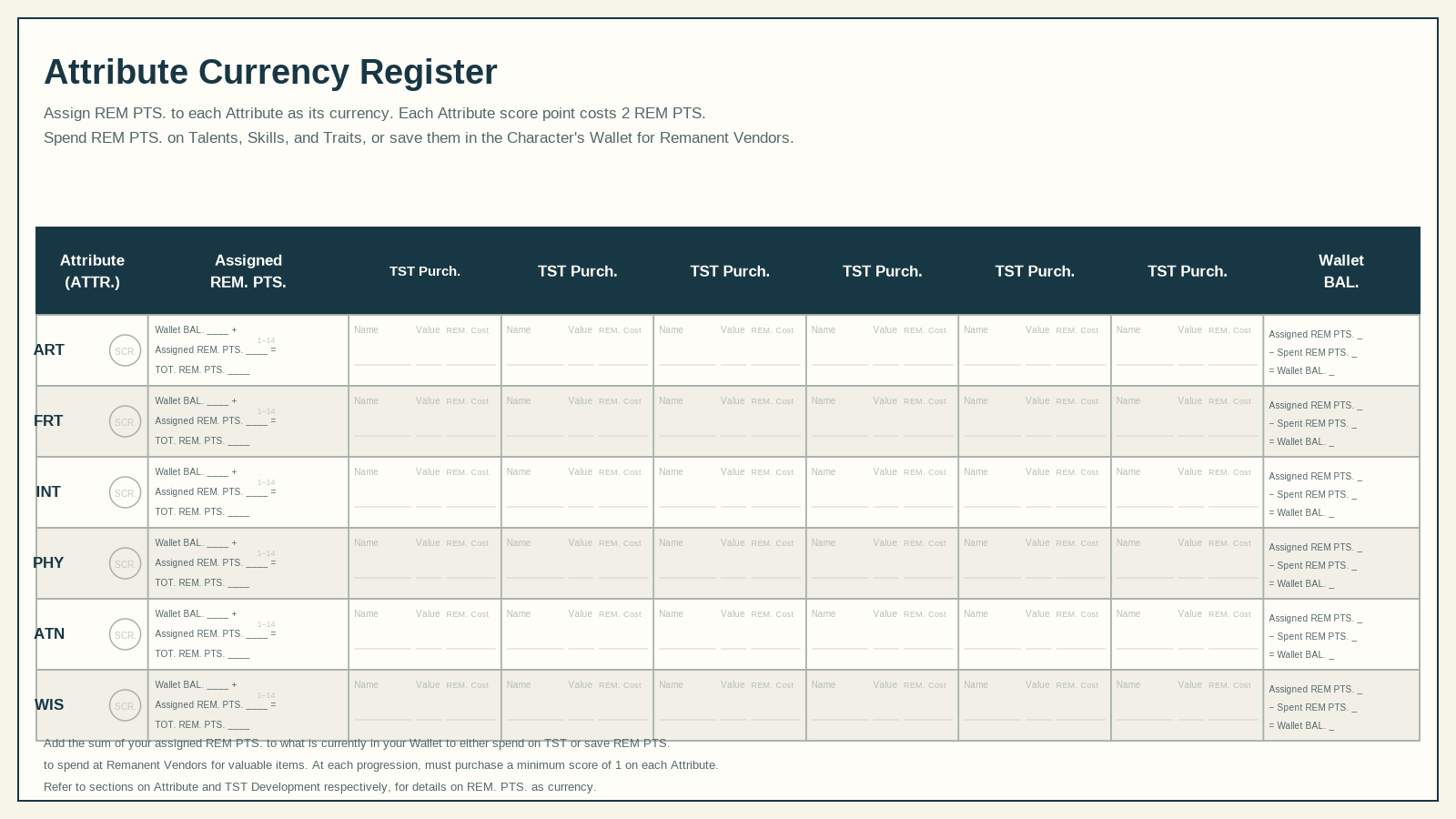
The Attribute Currency Register records each Attribute's score, assigned REM PTS., purchases, REM PTS. spent, and remaining Wallet BAL. The Character Sheet records Attribute and TST scores; this Register records the REM PTS. used to purchase them.

Using the Attribute Currency Register

  1. Generate and assign REM: At LVL 0 and every new Character LVL, roll 1d10 + 1d4 eight times. Discard the two lowest totals and assign the six remaining totals, one to each Attribute.
  2. Find the total: For each Attribute, add its current Wallet BAL. to the newly assigned REM PTS. to find TOT. REM PTS. Record both values and the total in the Assigned REM. PTS. column.
  3. Record purchases: At each progression, spend at least 2 assigned REM PTS. on each Attribute to purchase at least 1 score point. Record each TST's name, value, and REM. Cost in the six TST Purch. columns. Include Attribute score increases, Profession Expertise openings, and TST purchases in the REM PTS. spent.
  4. Calculate the remainder: Subtract total REM PTS. spent from the total REM PTS. available. Record the remainder in Wallet BAL. for that Attribute; keep each Attribute's Wallet balance separate.
  5. Save REM PTS.: Unspent REM PTS. stay REM PTS. in the Character's Wallet and carry forward. They may later be spent on special items from Remanent Vendors.

Examples: For PHY, a previous Wallet BAL. of 5 plus 14 newly assigned REM PTS. gives 19 TOT. REM PTS. If Attribute and TST purchases cost 6 REM PTS., record 13 in Wallet BAL. For ART, a previous Wallet BAL. of 5 plus 14 newly assigned REM PTS. gives 19 TOT. REM PTS. If purchases cost 19 REM PTS., record 0 in Wallet BAL.
Editable Sheet | PDF

Blank Attribute Currency Register with one row per Attribute, assigned REM PTS., six TST purchase columns, and a Wallet BAL. calculation.
Blank sheet preview. Use the editable PDF or print a copy to record Attribute and TST purchases for a progression.

ATTR scores have a minimum of 0. Above the starting floor required by innate Traits, characters may not apply more than 2 points of their roll results to any given ATTR at every LVL of progression. No ATTR may exceed a score of 50. For example, at LVL 2, an ATTR SCR may be 0, and may receive up to 4 purchased increases above its starting floor. It must also meet every positive aligned Trait score.

The ATTR cap of 50 is a theoretical maximum, achievable only by dedicating 2 points per LVL to one ATTR for 25 LVLs. Because each ATTR is individually capped at 50 and points are spread across all ATTRs, most characters will have one high ATTR and the rest significantly lower, encouraging specialization. Players should expect most ATTRs to fall between 12-25 unless they deliberately hyper-specialize.

Example, Torv, Barbarian Mountaineer

This example demonstrates how a Player applies the Attribute rules to Torv, including score allocation and the resulting decisions for a Barbarian Mountaineer.

ATTRLVL Reached SCRMax SCR (per LVL cap)
Intellect12
Artistry510
Fortitude1020
Physique2550 (cap)

Torv's Physique reaches its intended stopping point by LVL 25. In the 5 LVLs remaining, he shifts his 2-point-per-LVL allocation to Fortitude instead, gaining up to 10 more score there (2 per LVL x 5 LVLs). At LVL 30, any remaining REM PTS. may be spent on Talents, Skills, or Traits (TST).

For each aligned Trait, Talent, or Skill, the ATTR score sets the maximum cumulative investment points. At each Progression, each investment point purchased adds 2 SCR to that TST's recorded score: 2 points put into Strength add 4 Strength SCR, while 1 point adds 2. Trait and Talent points cost 1 matching REM PTS. each; a Profession Skill's price follows its Profession Expertise tier. Spend REM PTS. assigned to the matching Attribute. Racial, Ability, equipment, and other modifiers apply at their listed values.

The investment limit applies separately to each TST. Raising an ATTR allows further investment up to its new score. A positive innate racial Trait modifier sets a minimum for its aligned ATTR; a negative Trait modifier does not lower an ATTR below 0. Each ATTR score is 0 or higher.

This is what keeps ATTR SCRs meaningful. They set the depth any one TST can reach, while the Character's 199 total sets how much can be spread across all of them.

Example, spending against Physique 3: Darro has PHY 3. Physique aligns to Strength, Agility, Grit, and Atavism.

During this Progression, he buys 3 Strength investment points, reaching the Physique 3 limit. Each point adds 2 SCR to the Trait, so Strength rises from 0 to 6. Trait investment costs 1 PHY REM PTS. per point at Novice.

He buys 3 Agility investment points as well. The limit applies separately to each TST, so Agility also rises from 0 to 6.

He has no Strength investment points remaining at Physique 3. If he raises Physique to 4, he may buy 1 more Strength point; it adds 2 to the current score, raising Strength from 6 to 8.

PHY: 3
  STR: 6  (3 points spent)
  AGI: 6  (3 points spent)

Each Trait investment point purchased during a Progression adds 2 SCR: 3 points produce a recorded score of 6. Darro adds his recorded STR 6 once to a Strength Trait Check to force a stuck door: d100 55 + STR 6 = 61. The ATTR sets his investment-point limit.

Darro could keep 100 REM PTS. in his PHY Wallet BAL. and still be at Strength 6 until Physique climbs. Breadth is cheap; depth costs ATTR.

Each retained roll remains REM PTS. assigned to its Attribute. For example, a roll total of 9 assigned to PHY gives the Character 9 PHY REM PTS. to spend on Physique and its aligned TST at their listed prices, subject to prerequisites and per-Level and Attribute limits. The updated PHY score and TST scores are recorded on the Character Sheet; any REM PTS. left after purchases is written in the PHY Wallet BAL. and carries forward.

Players choose how to spend each Attribute's assigned REM PTS. among its score and aligned TST purchases, following their prerequisites and limits. This supports customized development across Attributes, Traits, Talents, and Skills.

Note: Every 24 hours (each game day), Players may choose a daily maintenance fee for selected items. This fee covers upkeep such as armament repairs, ammunition, hygiene, and health supplies. Players choose which items to include in daily maintenance or buy and replenish manually; no item is charged automatically. Maintenance fees are tied to each race's food and water consumption requirements.

Notes to the Game Master, Using Attribute Scores

GMs are provided with detailed guidelines within campaign modules but may also use ATTR SCR at their discretion, for example, when adventures go off-script, or when applying homebrew rules or Unique story elements.

Talents

A Talent Tree contains multiple Disciplines, each of which groups multiple Talents. A Discipline has a description and may list a prerequisite, but has no score. Each Talent has its own description, aligned ATTR, score, prerequisites, and use rules, and is represented by a Talent Card. Each Talent is labeled Active or Passive. An Active Talent requires deliberate use; a Passive Talent applies automatically when its listed conditions are met. Talent Trees do not use Profession Expertise. A Trait Score applies to a roll only when a rule, module, or the GM specifies it; a roll using a Trait Score is a Trait Check, and a Trait Score added to another roll or value is a Passive Modifier. Resolve an Active Talent using its listed check and modifiers; Talent scores do not strengthen Trait scores.

Talent Resolution

When a Talent calls for a check, roll d100 against the Difficulty Score (DIFS) set by the GM. Add the recorded Talent SCR and one applicable Trait SCR to the d100 result. When more than one Trait fits, the GM selects one. Add each recorded score at its listed value.

Action cost and combat use: Follow the action cost and limits listed by the Talent's rule or Card. A Talent may be used in combat only when its Card or a specific combat rule permits it.

Talent Check Formula:
d100 + Talent SCR + one Trait SCR ≥ DIFS = Success

Talent SCR: Each Talent investment point purchased during a Progression adds 2 SCR to its recorded score and costs 1 matching REM PTS. The Talent's aligned ATTR sets the maximum cumulative investment points in that Talent. Add the recorded Talent SCR once when its rule calls for it.

Prerequisites: Talent Trees and Disciplines have no score and cost no REM PTS. to access. A Discipline opens when the Character meets its listed prerequisite. Meet any additional prerequisite listed for a Talent before buying or using it. To buy a Talent's score, the Character must have at least 1 in its aligned ATTR; the ATTR also limits cumulative investment points in that Talent. A Talent must have a score of at least 1 to be used. The Character must have any required gear or kit, such as lockpicks for a lockpicking Talent or a pole for a vaulting Talent.

Difficulty by Challenge Type: The GM sets the DIFS based on the difficulty of the challenge:

Success Outcomes: On a successful check, the Character accomplishes the intended action. A critical success (96-100 roll) may grant an additional benefit as determined by the GM (e.g., completing the task faster, gaining extra information, or impressing an observer). On a failure, the Character fails to accomplish the task and may face consequences determined by the GM (e.g., time wasted, danger incurred, or a broken tool).

Talent Trees use no Expertise tiers. A Character may access a Talent Tree without an opening cost; each Discipline or Talent lists any prerequisite that must be met. Talent scores are purchased during Character Creation and Character Level progression. A Talent's score is capped at 100; its aligned ATTR limits cumulative investment points in that Talent. Each point purchased during a Progression adds 2 SCR to its current score and costs 1 matching REM PTS. Spend REM PTS. on the Talents the Character chooses.

Additional Talent Trees are released with each module and its expansions. Browse all available Talent Trees or see pg. 7 for a list.

Talent Tree structure and Talent score advancement are detailed below.

Talent Hierarchy Structure

Each Talent Tree contains multiple Disciplines, and each Discipline houses multiple score-bearing Talents:

Example Structure:

I. Talent Tree
   1. Discipline — description and prerequisite; no score
      a. Talent — description, aligned ATTR, score, and Card
      b. Talent — description, aligned ATTR, score, and Card
Example, opening a Discipline and buying a Talent: During a Progression, a Scout meets the prerequisite listed for a Discipline in the Scout Talent Tree. The Discipline opens without a REM PTS. cost. One of its Talents requires PHY 2 and has PHY as its aligned ATTR. With PHY 2, the Character may buy up to 2 investment points in that Talent; each point costs 1 PHY REM PTS. and adds 2 SCR to its current score.

Skills

Skills are scored professional capabilities learned within a Profession Tree. They cover work in Crafting, Building, Automation, Gatherer, and Assembly Professions; they are separate from Talent Trees and are not combat Abilities.

Each Character begins with free Novice Expertise access in every Profession Tree. Profession Expertise tiers apply only to Professions and their Skills; Talent Trees do not use Expertise. Higher Profession Expertise tiers follow the thresholds and opening costs below. Skill scores have the 100-SCR individual TST cap. Each Skill Card or task reference lists the requirements and procedure for its use.

Additional professions are released with each module and its expansions. Browse all available professions or see pg. 7 for a list.

Profession Skills are accessed through Profession Expertise tiers, described below.

Profession Hierarchy Structure

Profession Categories organize Profession Trees, and each Profession Tree contains its Skills:

Example: Assembly → Farmer → Beekeeping. Assembly is the Profession Category, Farmer is the Profession Tree, and Beekeeping is a Skill.

Profession Category: Assembly
  Profession Tree: Farmer
    Skill: Beekeeping

Profession Reference Documents: Recipes support Crafting, blueprints support Building, Schematics support Automation, and a Manual supports Gatherer Professions. Assembly Skills follow the directions stated in their Skill entries or task references.

Profession/Skill Resolution

Each Profession Skill's entry names the applicable Trait, DIFS, requirements, time, and outcome. Roll d100 + recorded Skill SCR + one applicable Trait SCR + explicitly allowed modifiers. If more than one Trait could apply, the GM selects one; Trait Scores do not stack.

Profession Skill Check:
d100 + recorded Skill SCR + one applicable Trait SCR + explicitly allowed modifiers vs. DIFS

Skill SCR: Each Skill investment point purchased during a Progression adds 2 SCR to its recorded score. Its REM PTS. price per point follows its Profession's Expertise tier. Add the recorded Skill SCR once when a rule calls for it.

Prerequisites: To use a skill, you must have a score of at least 1 in that skill. You must also have access to the required tools, workspace, and materials appropriate to that skill. For example, a Blacksmith requires a forge and metal, a Cook requires a kitchen or campfire and ingredients, and a Jeweler requires a workspace and gems. Without these resources, the skill check cannot be attempted.

Expertise Levels and Skill Advancement: Skills progress through Expertise LVLs (Novice, Apprentice, Journeyman, Master, Grandmaster). Opening a Profession tier grants access to its Skills for purchase. Each Skill's aligned ATTR SCR sets its maximum cumulative investment points. Each point purchased during a Progression adds 2 SCR to the current Skill score, up to the 100-SCR individual TST cap. Expertise determines access and the REM PTS. price per point. The Expertise LVL required for an item or technique is listed on its Recipe or Skill Card.

DIFS: The Skill Card or task reference lists the DIFS for its check. For tasks that use rarity benchmarks, the following ranges provide guidance:

Success and Failure: Meet or exceed DIFS to succeed; a lower total fails. The listed time is spent either way. On success, apply the outcome stated by the Skill Card or task reference. On failure, the intended result does not occur unless that entry specifies a partial result. No additional quality roll or automatic Skill or Expertise gain occurs unless the entry specifies it.

Consumable Inputs: All listed consumable inputs are spent when an attempt is made, whether it succeeds or fails. A failed attempt produces no finished item or other intended result unless the task reference states otherwise. If it lists a salvage basis, roll on the Salvage Raw Material table after failure; recovered raw material comes from the failed work and does not refund the spent inputs.

Salvage Raw Material: Each task reference that permits salvage lists the raw material returned and its salvage basis—the quantity at 100%. After a failed attempt, roll d100 and apply the corresponding percentage to that basis, rounding down to whole units. For example, a salvage basis of 4 ore units and a roll of 63 returns 1 unit. A successful attempt consumes the inputs and has no salvage roll.

d100Salvage Raw Material
01–400%
41–5010%
51–7525%
76–10050%

Resources Required: The Skill Card or task reference lists any required tools, workspace, materials, and time. A check cannot be attempted when a listed requirement is absent.

Action Time & Combat: All Profession work requires actions and takes time, and Profession work can never be performed during combat, no exceptions. A Profession's action time can be decreased with Expertise: as a character's Expertise advances, the same work takes less time.

Endurance and Crafting: Profession work spends only from the separate 10-Vitality Chip daily Crafting reserve: 1 Endurance Vitality Chip per full action, 0.5 Vitality Chip per half-action, and none for a free action. The party may schedule this Crafting before or after its daily adventure. The task's time follows its Skill or Recipe entry and any Expertise reduction; unused Crafting Endurance does not carry over or transfer to the daily routine allotment.

Profession Expertise

Expertise applies only to Profession Trees and their Skills. Each Character begins with free Novice Expertise access in every Profession Tree. A Profession's total recorded Skill SCR in its current Expertise tier determines when the Character qualifies to open the next tier. Meet the listed threshold, then pay the listed opening cost in REM PTS. assigned to the relevant Attribute; tiers open in order. Opening a tier grants access to its Skills but does not change the Skill score formula. A Skill's aligned ATTR limits its investment points, while Profession Expertise sets the REM PTS. price per Skill point.

Profession ExpertiseOpen CostPer Skill Investment Point
NoviceFree1 matching REM PTS.
Apprentice1 matching REM PTS.2 matching REM PTS.
Journeyman1 matching REM PTS.3 matching REM PTS.
Master1 matching REM PTS.4 matching REM PTS.
Grandmaster1 matching REM PTS.5 matching REM PTS.
Example, price against limit: A Physique-aligned Profession Skill at Master Expertise costs 4 PHY REM PTS. per investment point. With Physique 4, a Character may buy up to 4 points in that Skill, costing 16 PHY REM PTS. and adding 8 SCR to its current score. The ATTR limits the number of points, while Profession Expertise sets their REM PTS. price. Any PHY REM PTS. left after the purchase remains in the PHY Wallet BAL.

TST Score Cap

A Character may hold no more than 199 TST score in total, counted across every Talent, Skill, and Trait they own. The individual cap is 100. Those two numbers together mean exactly one TST can ever be taken to its cap: max one at 100 and 99 remains for everything else. This encourages diversity rather than stacking everything into a single entry.

Advancing Profession Expertise

For a Profession Tree, total the recorded SCR of its Skills in the current Profession Expertise tier. When that total meets the listed threshold, pay the listed opening cost in REM PTS. assigned to the relevant Attribute to open the next tier. Profession Expertise tiers open in order. Talent Trees do not use this progression.

Advance FromSCR Threshold
Novice → Apprentice10
Apprentice → Journeyman25
Journeyman → Master45
Master → Grandmaster80

Example, Advancing Profession Expertise

A Character has 10 total Skill SCR in a Profession's Novice tier, meeting the Novice-to-Apprentice threshold. The Character pays the listed opening cost in REM PTS. assigned to the relevant Attribute to open Apprentice. The next Profession Skill points are priced at the Apprentice rate. The Skill score formula remains the same; the tier changes access and point cost.

Talent Trees have no Expertise tiers or tier-opening costs. A Character meets each Discipline or Talent prerequisite and purchases Talent points for 1 matching REM PTS. per point.

Traits

Note: Potential consists of Apex, which sets Vitality capacity, and Spirit, which sets regeneration potential. They are not Traits or Vitality resources. Wellness determines their effective values. See Vitality, below.

Trait Checks, Passive Modifiers, and Talents

A Trait Check is a roll that uses one Trait Score. Add the recorded Trait SCR once. A Passive Modifier is a Trait Score applied to another roll or value; use the formula listed for that Trait or effect. Only one Trait Score applies to a roll or PROTS calculation; when more than one fits, the GM chooses one. Add Talent or Skill scores, weapon Rank, equipment, and situational modifiers at their listed values.

Trait Checks with Talents

A Talent check that uses a Trait Score is a Trait Check. Add the recorded Talent SCR and one applicable Trait SCR; when more than one Trait fits, the GM chooses one. For example, a Thief using a lockpicking Talent rolls d100 + Talent SCR + Dexterity Trait SCR.

Trait Scores remain independent: Talent Scores do not change Trait Scores. A Trait Score and a Talent Score may both apply to the same roll because they are different kinds of scores.

Example: A Scout has a recorded Perception Trait SCR of 4 and a Talent SCR of 6. When using that Talent, the check is d100 + 6 + Perception 4 = d100 + 10. Each recorded SCR includes its Progression investment. Perception and each Talent keep separate scores.

Traits represent a Character's capabilities in challenges, defense, and combat. A roll that uses a Trait Score is a Trait Check; a Trait Score added to another roll or value is a Passive Modifier. Add the recorded Trait SCR once in either case.

Traits are closely aligned with Abilities, Talents, and Profession Skills associated with the same ATTR. For example, Traits linked to physique influence combat Abilities and Talents related to physical strength and agility, while Traits associated with intellect impact mental Profession Skills and resistance. This alignment ensures that Talents, Profession Skills, and combat Abilities are supported by their Traits and corresponding ATTRs.

Each Trait embodies a particular aspect of a Character's capabilities, both in resisting harm and gaining offensive advantages. These Traits reflect core qualities that influence defensive resilience and offensive potential, often working in tandem with Abilities, Talents, and Skills aligned with the same ATTR.

Trait Scores apply to the rolls and values listed in each Trait’s rule. A check adds the recorded Trait SCR once. Use one Trait Score per roll or PROTS calculation. Talent, Skill, Rank, equipment, and situational modifiers apply when their rules specify them. Basic weapon ATTKs use the Trait adjustment in Combat's Basic Actions section. Abilities and other procedures use the Traits and modifiers their Cards or rules name; Trait Secondary Effects and other non-roll uses follow their listed rules.

Mechanics

A Trait Check uses d100 plus one recorded Trait Score and resolves against the threshold named by its rule, such as DIFS or PROTS. It requires no separate action or Stamina cost. Other Trait applications use the formula listed for the relevant Trait or effect. If several Traits could apply to one roll or PROTS calculation, the GM chooses one. Trait Scores never stack with one another. Trait Scores may be negative; add a negative score the same way; for example, -5 Wit contributes -5.

The GM chooses the one Trait that best matches the Character's described approach. A trapped door could use Dexterity for picking it or Strength for forcing it; talking down a hostile crowd could use Charisma or Courage; spotting a forgery could use Wit, Intuition, or Scrutiny. Use the selected Trait Score only, without adding another Trait Score to the same roll.

A d100 check that uses a Trait adds its recorded Trait SCR once. Other Trait applications, including damage and PROTS, use the formula listed for the relevant Trait or effect. A Trait may be added alongside a Talent or Skill Score when the theme fits; the Trait remains the roll's only Trait Score. Constitution and Focus also contribute to their listed formulas and secondary effects. Health is a subsection of Wellness, not a Trait.

A Trait Score may be used with a Talent or Skill Score when the theme fits. The GM chooses one applicable Trait; a Talent or Skill Score may also apply because it is not a Trait Score. For example, Strength may accompany a heavy-craft Skill, Agility an athletic Talent, Dexterity a lockpicking Talent, or Acuity an Apothecary Skill.

Trait Scores may be negative. A positive innate racial Trait modifier sets a minimum for its aligned ATTR; a negative Trait modifier does not lower that ATTR below 0. Each Trait follows the TST investment rule above, with its aligned ATTR score setting the maximum cumulative investment points. A Character needs at least 1 in an ATTR before purchasing an aligned TST; the default Novice investment costs 1 REM PTS. assigned to that Attribute.

ATTRs are the building blocks. Trait Scores describe how a Character applies those capabilities through Trait Checks, Passive Modifiers, and Trait Secondary Effects.

  1. Agility
    Description: Represents quickness, balance, and speed.
    Application: Agility modifies ranged Hit Checks, damage, PROTS, and Critical Hits when a specific rule or Ability Card lists it; Basic ranged Weapon attacks use the Trait adjustment stated in Combat's Basic Actions section. Agility also supports movement, falling damage, and Trait Checks when their rules call for it. If another Trait could apply to one roll, the GM selects one; Trait Scores do not stack.
    ATTR: Physique (PHY)
    Ranged Avoidance example: once in a three-Turn interval, the GM rolls d100 + Lira's Agility 5 against Avoidance DIFS 100. If it fails, the attack resolves against her current PROTS.
  2. Strength
    Description: Embodies brute force, physical power, and intimidation.
    Application: Strength modifies melee Hit Checks, damage, PROTS, and Critical Hits when a specific rule or Ability Card lists it; Basic melee Weapon attacks use the Trait adjustment stated in Combat's Basic Actions section. An untrained Combat Grapple uses the Unarmed Hit procedure against the target's PROTS; a learned technique follows its Ability Card. Outside Combat, a feat of force uses a Strength Trait Check against the DIFS set by its rule. Strength governs untrained combat maneuvers where their rules specify it. Each positive point of Strength adds 15 lbs to base carry capacity; see Encumbrance (below). Use one Trait Score per roll; the GM chooses Strength when it best fits the action.
    ATTR: PHY
    Strength Trait Check: A human warrior rolls d100: 55 + STR 12 = 67 vs DIFS 65 and forces the jammed door. A gnome's innate penalty of −5 Strength and +5 Strength balance to Strength 0; the gnome rolls d100: 48 + STR 0 = 48 vs DIFS 47 and also forces it.
  3. Courage
    Description: The drive to act under high stakes and continue despite overwhelming dread, physical hazards, or tactical suppression. Courage channels fear into momentum for risky maneuvers when the stakes are highest.
    Application: Courage modifies high-risk gambits, frightening physical hazards, and vital tasks performed under direct threat. Defensive: A Courage Trait Check resists conditions or environmental penalties that cause hesitation, panic, or tactical suppression. Offensive: Courage can improve the outcome or critical effect of a successful maneuver against a higher-tier threat or while clearing a higher-tier hazard.
    ATTR: Fortitude (FRT)
    Courage Trait Check: Vex rolls D100: 61 + COU 8 = 69 vs DIFS 65 and holds steady. A character at -2 Courage rolls D100: 57 + COU -2 = 55 vs DIFS 60 and fails, routed by fear.
  4. Constitution
    Description: Physical body integrity and cellular resilience, reflecting the body's capacity to sustain Life.
    Application: Constitution adds twice its recorded Trait Score to the Character's maximum Life. Apply this modifier once, not at each Level. Constitution also extends the negative Life threshold before rejuvenation is required: threshold = -(10 + recorded Constitution score).
    ATTR: PHY
    Passive Modifier: Mira has Constitution 4, so Constitution adds 8 to her maximum Life. Her negative Life threshold is -14.
  5. Perception
    Description: Reflects awareness, perception, and alertness, allowing characters to detect surprises and environmental hazards.
    Application: A Perception Trait Check detects hazards, traps, ambushes, and other details when a rule calls for a check. The threshold is set by how well the hazard is hidden, opposed by its maker's Dexterity when a creature set it, or set by the GM for a natural hazard.
    ATTR: Attunement (ATN)
    Perception Trait Check: Kael rolls D100: 58 + PER 12 = 70 vs DIFS 68 and spots the pressure plate trap. Grommak the Ogre has PER -4. He rolls D100: 55 + PER -4 = 51 vs DIFS 68 and steps on it.
  6. Vigilance
    Description: Represents a character’s sharp awareness and alertness derived entirely from their actual physical senses—such as sight, hearing, smell, and touch—combined with learned knowledge and experience. This trait governs the ability to actively read the environment, interpret sensory cues like the scent of smoke, the shift in wind before a storm, or a faint scuffle in the dark, utilizing practical training to identify any tangible threat.
    Application: Vigilance modifies sensory checks, environmental analysis, and alertness to physical signs of danger. Defensive: When a tangible threat approaches or a hazard changes, a Vigilance Trait Check can catch its physical signs and maintain awareness. Offensive: While tracking or surveying, a Vigilance Trait Check reads tracks, weather, or sensory anomalies to anticipate hazards or positions.
    ATTR: Attunement (ATN)
  7. Intuition
    Description: Represents inner senses, instinctive gut feelings, and subconscious hunches independent of physical senses. It governs danger sense, suspicion of deception, hidden treasure, and concealed threats sensed through premonition.
    Application: Intuition modifies instinctive danger checks, locating hidden treasure, sensing traps, and interpreting hunches about unrevealed threats. Defensive: When entering an unrevealed trap or deceptive interaction, an Intuition Trait Check can sense that something is wrong; apply the Attunement Attribute modifier when the rule calls for it. Offensive: During exploration or a standoff, an Intuition Trait Check can reveal a pull toward hidden secrets, treasure, or an opponent's sudden shift.
    ATTR: Attunement (ATN)
    Intuition Trait Check: Nira rolls D100: 60 + ITU 10 = 70 vs DIFS 68. She senses the ambush before it springs and warns the party.
  8. Dexterity
    Description: Represents hand-eye coordination and guile. Precision behind fine motor tasks, physical fluidity, and intricate work.
    Application: Dexterity governs Dodge Avoidance and Basic Dual-Wield Hit checks as stated in Combat's Basic Actions section; it does not modify Dual-Wield damage. Dexterity is a Passive Modifier for fine handwork, crafting, sleight of hand, mechanical trap avoidance and disassembly, guile, and sneaking when the rule calls for it. A Dexterity Trait Check resolves a precision task when its rule calls for one. The GM chooses Dexterity when precision or hand control best fits the task. Agility applies to falling damage. Trap-related DIFS is set by the trap's construction, opposed by its maker's Dexterity when a creature built it. Melee damage follows the weapon and damage rules. An Improvised Tool attack follows its Improvised Tool rules.
    ATTR: Artistry (ART)
    Dexterity Trait Check: Nira rolls D100: 61 + DEX 10 = 71 vs DIFS 68 and picks the lock cleanly. Parry uses Strength and requires an equipped two-handed melee weapon.
  9. Deceit
    Description: Focuses on deception, mimicking death, and trickery to mislead opponents.
    Application: A Deceit Trait Check misleads a target, creates a feint, or mimics death when a rule calls for a check. It is opposed by the target's Perception or Intuition, selected by the GM based on what would reveal the deception.
    ATTR: ART
    Deceit Trait Check: Vex rolls D100: 55 + DEC 8 = 63 vs DIFS 70 and fails to sell the feint. Vex then rolls a Deceit Trait Check: D100: 58 + DEC 2 = 60 vs DIFS 62 and fails to distract the guard.
  10. Toughness
    Description: Represents the outer physical protection of a character, tough skin, dense muscles, and strong bones. Adds an Armor Score bonus equal to twice the Toughness score, providing additional protection against physical damage and penetrating attacks.
    Application: Toughness is a Passive Modifier to Armor Score for unarmored or lightly armored Characters when its rule calls for it. A Toughness Trait Check can resolve breaking through a barrier or obstacle against a DIFS set by its material and construction.
    ATTR: PHY
    Toughness Trait Check: Darro rolls D100: 63 + TGH 10 = 73 vs DIFS 70 and absorbs the blow with no penetrating effect. For a barrier, he rolls D100: 66 + TGH 5 = 71 vs DIFS 70 and breaks through.
  11. Grit
    Description: Raw physical toughness that anchors a character against disruptive forces and combat conditions.
    Application: A Grit Trait Check rolls d100 + Grit SCR against DIFS when resisting stun, knockback, or knockdown. The check is opposed by the source's Strength for a creature's attack or a fixed DIFS for a natural force such as a blast or tremor. An ongoing disruption calls for a fresh Grit Trait Check each round until it ends.
    ATTR: PHY
    Grit Trait Check: Darro is hit by a shockwave and rolls D100: 58 + GRT 12 = 70 vs DIFS 66. He holds his ground, avoiding knockback.
  12. Vigor
    Description: Physical endurance and bodily resilience against harmful substances and conditions.
    Application: A Vigor Trait Check rolls d100 + Vigor SCR against DIFS when resisting Martial-sourced poison, disease, contamination, or venom. DIFS is set by the affliction's own potency, not an opposing Trait. An ongoing affliction calls for a fresh Vigor Trait Check each round until cured or it runs its course. Spell-sourced effects use the score and resolution specified on the Spell Ability Card; apply matching Warded to that score.
    ATTR: FRT
    Vigor Trait Check: Mira rolls D100: 47 + VGR 6 = 53 vs DIFS 60. She fails; the poison takes hold and causes ongoing damage.
  13. Willpower
    Description: Mental determination, emotional composure under pressure, and resilience against intellectual mind control, temptation, and confusion.
    Application: Willpower modifies resistance to mental influence, temptation, and confusion. Defensive: A Willpower Trait Check maintains mental clarity and resists mind effects against the threshold set by the effect.
    ATTR: INT
    Willpower Trait Check: Vex rolls D100: 70 + WIL 12 = 82 vs DIFS 78 and resists the charm spell. An Ogre at -2 Willpower rolls D100: 65 + WIL -2 = 63 vs DIFS 75 and is charmed.
  14. Acuity
    Description: Raw mental power and magical acuity, the ability to channel and focus arcane or divine energy with precision.
    Application: A Spell Ability targets PROTS for damage or destruction and DIFS for disabling a Mechanism. Its Card lists flat damage; Acuity modifies Hit or damage only when the Ability Card or a specific rule lists it.
    ATTR: INT
    Spell Hit Check: Kael rolls d100: 74 vs the target's PROTS 65. The spell hits; apply the Ability Card's printed flat damage and listed modifiers.
  15. Wit
    Description: Mental resilience, sharp perception, and the ability to avoid deception or complex traps.
    Application: A Wit Trait Check detects a scam, trap, or deception against its concealment DIFS or an opponent's Deceit. The GM may select Intuition for a maze or disorienting puzzle when it better fits the approach. Wit may also modify mental defenses when its rule specifies it.
    ATTR: INT
    Wit Trait Check: Kael rolls D100: 58 + WIT 10 = 68 vs DIFS 65 and spots the merchant's scam before paying. An Ogre with -5 Wit rolls D100: 62 + WIT -5 = 57 vs DIFS 60 and pays double.
  16. Scrutiny
    Description: Careful examination and analysis of details, evidence, and patterns.
    Application: A Scrutiny Trait Check examines evidence, compares details, identifies inconsistencies, or draws conclusions when a rule calls for it.
    ATTR: Intellect (INT)
  17. Piety
    Description: Embodies a character's devotion, reverence, and moral integrity toward their deity, sacred principles, or spiritual path. It reflects their commitment to their faith through acts of worship, moral conduct, and spiritual discipline. Characters with high Piety often gain divine favor, protection, and influence, while those with low Piety may lack spiritual resilience or be more susceptible to dark influences. Piety also covers knowledge of religion and its teachings concerning evil, the lawful, and beliefs or powers between them.
    Application: A Piety Trait Check resists divine corruption, dark curses, and malevolent holy magic against a DIFS set by the effect's divine potency. Piety also modifies defense against holy or divine effects when its rule specifies it.
    ATTR: Attunement (ATN)
  18. Wilderness
    Description: Knowledge of wilderness regions, natural environments, wildlife, weather, and survival.
    Application: A Wilderness Trait Check interprets natural conditions, tracks, wildlife, and survival challenges when a rule calls for it.
    ATTR: Wisdom (WIS)
  19. Charisma
    Description: Personal magnetism, verbal mastery, and a commanding aura, often amplified by an impressive appearance. Charisma governs conversational influence, social charm, and diplomatic strategy.
    Application: Charisma modifies social rolls involving persuasion, negotiation, or calculated deception. Defensive: When countering verbal manipulation or attempts to sway an audience, a Charisma Trait Check can answer the rival's rhetoric and maintain control of the conversation. Offensive: During a negotiation or public debate, a Charisma Trait Check can use articulate charm or presence to press an opponent toward a disadvantageous compromise.
    ATTR: ART
  20. Focus
    Description: The ability to concentrate, maintain sustained attention, and channel mental discipline during multi-turn tasks. Focus lets a character remain alert under pressure so complex operations such as spellcasting or precision engineering can continue amid distractions.
    Application: Focus modifies concentration on complex tasks, spellcasting, or disabling traps when a rule calls for it. Defensive: A Focus Trait Check resists losing concentration from distraction or damage and supports sustained actions.
    ATTR: INT
  21. Craftsmanship
    Description: A character's skill with tools, materials, and fine handiwork, the discipline behind building, repairing, and shaping things well.
    Application: A Craftsmanship Trait Check resolves Crafting Resolution and heavy-craft Skill Checks when the GM selects Craftsmanship for the task. It does not stack with Dexterity or another Trait Score on the same roll. DIFS is set by the item's own complexity, rarity tier, and required quality.
    ATTR: ART
    Craftsmanship Trait Check: Nira rolls D100: 60 + CFT 10 = 70 vs DIFS 66. The blade comes out true.
  22. Atavism
    Description: The old blood surfacing. An inherited, pre-civilized capacity that wakes when the body is driven past what training accounts for, the ancestral form pressing through the modern one. Where Strength applies force a body has trained for, Atavism draws on force it never learned.
    Application: An Atavism Trait Check resolves action beyond what training accounts for, such as untrained exertion, instinctive movement, endurance beyond conditioning, or carrying a force through the body. Its DIFS is set by the force involved or opposed by the source's output. Toughness provides its listed physical protection; matching Warded modifies the PROTS or DIFS the magical effect tests.
    ATTR: PHY
    Atavism Trait Check: Darro rolls D100: 59 + ATV 14 = 73 vs DIFS 70. Three days without food and he still lifts the beam off his shield-brother, the old blood rising.

Enhancement Types describes Enchantment and Warded, including their values and effects during play.

Additional Considerations

These considerations explain the practical limits and edge cases that apply when Players and GMs interpret Attribute, Talent, Skill, and Trait results together.

Trait Secondary Effects (Score 10+)

Trait Tier Formula: Effect tier = floor(Trait SCR ÷ 10), with tier 0 below a score of 10 (no effect yet active). A Trait score of 10-19 grants tier 1 effects, 20-29 grants tier 2, 30-39 grants tier 3, and so on up to the Trait cap of 100 (tier 10). Each tier increase strengthens the effect accordingly.

Every Trait carries a second, passive effect that unlocks once its score reaches 10, on top of its normal d100 roll bonus. Three Traits regenerate a Vitality resource: Constitution regenerates [tier] Vitality Chips to Life each Turn, Willpower regenerates [tier] Vitality Chips to Mana each Turn, and Grit regenerates [tier] Vitality Chips to Stamina each Turn. Vigor and every other Trait instead let the Player designate one Ability aligned with that Trait's theme to reset its Cooldown or Recharge early [tier] times per encounter (see How to Read a Card, above, for the CD/RECHRG markers), removing Unit Tokens from the Card sooner than its normal Turn or Rest timer would. Reaching 20, 30, 40, and every 10 points after repeats the same effect at a stronger tier, right up to the Trait cap of 100.

Example, To the Game Master: Creating a Level 30 Divine Wild Chimassu

Utilizing the rules found in SORC's GM Codex, on Species and Rank, this Chimassu's Innate Traits started as a Hawkbear of the same species and size. Hawkbear Innate Traits, the closest playable race to the Chimassu because both are Goliath-sized hybrid creatures combining two distinct animal forms, sharing the same fusion of brute physical power and aerial agility.

The character begins with Wit −2, Deceit −2, and Piety −1. Each Trait investment point costs 1 REM PTS. assigned to its matching Attribute and adds 2 SCR to its current score: 1 INT REM PTS. brings Wit to 0; 1 ART REM PTS. brings Deceit to 0; and 1 ATN REM PTS. raises Piety to +1. Each further Trait point adds 2 SCR, subject to that Trait’s cumulative investment-point limit. Unspent REM PTS. remain in the corresponding Attribute Wallet.

Across 30 LVLs, assign each Attribute's retained REM totals to the corresponding Attribute. The Character records purchases against each matching balance and carries each remainder forward in that Attribute's Wallet. A Divine rank Chimassu could use those balances to develop more Attributes and TST scores, subject to their prerequisites and limits.

Vitality

The Vitality System in Slayers of Rings & Crowns tracks Life, Mana, Stamina, and Endurance with stackable Vitality Chips, each representing one unit gained or lost. These resources begin with base amounts determined by Character size. Potential governs additional capacity and regeneration; it has two components, Apex and Spirit. Race-specific starting values and Growth Stage gains establish Potential, with no maximum Potential score. Constitution adds its one-time modifier to maximum Life. Character Level does not increase Potential. Wellness determines how much Potential affects effective capacity and regeneration.

Potential

Potential is the Character's capacity and regeneration reserve, established by race-specific starting values and increased at each Growth Stage. Each point contributes one Vitality Chip of Potential. Wellness determines the effective Vitality capacity and regeneration produced by those points. Potential has no maximum and is not purchased.

Apex

Apex is the capacity component of Potential. The Character's race sets its starting value and the amount gained at each Growth Stage. The Player allocates Apex among Life, Mana, Stamina, and Endurance. Each Apex point contributes one Vitality Chip of potential capacity to its allocated resource; Wellness determines the effective capacity.

Spirit

Spirit is the regeneration component of Potential. The Character's race sets its starting value and the amount gained at each Growth Stage. The Player allocates Spirit among Life, Mana, and Stamina. Each Spirit point contributes one Vitality Chip of potential regeneration per turn to its allocated resource; Wellness determines the effective regeneration. Spirit does not restore Endurance; the daily Endurance allotment resets at the start of each game day (see Endurance, below). Spirit regeneration applies in and out of combat and during rest, and stacks with Nature or Spell Abilities that restore Vitality.

Wellness

Wellness tracks how well a character takes care of themselves on a day-to-day basis. Characters maintain Wellness through the choices they make, how they treat their bodies and minds, and the activities that either support or harm their health. Wellness ranges from 0% (minimum, representing neglect and decline) to 150% (maximum, representing peak physical and mental conditioning). A Character begins play at 75% Wellness or higher; the GM may adjust the starting value to reflect the Character's Background.

What triggers Wellness changes: Wellness is affected by lifestyle choices, moral and conscience decisions determine Wellness trajectory: unhealthy choices lower it, moderate choices hold it steady, and healthy choices raise it. Diet provides a small, steady tick that builds over Growth: good diet gradually raises Wellness, poor diet gradually lowers it, the benefit accumulating as characters age. Poison, disease, and status effects cause Wellness to tick down. Loss of Life hurts Wellness; retaining Life through care and healing helps it. Sustained rest restores Wellness (see Rest Mechanics, below). Honing abilities, talents, and skills through practice maintains and improves it. Multiple professions support Wellness: Practitioners provide direct healing and recovery, Hunters and Fishermen provide fresh game and catch, Cooks prepare nourishing meals, Scouts keep characters mobile and aware, Healers provide medical care, Buffers support morale, moral leaders inspire good choices, and Field Medics provide emergency care and treatment.

Wellness and Vitality: Wellness determines the effective capacity and regeneration provided by Potential. At low Wellness, less Apex capacity and Spirit regeneration are effective; at high Wellness, more of each is effective. This creates a feedback loop: characters in poor health have smaller reserves and recover more slowly, while characters in good health have larger reserves and recover faster.

How Wellness ticks: Wellness ticks up or down automatically over time, like Heal-over-Time (HoT) and Damage-over-Time (DoT) effects. Neglect causes automatic decline, while healthy living causes automatic increase. Nothing ticks below 75% Wellness; below that threshold, only direct neglect, poison, disease, and injury can lower it further. At 75% Wellness and above, the threshold activates: both positive and negative effects accelerate, good habits snowball faster and bad habits compound quicker, the further from baseline a character drifts.

Health

Health is a subsection of Wellness, not a Trait or TST. Its score sets the Health tier: floor(Health score ÷ 10). Below 75% Wellness, each tier adds 2 days to the interval before a direct Wellness loss, slowing decline. At 75% Wellness and above, each tier removes 1 day from the automatic tick interval, to a minimum of 1 day. A Health score below 10 is tier 0 and applies no modulation. Higher Health scores slow direct Wellness losses below 75% and accelerate Wellness changes at 75% and above.

Rest Mechanics: Sustained rest restores Wellness more effectively than any other activity. A Breather (brief rest, 10 minutes) ticks Wellness slowly. A Short Rest (1 hour) ticks faster. A Full Rest (8 hours, requires a bed) ticks significantly faster and requires proper sleeping conditions; a comfortable bed is necessary for full Wellness recovery potential. Endurance is not restored during a Breather or Short Rest; its daily allotment resets only at the start of a new game day, including when a Full Rest crosses that boundary. Without a bed, Wellness ticks more slowly during a Full Rest. Environmental conditions affect rest quality: temperature extremes, noise, discomfort, and stress all reduce Wellness ticking during rest. A character resting in ideal conditions (warm, comfortable, safe, well-fed) gains maximum Wellness ticking; a character resting under poor conditions gains minimal benefit.

Practitioners and Standing: Practitioners are NPCs (not a playable profession) who specialize in supporting character wellness. Characters benefit most from establishing a relationship with a primary Practitioner who knows them well, this creates Standing, an important measure of trust and familiarity. Regular visits with an established Practitioner accelerate Wellness recovery and provide bonuses to health-related checks. These visits typically require scheduling appointments. Practitioners exist throughout the world; characters can visit any Practitioner in emergencies, but emergency visits provide limited benefits compared to regular visits with an established primary Practitioner. Building Standing requires time and repeated contact.

Larger races begin with higher Life and Stamina but lower Mana, their mass favors physical endurance over magical capacity. Smaller races begin with higher Mana but lower Life and Stamina, reflecting a natural affinity for magical energy over brute resilience. Standard-sized races begin with balanced amounts across all four. Base values for each size category are listed under Playable Races (pg. 2). Race-specific innate traits, ATTRs, and class bonuses modify these base values further.

Martial Abilities spend Stamina at their listed cost, with a minimum cost of 2 Stamina Vitality Chips. Spell Abilities spend Mana at their listed cost, with a minimum cost of 2 Mana Vitality Chips. Each Ability also costs at least 1 action; Stamina and Mana do not change the base of 5 actions per Turn. Life, Mana, and Stamina regenerate via Spirit between every turn. Endurance is spent across the day at the full-action, half-action, and free-action rates listed below and resets at the start of each day. Each Vitality resource has its own score, called a Vitality SCR (VIT SCR), tracked through Vitality Chips. Each VIT SCR is the number of Vitality Chips that Vitality resource is capped at (see Vitality Progression, below).

Vitality Progression

Vitality capacity and regeneration Potential advance at each Growth Stage, not at Character Levels. Each Stage adds the race-specific Apex and Spirit gains listed for that race. Each Potential point contributes one Vitality Chip to its allocated capacity or regeneration; Wellness determines the effective amount. The Player allocates Apex among Life, Mana, Stamina, and Endurance, and Spirit among Life, Mana, and Stamina. Character size sets the starting Vitality values; Apex allocated to Endurance raises its Growth-adjusted daily base. Applicable Armament Enhancements may raise Life, Mana, or Stamina as stated on their Cards; they do not increase the daily Endurance allotment.

Example: At each Growth Stage, Kaida adds her race's listed Apex and Spirit gains to her Potential. She allocates Apex among her Vitality resources and Spirit among Life, Mana, and Stamina; her Wellness determines the effective capacity and regeneration. Character Level does not increase her Potential.

Vitality Recap: Potential consists of Apex and Spirit. A Character's race sets their starting values and Growth Stage gains; each Potential point contributes one Vitality Chip, with no maximum Potential score. Apex can be allocated to Life, Mana, Stamina, or Endurance; Spirit can be allocated to Life, Mana, or Stamina, never Endurance. Wellness determines effective capacity and regeneration.

Life Red / Purple Vitality Chips

At half: Move at half speed; apply a 0.5× modifier in the Movement calculation, stacking multiplicatively with other applicable movement multipliers.

At zero: Incapacitated. Use purple Vitality Chips to track negative Life. At -(10 + Constitution score) Life, must go through rejuvenation (see dying and death below).

Mana Blue Vitality Chips

At half: Deals half of the Spell's power.

At zero: Cannot cast until Mana regenerates (see Spirit). Spell cost = the Spell's LVL divided by 2, rounded up, minimum 2 Mana.

Stamina Yellow Vitality Chips

Costs: Martial Ability cost = the Ability's LVL divided by 2, rounded up, minimum 2 Stamina. In structured encounters, moving any distance costs 1 Stamina Vitality Chip for the turn, plus 1 Vitality Chip for each full or partial 5 ft. moved beyond the pre-mode allowance (race base speed plus applicable pre-mode movement modifiers, including Agility). Moving less than the pre-mode allowance still costs 1 Vitality Chip; choosing no movement costs no movement Stamina. The Agility movement modifier costs no action and is included in the pre-mode allowance for calculating extra Stamina. A full Run beyond that allowance costs additional Stamina under this same distance formula. See Stamina and Mana Costs under Actions.

At half: Martial Abilities have half results.

At zero: Cannot use Martial Abilities or move in a structured encounter until Stamina regenerates (see Spirit). See Encumbrance (below) for weight-based movement and action penalties.

Endurance Green Vitality Chips

Endurance is the Character's fixed daily action allotment. At the size baseline, Small receives 60 Vitality Chips, Standard 65, and Goliath 70. Of those totals, respectively, 50, 55, and 60 Vitality Chips are allocated to daily adventuring and routine Turn actions, including Combat, Talents, Movement, and other paid actions; 10 Vitality Chips are reserved for Crafting. The party chooses whether to use the Crafting reserve before or after its day's adventure. Each full action costs 1 Vitality Chip, each half-action costs 0.5 Vitality Chip, and free actions cost none. The routine allotments cover 10 Small, 11 Standard, or 12 Goliath fully paid Turns at five full actions per Turn; half- and free-cost actions may extend the number of actual Turns. Growth Stage Potential allocated to Endurance raises its daily base; Wellness determines the effective capacity from Potential. The Crafting reserve remains 10, and the routine allotment is the remainder. No Character may spend beyond their current effective daily Endurance allotment. Breathers and Short Rests do not restore Endurance, and the daily allotment cannot be replenished during the day; it resets at the start of a new game day.

At zero: When the routine allotment is spent, no further paid routine actions can be taken that day; the separate Crafting reserve remains available. When the Crafting reserve is spent, no further paid Crafting actions can be taken. Free actions remain available.

A Character may use the separate 10-Vitality Chip daily Crafting reserve for work while the Player is away, provided the required materials and Recipe or Skill are available. Rolls are made at the start of the next session; unused Crafting Endurance does not carry over.