Character Creation
Character Creation happens BEFORE LVL 1. During creation, Players establish their Character's initial Talents, Skills, and Traits (TST). After completing the first quest and reaching LVL 1, Attributes and TST advance at each Character Level. Class Abilities are chosen at LVL 1, at each midpoint between Levels, and at each Level.
Character Creation Steps
These steps establish a Character’s identity, alignment, background, race, attributes, starting equipment, and first progression choices before play begins.
- Establish Alignment - Choose your character's moral outlook on the 5-point spectrum (Lawful, Moral, Ambivalent, Amoral, Evil). This is locked in first and is foundational to all subsequent choices.
- Select/Create Background - Choose or create the Character's upbringing and cultural history. Background informs initial Standing with factions and cultural Equipment access.
- Define Mission Statement - Establish your character's personal mission or purpose. This must adhere to your Background and will tie you to NPCs and factions who have a stake in its success or failure.
- Select Race - Choose your character's race, which determines: size category, base carry capacity, speed, starting age range, Innate Trait Adjustments (bonuses/penalties), Innate Aptitude, Innate Inaptitude, Favored Class Trees, trait bonuses and penalties, and Favored Companions.
- Choose Age - Select your character's age up to five years below or above your race's Base Age, without going below the race's age of adulthood.
- Choose Name and Details - Establish your character's name and personal details.
- Roll and Allocate ATTRs - Roll and distribute your six ATTRs: Artistry, Fortitude, Intellect, Physique, Attunement, and Wisdom.
- Select TST - Choose Talents, Skills, and Traits using Remnant (REM) PTS. Also select your Aura, which is chosen every Eon (year).
- Store, Equipment and Encumbrance - Select starting Equipment and Armaments from the options offered by the Module's store, respecting carry capacity, Background, Alignment, Class, and Card prerequisites. The store's Rank range describes its available stock; Character Rank governs use of Armament and Companion Cards. Record starting Armament RP; Character Rank is determined by banked Armament RP alone. Calculate total weight and encumbrance status.
- Starter Standing Notes - Gather any starter Standing notes that can be derived from your Background or Cultural details.
- First Quest and LVL Advancement - Geared up and ready for combat, your character gets their first quest (an easy task). After completing this quest, your character reaches LVL 1.
- Class Tier Selection - At LVL 1, select your Class Tier and repeat Step 8 (TST selection with increased REM PTS. assigned to Attributes and expanded options).
Character Creation in SORC begins, at the table, by establishing a character's alignment and moral outlook. Alignment (Lawful, Moral, Ambivalent, Amoral, or Evil - see Alignment below). Once alignment is locked in, Players select a Background that adheres to that alignment, then select a race, then roll dice to determine points to spend on ATTRs and select TST (Talents, Skills, Traits). After completing the first quest, the Characters reach LVL 1, where they select their Class Tier and repeat their TST selection, a process repeated every time a Character Levels, see ATTR Development on pg. 2. As characters LVL up they'll unlock Main Class Trees and their Abilities. Reaching LVL 1 unlocks Main Class Tier Abilities, LVL 4 unlocks Main Class Path Abilities, and reaching LVL 21 unlocks chosen Path's Branch Abilities.
The character's inventory tracks items without Penalty up to encumbrance limits, and additional character pages allow for tracking personal history, relationships, and achievements. Each character is assigned a Unique ID for online tracking, trading, and achievements.
The character Sheet serves as a central record, displaying key details like background, mission, reputation, and standing, along with customizable elements such as Portraits, armor, and weapons. Customization of a character is also available online, via SORC Web. Open Character Customization
Utilizing SORC Web, Players can save and export their characters as images or printouts, and have options for high-resolution Portraits reflecting their character's identity. Character pages can be customized with images, background info, and logs of ongoing progress, quests, discoveries, and personal notes.
Creation Locks and Changeable Features
Names and Faces are locked in at creation. Body Type is governed by Physique (see Physique) and can be changed according to the Physique rules. Armaments and Companions can be changed after creation.
Character Sheet
Displays key details such as name, race, class, LVL, Attributes, TST scores, equipment, and Companions. The Companions section records each active Companion Card, Tier, Rank, occupied slots, Bond, Standing, Mood, and current activity; the active Tier Card provides the Companion's statistics and Abilities.
Character Details During Creation
This section organizes the identity, appearance, history, and personal records that a Player establishes while creating a Character.
Birth
Player's Name, Nickname, Character Portrait or Photo, Age, Gender and a Character Unique Identification (UID) which is a random 5 unit number combination exclusive to Players that choose to delve into SORC Web's online features.
Age and Growth
Age is the character's numerical age at the start of play. At creation, choose a character's starting age up to five years below or above their race's Base Age, without going below the race's age of adulthood (see each race's entry and the Lifespan, Starting Age, and Retirement Age table, pg. 6). Whatever age is chosen becomes the Character's actual Beginning Age going forward. All characters retire after 40 years of adventuring (see Retirement, pg. 5). Characters gain no mechanical advantages from age alone; age is purely narrative and establishes the character's life stage, maturity, and starting point in the story.
Growth records a Character's development through years lived during play. A Character reaches one Growth Stage every five years, from Stage 1 at Year 5 through Stage 8 at Year 40. Each Stage advances the race-specific Potential gains listed for Apex and Spirit. Character Level does not increase Potential or Vitality capacity. Wellness determines the effective Vitality capacity and regeneration. Innate Aptitude follows its separate yearly progression. See the Growth table and procedures in the GM Codex, Ch. II.
Birthday
Birthday records place a Character on Essentia’s seasonal calendar and provide the date used for their in-world age and story history.
A character's birthday anchors them to Essentia's seasonal calendar. During character creation, choose a specific date within one of the six seasons. The format is: Season Day, Current Year EA
Example: Aut 15, 10,023 EA (Autumn, Day 15 of the current Eon of Adoria)
Each season contains 61 days. Use the season abbreviations: Spr (Spring), Sum (Summer), Aut (Autumn), Win (Winter), Sol (Solstice), Vei (Veil). Days range from 1–61 for each season. See Tomes of Essentia for complete seasonal calendar details.
Character UID
The Character UID is the unique identifier used to distinguish an online Character from others with the same name and connect records to that Character.
Character ID's are RNG numbers provided by our servers and no two ID's are alike, to avoid conflict between online Characters that have the same name and to keep track of acquisitions.
Race
Upon creation, characters will choose between 38 races and kinborns from three size categories; Goliath, Standard and Small. See races below.
Alignment
A character's alignment is their ideological and moral orientation, a freely chosen value system that only their Higher Power knows. Your alignment choice directly gates which Main Class Tree Abilities you can learn and which Higher Power you can devote to. It is a foundational decision chosen during character creation before any other class decisions. SORC runs alignment along a five-point spectrum:
- Lawful: bound by tradition, order, and divine authority.
- Moral: virtuous and well-meaning, but personally driven rather than bound to institution or oath.
- Ambivalent: ambivalent to religion entirely, flexible and pragmatic, unconstrained by either pole. Replaces what earlier notes called Neutral.
- Amoral: self-serving and pragmatic, willing to bend ethics without embracing outright malice.
- Evil: driven by ambition, primal instinct, or forbidden magic.
Alignment's Function: the Spectrum The five-point spectrum runs Lawful | Moral | Ambivalent | Amoral | Evil. Every Path holds a base alignment, and its Spectrum is that base plus the alignment on either side of it, three alignments at most. That base carries through all three of the Path's Branches.
A Character learns a Path's or its Branches' Abilities while their alignment sits anywhere in that Path's Spectrum. Devotion to the Path's Higher Power needs the base alignment exactly, and a Character who drifts off it keeps the Abilities and loses the Higher Power bonus until they return.
A Main Class has no base of its own. Its range is whatever its Paths and Branches reach between them, and each class card names that range.
A Witch's Norwitch Path bases at Moral, so a Norwitch may hold Lawful, Moral or Ambivalent. Only a Moral Norwitch draws the Higher Power bonus, and there is no Lawful Higher Power for a Witch to devote to.
| A Main Class's lean | Its Spectrum, who may learn it |
|---|---|
| Lawful | Ambivalent, Moral, Lawful |
| Evil | Ambivalent, Amoral, Evil |
Tier Abilities require the Spectrum. A Character may only learn a Main Class's Tier Abilities while their own alignment sits inside that Class's Spectrum. Every one of that Class's Paths, and every Branch beneath them, falls within the same Spectrum.
Paths and Branches carry their own alignment, and it works on two levels. To learn a Path's or Branch's Abilities, your alignment need only sit inside the Main Class's Spectrum. To draw the Higher Power bonus of that Path and its Branches, you must hold that Path's exact base Alignment, which is the Higher Power's own requirement, not merely somewhere in the permitted range. A Warlock at Ambivalent may learn an Evil Path's Abilities, but takes none of its patron's bonuses until they stand at Evil themselves.
Fall outside a Main Class's Spectrum and you can no longer learn new Abilities from its Tier, its Paths or its Branches, though every Ability already learned remains fully usable. Drift off a Higher Power's exact alignment and its bonuses stop until you return to it (see Fallen and Risen, pg. 3).
A Character's current alignment position is tracked on the Progression Sheet. Your choices during play can change your alignment. It is not locked at creation.
Alignment's Sole Purpose: Alignment gates two things only: which Class Tier, Path, and Branch Abilities you can learn (based on Spectrum), and whether you can devote to a Higher Power and hold Standing with its Church (based on exact alignment). Those are its only mechanical gates in the game.
What alignment does not touch. Other beings, NPCs, MAC, and even your own party cannot see your alignment, it is invisible to everyone but your Higher Power. They may scoff at or judge you based on your actions, but every being in Essentia holds the right to follow whatever alignment it chooses. Alignment carries no advantage or disadvantage in Companion Mood or NPC Vendor interactions. Certain guilds and clans, however, do require a particular Spectrum or an exact alignment for entry (a Class or Path gate, not a social one).
How others judge you: Your actions and choices during play generate Praise and Blowback, which build your Reputation and Standing with factions and NPCs. Others use these to form opinions of you, not your alignment. Your Background and Mission Statement are what they see and interact with. Your Alignment remains known only to you and your Higher Power (see Standing & Mission Statement, below).
Player Knowledge vs. Character Knowledge: While all Players at the table know each other's chosen alignments at character creation (to coordinate party composition and narrative), the Characters themselves do not yet know each other's alignments. Each character discovers the moral stance of their companions through roleplay, actions, and choices made during play. This separation allows alignment to remain a dynamic element of interaction and discovery within the game world.
Alignment and Higher Power Mechanics: Once you've devoted to a Higher Power at LVL 4, your alignment determines whether you can hold that devotion and access its bonuses. See Higher Power for the full mechanics of devotion, Falling, and Rising.
Higher Power
Higher Power describes devotion, church membership, alignment requirements, patron benefits, and the consequences of neglecting or leaving a chosen patron.
Every Path is tied to a Higher Power, a divine or otherwise transcendent force. At LVL 4, when a character commits to their first Path, they choose to devote to that Path's Higher Power or remain undevoted. This choice is permanent: devotion is a lifetime commitment that applies across every Class Tree the character invests in thereafter. A second Path taken later in another Class does not grant a second patron; a character holds one Higher Power across all their classes, or remains undevoted in all of them. Upon choosing to devote to a Higher Power, you automatically become a member of that Higher Power's church.
Choosing to Devote: A character who devotes to a Higher Power gains access to Abilities from that Path and all three Branches beneath it (if reached). The Higher Power grants a Benefit on Abilities drawn from that Path and any checks made in its service or in its places. However, devotion comes with a cost: the character must practice devotion to the Higher Power's religion or cult and maintain their Standing with the Church.
Church Membership and Devotion Requirements: Upon devotion, you automatically become a member of the Higher Power's church. A devoted character must spend at least one of their daily Endurance actions to honor their Higher Power and its religion. The exact practices vary by patron, but typically involve prayer, ritual, study, or service. Once per week, the character must attend a ceremony or gathering lasting at least one hour, either with other faithful or in private devotion. These are mandatory; neglecting them damages your Standing with the Church.
Standing with Church vs. Alignment: Your Standing with the Church is separate and independent from your Alignment. Standing reflects your devotion actions and whether you practice the required daily and weekly rituals. Your Alignment reflects your ideological values, known only to your Higher Power. You can maintain perfect Standing with the Church through faithful devotion while secretly holding a different alignment, but if the Higher Power detects this misalignment through your actions or choices, it may withdraw bonuses and test you accordingly. Conversely, your Alignment can shift during play due to your behaviors and acts, potentially causing you to Fall from or Rise toward your devoted Higher Power, but this does not automatically damage Standing with the Church, only failure to practice devotion rituals does.
Neglect and Testing: If a character neglects their devotion, failing to spend required Endurance actions or missing weekly ceremonies, they lose Standing with the Church. A neglectful character loses all bonuses from that Higher Power but retains all Abilities already learned. If Alignment shifts away from the exact alignment required by the Higher Power, the character Falls (or Rises for Evil/Amoral paths), losing bonuses but keeping learned Abilities if still within the Spectrum. The Higher Power may test the character through random events, curses, or challenges when alignment drifts or devotion is neglected. A character who returns to proper devotion and alignment may regain the Higher Power's favor, subject to the patron's judgment.
Choosing Not to Devote: A character may refuse to devote to any Higher Power. An undevoted character forfeits all Higher Power bonuses and can never Fall or Rise (see Fallen and Risen Classes, pg. 3), but carries no Drawback and no Path is ever closed to them by a patron. They have complete freedom but sacrifice the power that comes from divine or infernal patronage.
Higher Power Culture. Each patron carries its own observances, its own foes, and its own list of traditions it will not share a Character with. A devoted Character takes on that culture alongside their Race Culture and their Background (see Culture, below).
| Patron | Observance | Will not share a Character with |
|---|---|---|
| Lawful | Oath, record and public rite. Devotion is witnessed and written down. | Evil, and any Path that takes by force what it has not earned. |
| Moral | Service and care. Devotion is spent on other people rather than performed. | Evil and Amoral. |
| Amoral | Bargain and price. Devotion is a contract kept, whatever it was for. | Moral. |
| Evil | Offering and dominion. Devotion is paid in what it costs someone. | Lawful and Moral. |
Ambivalent's Advantage: Ambivalent Paths answer to no god and no patron at all. A character taking an Ambivalent Path gains no bonuses from a Higher Power (there is none to devote to), but also faces no devotion requirements and no risk of the patron's tests. Ambivalent characters are not bound by religion and do not spend Endurance on devotion. This freedom is their trade-off for lacking the patron's blessings.
Forbidden Paths: A Higher Power will not share a character with rival traditions. While devoted, a character cannot learn new Abilities from any Path their patron forbids, whatever their alignment. Abilities already learned remain usable; the forbidden Path simply closes to further picks while the devotion holds. Each patron's forbidden Paths are listed in its own Path entry.
Higher Power Categories: Lawful and Moral Higher Powers are divine or otherwise virtuous, Lawful the more institutional and oath-bound, Moral the more personally-driven. Evil and Amoral Higher Powers are corrupting or self-interested, Evil the more overtly malicious, Amoral the more pragmatic. Only Lawful and Moral Higher Powers carry the risk of Falling; only Amoral and Evil Higher Powers carry the risk of Rising.
Abilities
SORC Abilities are combat-only and come in two forms: Martial Abilities and Spell Abilities. Martial Abilities are physical combat maneuvers and spend Stamina; Spell Abilities are magical combat actions and spend Mana. Both are learned through Main Class Trees and use their card's listed Action cost, Vitality cost, range, effects, and limits.
SORC has 16 distinct Main Classes. Each Main Class contains one Tier - LVL 1 - LVL 3, three Paths from LVL 4 through LVL 20, and three Branches within each Path from LVL 21 through LVL 30.
At each level, 4 slot Abilities are offered as choices; representing various Abilities to choose between: Heals, Damage, Protection, Support and one Hybrid always available as a choice. This process happens at every Class Level of Progression and the midpoint between the next, so two Abilities at each level.
There is no Class selection: a Character learns Abilities from whichever Main Classes they invest in, subject to Alignment Spectrum thresholds and Weapons requirements, which are readied every long rest.
A Character may learn a maximum of 59 Abilities across all Main Classes. The 59-Ability cap allows one invested Main Class to reach its LVL 30 capstone - if you choose to - with a remainder of 29 abilities to be spent in any manner the player chooses until they reach level 30. Levels beyond 30 are exemplary levels and grant no additional Class Abilities. The 59 Abilities may be distributed across multiple Main Classes in any fashion.
Tier Abilities, Path Abilities, and Branch Abilities retain the Weapon, Armor, Alignment Spectrum, and prerequisite rules printed for their Main Class. Without a Weapon allowed by the Ability's full profile, you may not use it. Each learned Ability grants +1 Proficiency for every Weapon its Tier, Path, and Branch profile allows, applying to the Weapon Type the Ability requires; see the Appendix for tracking and use.
Basic ATTKs are ordinary weapon attacks, separate from learned Abilities. A Character may use a readied Weapon they can physically wield and whose Card Rank they meet. A Basic ATTK uses the listed Trait adjustment in Combat's Basic Actions section for its d100 Hit check against PROTS; its natural result determines location. It adds no Ability, Proficiency, class/path/branch, or Weapon Rank/Hand Hit bonus. On a Hit, roll the Weapon Rank/Hand base damage dice, calculate the location pool, and apply permitted modifiers. Proficiency tracks Ability and Armament prerequisites; it does not modify attacks.
Each Character must be within a Path's Alignment (Lawful, Moral, Ambivalent, Amoral, or Evil) Spectrum to perform the abilities of its Path and through any of its three Branches. Falling and Rising can be explained in the Alignment section.
Armaments and Ability Progression
Armament Selection Sequence: Armaments are always chosen AFTER committing to the relevant Ability Tree stage - never before. The sequence is fixed:
- At LVL 1 (Tier Abilities): After choosing the Tier Ability slot, select starting Armaments that meet that Ability Tree's Tier requirements.
- At LVL 4 (Path Abilities): After entering the Path progression, select or update Armaments to match the chosen Path.
- At LVL 21 (Branch Abilities): After entering the Branch progression, select or update Armaments to match the chosen Branch.
Your Armaments must meet the Prerequisites set by your currently chosen Tier, Path, or Branch. Changing Tier, Path, or Branch may require you to re-select your Armaments to maintain compatibility with your new Ability set. Armaments determine which weapon-specific Abilities you can activate, so the sequence ensures your equipment always aligns with your current progression.
Basic Info
Character Details are solely role playing Elements and the amount of detail provided here, is entirely up to the Player.
Details
Height, weight and frame, cultural style, crest, tattoos/marks/scars, facial features, eye color, hair color and style, skin tone, and voice tone. Not applicable (N/A) and Unknown (UKN) can be used to fill out any details at the Players' discretion.
Inventory and Value
This is where Characters list the items they have on their person. They can hold as many items as the Player wishes without a movement or action penalty while their total weight remains within 94% of carry capacity. See Encumbrance for the full thresholds and penalties.
Characters may also keep items in their Home or on their land, if they rent or own it. Banks and vaults and storage are also good for safe keeping; However, each home has its own space threshold, see Home and Family Page below. Players can also bury or stash items, and log them into their journals.
Background (BG)
A character's Background (BG) is their back story which has led them to their current status. The Player selects or creates a Background that fits their character concept. Each Background contains narrative and thematic elements that define how the Character views the world and their place in it. Modules provide curated Backgrounds in that module's appendix (further discussed in the GM Codex), visible to the GM and Players alike.
Custom Backgrounds: Players can also create their own custom Background with the GM. The GM must verify that the custom Background fits the character's established concept and narrative. Once a Background is chosen or created and verified, it becomes part of the Character's locked-in foundation and cannot be changed.
Backgrounds answer questions like: Were you a stowaway, runaway, escapee, or sent on a pilgrimage? How did the party find one another? What experiences shaped who you are? What is your Mission Statement (see below)? Characters may create a detailed version of their story in their Journal.
Background sets Culture. A Background carries the Culture a Character was raised into, and any Culture in Essentia may be taken by any race this way. Race sets no limit on it. An Orcus raised Nordian is Nordian, a Dwarf raised among the Omnè is Omnè, and a Human raised among the Fae is Fae, for every cultural purpose (see Culture, below).
Mission Statement
A Mission Statement gives the Character a personal purpose that follows from their Background and creates ties to the NPCs, factions, and conflicts invested in its outcome.
The Mission Statement defines a character's concrete, actionable goals and purpose. It must adhere to the character's Background and be tied to their initial Standing with factions. Mission Statements are not abstract philosophical values or beliefs, they are specific, tangible objectives that the character will actively pursue and accomplish through play. Examples of proper mission statements: "Establish a dwarven trade outpost and defend it" (concrete objective), "Hunt down and destroy the draconic bloodline council" (specific goal), "Locate the legendary Animated Compass Map to control hidden trade routes" (actionable target). The GM must verify that custom mission statements involve concrete, actionable goals aligned with the Character's Background and connected to a faction that matters to their Standing before character creation is finalized.
A character's mission statement ties them to factions, NPCs, and their Standing with them. Every Background and mission statement connects a character to other people and organizations in the world. Whether a Player pursues, ignores, or completes their mission statement, that connection carries consequences and rewards, playing out before, during, and after any attempt at completion. Mission progress and changes are recorded in a character's Journal. Mission statements do not need to be completed; they define a character's throughline, not a checklist.
Praise and Blowback on a Mission Statement: A mission statement is watched by NPCs and factions. Some want the Character to accomplish it; others want them to fail. Both are always present, and the Character earns from both at once. Working towards a mission statement draws Praise from those who expect or hope the Character will see it done, and Blowback from those who do not want it done. Neglecting a mission statement reverses this exactly: Blowback from those who expected the Character to act, and Praise from those who are glad they did not. There is no way to sit still and avoid both. Both Praise and Blowback directly affect Standing with factions and NPCs (see Standing & Mission Statement and Standing Tiers, below). See Praise & Blowback under Prestige, below.
When Your Mission Statement Fails: The faction connected to your Mission Statement watches your actions toward it. If your Standing with that faction falls to a breaking point, the faction issues a final chance: repair the Standing or the Mission is abandoned, and you lose access to all benefits and opportunities tied to it. If you fail to restore Standing with that faction after receiving this last chance, your Mission Statement is dead and cannot be revived. You may take a new Mission Statement tied to a different faction at the GM's discretion, but this is a permanent narrative consequence.
Attributes
ATTRs govern raw capability, how physically powerful, resilient, perceptive, charming, animated, and the like a Character is. Traits, covered in the next section below, determine how Characters apply that capability under pressure.
ATTRs begin at 0 by default and cannot have negative scores. A positive innate racial Trait modifier sets the starting floor for its aligned ATTR; use the highest such modifier, not their sum. Each aligned ATTR sets the maximum cumulative investment points for each Trait, Talent, or Skill. Negative Trait scores do not lower an ATTR below 0. See Starting ATTR Floor on each race's entry. ATTRs also serve as prerequisites for Armaments, Gear, Items, Talents, Skills, and Traits.
The six ATTRs are Artistry, Fortitude, Intellect, Physique, Attunement, and Wisdom. Through their scores, purchased throughout progression, ATTRs determine how strong a character is in a variety of areas, including Abilities, Talents, Skills, and Traits (TST). ATTR SCRs also serve as prerequisites and more.
The Six Attributes
The six Attributes are the core scores used to describe a Character’s capabilities and to resolve the checks, development, and derived values explained in this section.
Artistry (ART)
Creativity, performance, and articulation expressed through precise dexterity, hand-eye coordination, body fluidity, and craftsmanship; encompassing charisma, tactical deception, and the mastery of fine motor skills. Aligns with Dexterity, Deceit, Charisma, and Craftsmanship traits. Poetry and Music Talents in the Performer Talent Tree use Artistry.
Fortitude (FRT)
Physical and mental resilience, including resistance to poison, disease, bleeding, damage over time, fear, intimidation, mental control, and elemental damage. Governs Wellness recovery and decline. Aligns with Courage, Vigor, Toughness, and Constitution traits.
Intellect (INT)
Mental acuity, spellcasting power, reasoning, and resistance to mental effects. Aligns with Wit, Focus, Acuity, Willpower, and Scrutiny traits. The Magic Talent in the Magician Talent Tree uses Intellect.
Physique (PHY)
Physical strength, speed, agility, and toughness. Aligns with Agility, Strength, Grit, and Atavism traits.
Attunement (ATN)
Awareness of the physical world and inner or spiritual signals. Aligns with Perception, Intuition, Piety, and Vigilance traits.
Wisdom (WIS)
Practical understanding of the world and its systems. Aligns with Wilderness.
Attribute Development
To develop ATTRs at LVL 0 and again at every new Character LVL, roll 1d10 + 1d4 eight times, adding the dice for each result. Discard the two lowest totals and assign the six remaining totals, one to each Attribute. Each total is 2–14 REM Points. At LVL 0, finalize all six allocations before advancing to LVL 1.
Assign each progression's six retained REM totals, one to each Attribute. Assigned REM PTS. remain REM PTS. and act as that Attribute's currency. Each Attribute score point costs 2 REM PTS. At each progression, purchase at least 1 score point in every Attribute. Spend assigned REM PTS. on that Attribute's score or aligned TST at the listed costs; keep any unspent REM PTS. in that Attribute's Wallet BAL. Record purchased Attribute and TST scores separately from the REM PTS. balance.
For each Attribute, add the newly assigned REM PTS. to its current Wallet BAL. to find the total REM PTS. available. Subtract all REM PTS. spent from that total; record the remainder in the Wallet BAL. for that Attribute.
Remanent Vendors
Remanent Vendors offer special items for REM PTS. Each listing states its prices and available items. A Character may spend saved REM PTS. from their Wallet on a vendor purchase.
An Animated Compass may be used to mark a Remanent Vendor's location as a Safe Haven for a return trip, though how many locations it holds depends on the Compass's own LVL. Refer to Animated Compass, pg. 5.
Apex and Spirit are never purchased with REM PTS.; they grow automatically through age and Growth progression. Life, Mana, and Stamina follow Vitality Progression; Endurance follows its size- and Growth-based daily allotment, not direct point purchase.
Attribute Score Range and Improvement
Every ATTR has a minimum score of 0. At Character creation, a positive innate racial Trait modifier sets the starting floor for its aligned ATTR; negative Trait values do not reduce this floor. Purchased Trait SCR follows the TST investment rule and does not raise the ATTR floor. No Attribute may gain more than 2 purchased score points per Character LVL. The racial starting floor applies before those increases.
Spending REM PTS.
Spend REM PTS. assigned to an Attribute on its score, its aligned Traits, Talents, or Skills, and Profession Expertise openings at the listed costs and within the listed limits. Unspent REM PTS. remain in that Attribute's Wallet BAL.
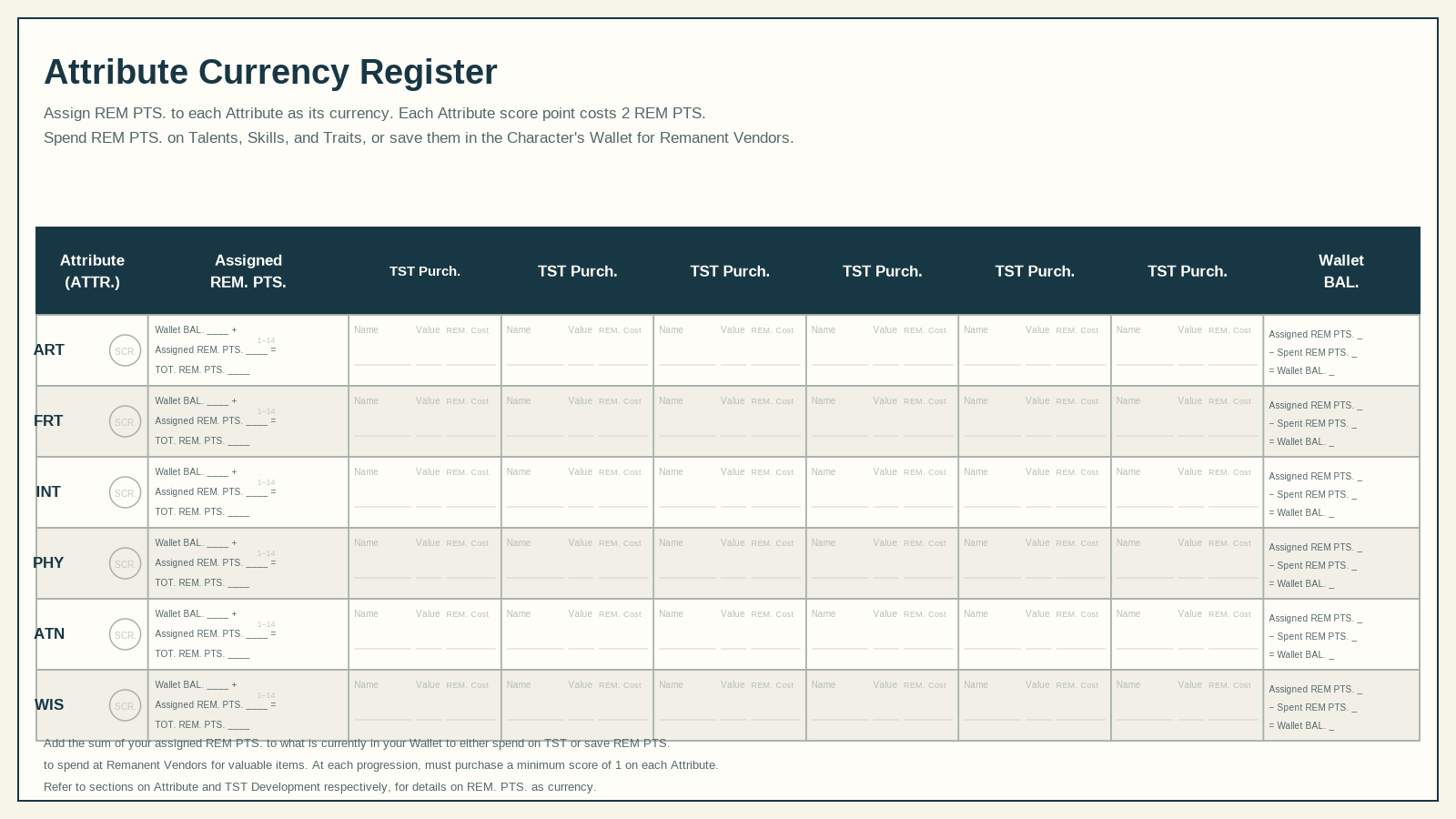
The Attribute Currency Register records each Attribute's score, assigned REM PTS., purchases, REM PTS. spent, and remaining Wallet BAL. The Character Sheet records Attribute and TST scores; this Register records the REM PTS. used to purchase them.
Using the Attribute Currency Register
- Generate and assign REM: At LVL 0 and every new Character LVL, roll 1d10 + 1d4 eight times. Discard the two lowest totals and assign the six remaining totals, one to each Attribute.
- Find the total: For each Attribute, add its current Wallet BAL. to the newly assigned REM PTS. to find TOT. REM PTS. Record both values and the total in the Assigned REM. PTS. column.
- Record purchases: At each progression, spend at least 2 assigned REM PTS. on each Attribute to purchase at least 1 score point. Record each TST's name, value, and REM. Cost in the six TST Purch. columns. Include Attribute score increases, Profession Expertise openings, and TST purchases in the REM PTS. spent.
- Calculate the remainder: Subtract total REM PTS. spent from the total REM PTS. available. Record the remainder in Wallet BAL. for that Attribute; keep each Attribute's Wallet balance separate.
- Save REM PTS.: Unspent REM PTS. stay REM PTS. in the Character's Wallet and carry forward. They may later be spent on special items from Remanent Vendors.
Examples: For PHY, a previous Wallet BAL. of 5 plus 14 newly assigned REM PTS. gives 19 TOT. REM PTS. If Attribute and TST purchases cost 6 REM PTS., record 13 in Wallet BAL. For ART, a previous Wallet BAL. of 5 plus 14 newly assigned REM PTS. gives 19 TOT. REM PTS. If purchases cost 19 REM PTS., record 0 in Wallet BAL.
ATTR scores have a minimum of 0. Above the starting floor required by innate Traits, characters may not apply more than 2 points of their roll results to any given ATTR at every LVL of progression. No ATTR may exceed a score of 50. For example, at LVL 2, an ATTR SCR may be 0, and may receive up to 4 purchased increases above its starting floor. It must also meet every positive aligned Trait score.
The ATTR cap of 50 is a theoretical maximum, achievable only by dedicating 2 points per LVL to one ATTR for 25 LVLs. Because each ATTR is individually capped at 50 and points are spread across all ATTRs, most characters will have one high ATTR and the rest significantly lower, encouraging specialization. Players should expect most ATTRs to fall between 12-25 unless they deliberately hyper-specialize.
Example, Torv, Barbarian Mountaineer
This example demonstrates how a Player applies the Attribute rules to Torv, including score allocation and the resulting decisions for a Barbarian Mountaineer.
| ATTR | LVL Reached SCR | Max SCR (per LVL cap) |
|---|---|---|
| Intellect | 1 | 2 |
| Artistry | 5 | 10 |
| Fortitude | 10 | 20 |
| Physique | 25 | 50 (cap) |
Torv's Physique reaches its intended stopping point by LVL 25. In the 5 LVLs remaining, he shifts his 2-point-per-LVL allocation to Fortitude instead, gaining up to 10 more score there (2 per LVL x 5 LVLs). At LVL 30, any remaining REM PTS. may be spent on Talents, Skills, or Traits (TST).
For each aligned Trait, Talent, or Skill, the ATTR score sets the maximum cumulative investment points. At each Progression, each investment point purchased adds 2 SCR to that TST's recorded score: 2 points put into Strength add 4 Strength SCR, while 1 point adds 2. Trait and Talent points cost 1 matching REM PTS. each; a Profession Skill's price follows its Profession Expertise tier. Spend REM PTS. assigned to the matching Attribute. Racial, Ability, equipment, and other modifiers apply at their listed values.
The investment limit applies separately to each TST. Raising an ATTR allows further investment up to its new score. A positive innate racial Trait modifier sets a minimum for its aligned ATTR; a negative Trait modifier does not lower an ATTR below 0. Each ATTR score is 0 or higher.
This is what keeps ATTR SCRs meaningful. They set the depth any one TST can reach, while the Character's 199 total sets how much can be spread across all of them.
During this Progression, he buys 3 Strength investment points, reaching the Physique 3 limit. Each point adds 2 SCR to the Trait, so Strength rises from 0 to 6. Trait investment costs 1 PHY REM PTS. per point at Novice.
He buys 3 Agility investment points as well. The limit applies separately to each TST, so Agility also rises from 0 to 6.
He has no Strength investment points remaining at Physique 3. If he raises Physique to 4, he may buy 1 more Strength point; it adds 2 to the current score, raising Strength from 6 to 8.
PHY: 3
STR: 6 (3 points spent)
AGI: 6 (3 points spent)
Each Trait investment point purchased during a Progression adds 2 SCR: 3 points produce a recorded score of 6. Darro adds his recorded STR 6 once to a Strength Trait Check to force a stuck door: d100 55 + STR 6 = 61. The ATTR sets his investment-point limit.
Darro could keep 100 REM PTS. in his PHY Wallet BAL. and still be at Strength 6 until Physique climbs. Breadth is cheap; depth costs ATTR.
Each retained roll remains REM PTS. assigned to its Attribute. For example, a roll total of 9 assigned to PHY gives the Character 9 PHY REM PTS. to spend on Physique and its aligned TST at their listed prices, subject to prerequisites and per-Level and Attribute limits. The updated PHY score and TST scores are recorded on the Character Sheet; any REM PTS. left after purchases is written in the PHY Wallet BAL. and carries forward.
Players choose how to spend each Attribute's assigned REM PTS. among its score and aligned TST purchases, following their prerequisites and limits. This supports customized development across Attributes, Traits, Talents, and Skills.
Notes to the Game Master, Using Attribute Scores
GMs are provided with detailed guidelines within campaign modules but may also use ATTR SCR at their discretion, for example, when adventures go off-script, or when applying homebrew rules or Unique story elements.